Daiso’s category expansion goes beyond simply broadening the range of low-priced household goods it sells. The company transferred to the beauty market capabilities accumulated in its household goods business: target-price-driven product planning, purchasing power secured through large-volume, stable orders, and a nationwide store network with logistics capabilities. It complemented the product expertise and brand trust required for cosmetics through collaboration with external partners and used small-volume products to turn low prices from a discount tool into a means of encouraging trial purchases. In contrast, when the same formula was applied to health functional foods, new gaps emerged in information and consultation, regulation and relationships with specialized channels. Existing capabilities can help a company enter a new market, but they cannot substitute for the complementary capabilities that the market requires.
“Is the JUNG SAEM MOOL Foundation in Stock?”
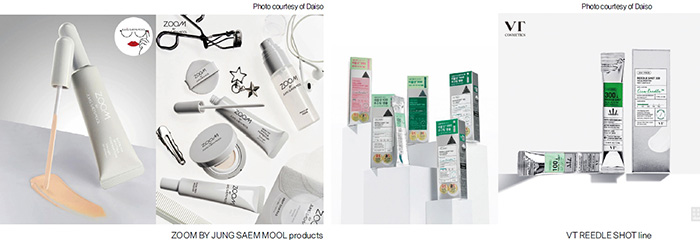
In January 2026, Daiso stores across Seoul were flooded with inquiries from customers looking for the so-called “JUNG SAEM MOOL foundation.” This was because the foundation and cushion foundation from ZOOM BY JUNG SAEM MOOL, a brand launched by makeup artist Jung Saem-mool specifically for the Daiso channel, sold out immediately after their release. Store inventories were quickly depleted on the Jan. 5 launch date, and products restocked online sold out in less than three hours. Sellouts continued, and the products were restocked four times within just two weeks of launch. Opening-time rushes and competition to buy before items sold out — phenomena more commonly associated with luxury or limited-edition goods — were now taking place at a uniform-price household goods store. PDRN ampoules, retinol serums and other products later also drew attention on social media, repeatedly selling out and being restocked. The scene showed that Daiso had evolved from a household goods store that sold cosmetics on the side into a beauty distribution channel that consumers visited specifically to find certain products.
The change was also evident in spending by foreign tourists. Payments at Daiso using foreign-issued cards rose 130% year over year in 2023, followed by increases of 50% in 2024 and 60% in 2025. This increase cannot be attributed solely to beauty. However, the growing amount of “Daiso haul”11Content in which foreign tourists introduce various products purchased at Daiso, including cosmetics and food, all at once on social media or YouTube닫기 content on YouTube, TikTok and Instagram featuring cosmetics and other products purchased at Daiso by foreign tourists shows that beauty has emerged as a major shopping category for them. If Olive Young is a specialized channel for discovering the latest K-beauty products, Daiso has established itself as a place where consumers can discover Korea’s value-for-money products all at once, from beauty to food, stationery and household goods. The two channels have thus become part of foreign tourists’ shopping itineraries in Korea in different ways.
15,000개의 아티클을 제대로 즐기는 방법
가입하면, 한 달 무료!
걱정마세요. 언제든 해지 가능합니다.
This content was originally written in Korean in the DBR, and translated into English by the original author with the aid of AI
The DBR has all legal authority over this content. Please note that unauthorized use and distribution may be subject to legal sanctions










 경제·경영 질문은


 닫기
닫기