Robot fingertip sensors to reach a US$6.4 billion market by 2034
Tactile-sensor robots to boost productivity by 40%
Miniaturization of components is essential amid high technical barriers
Samsung and LG create dedicated units to focus on tactile technologies
LG Electronics’ robot LG CLOiD repeatedly grasps and moves objects by hand at the Yangjae Data Factory that LG Electronics is building, generating and learning motion data. Provided by LG Electronics
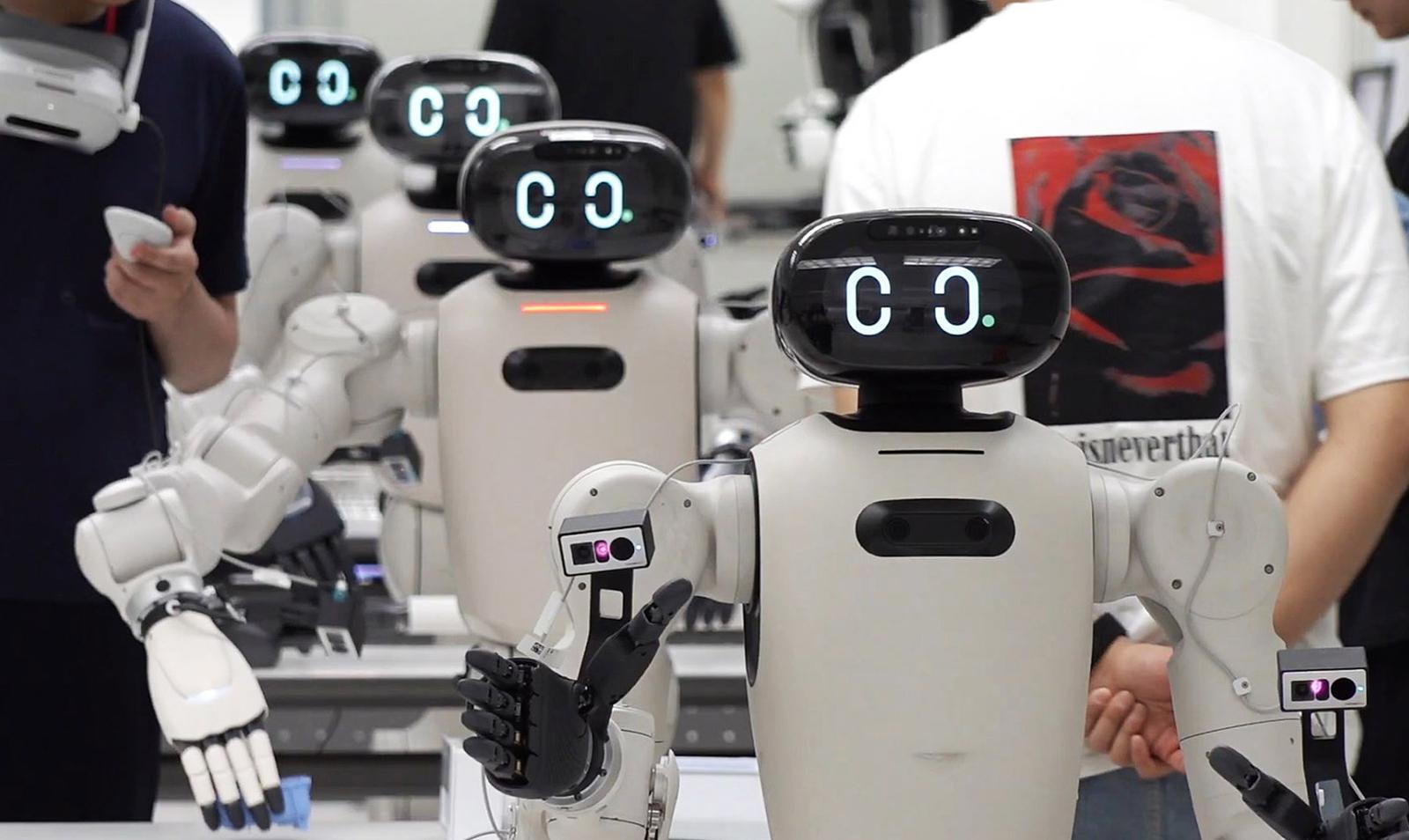
A humanoid robot folds a towel, moving its fingers one by one. When LG Electronics unveiled its home robot “CLOiD” at CES 2026, the world’s largest information technology (IT) and home appliance exhibition held in January this year, the scene that captured visitors’ attention was the robot picking up and folding objects with its five fingers like a human. Samsung Electronics’ yet-to-be-unveiled robot technology is also putting emphasis on “dexterity.” In a recent organizational reshuffle, Samsung Electronics spun off only the hand technology-related unit as an independent organization.
Thus, “hands” are emerging as the main battleground in recent humanoid development among major companies. While many companies have already implemented robots that can walk and run, delicate hand technology that allows robots to grip objects like humans remains a fiercely contested area with no clear winner. After Samsung Electro-Mechanics and LG Innotek secured a foothold in the camera module market—the “eyes” of robots and electric vehicles—by winning the entire camera supply for Tesla’s “Cybercab,” Korean companies are now concentrating their efforts on the next strategic arena: the “hand.”
●
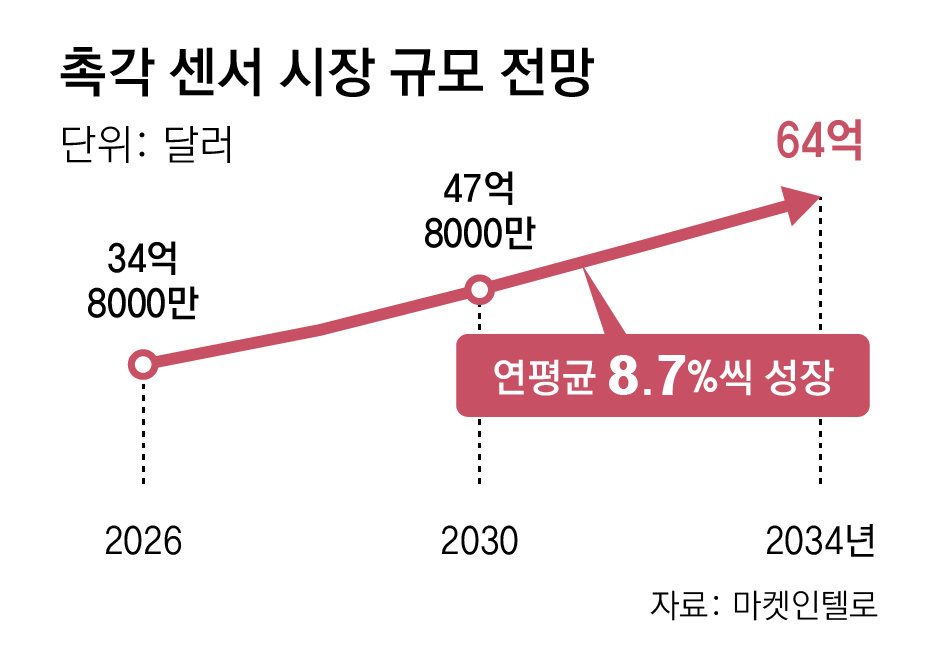
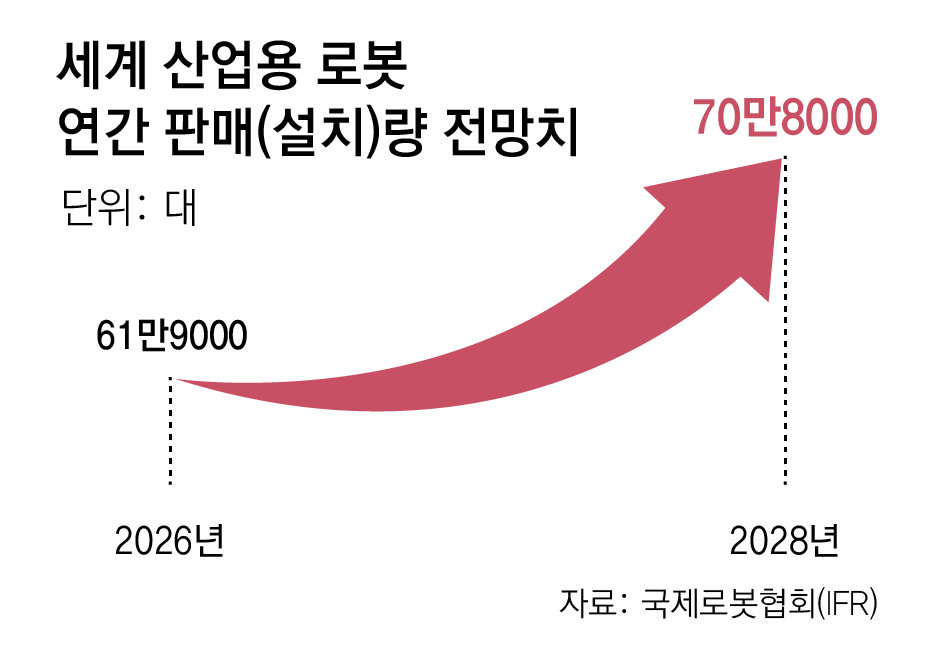
Growing hand market in step with rising robot numbersAccording to the International Federation of Robotics (IFR), annual installations of industrial robots worldwide are projected to increase from 619,000 units in 2026 to 708,000 units in 2028. Among industrial robots, “collaborative robots (cobots)” that work alongside humans must be equipped with tactile sensors in joints and fingertips to interact safely and handle objects precisely. The more precise the task of gripping objects by hand, the more important the role of fingertip sensors becomes. Market research firm Marketintello forecasts that the tactile sensor market will grow from USD 3.48 billion in 2026 to USD 6.4 billion in 2034, with a compound annual growth rate of 8.7%.
Despite this market expansion, building robot hands is a “high-difficulty” challenge. The main reason that hands are particularly difficult to manufacture compared with other parts is component miniaturization. Hwangbo Je-Min, professor of mechanical engineering at KAIST, said, “(The hand) has many muscles, yet its size is small, so motors, joints, and sensors all need to be fitted into a very tight space,” adding, “As components get smaller, they break more easily and become harder to make.” A single humanoid robot contains multiple actuators in each joint, and models designed to realize highly sophisticated hand movements require even more of them.
Even so, the reason companies are entering the hand technology race is clear: precise work ultimately requires “hands.” Professor Hwangbo said, “With advanced hand technology, a robot can flexibly handle complex tasks—for example, holding a plate in one hand while pressing a pump with the other to dispense detergent, or gripping a vacuum cleaner while adjusting the power with a button,” adding, “On factory assembly lines as well, many tasks involve handling tools, so robots with precise hands will have wide-ranging applications.” According to Marketintello, manufacturers using robots equipped with tactile sensors are increasing precision assembly productivity by up to 40%, while reducing defect rates from 15–20% to below 2%.
●
Korean companies joining the “hand war” one after anotherMajor Korean conglomerates regard robot hands as the next key battleground in humanoids and are responding aggressively. On July 21, Samsung Electronics established the “Robotics Experience (RX) Business Promotion Office” reporting directly to CEO Roh Tae-Moon, head of the DX (Device eXperience) Division. The company consolidated robot technology capabilities that had been scattered across different fields, and the unit drawing particular attention is “Hand Lab.” This is a dedicated organization focused solely on hand technology. Samsung Electronics also brought in Kim Eui-Gyeom, a professor at Ajou University and an expert in robot hands and manipulation, to this unit.
Hand Lab is known to be developing a “tendon” drive mechanism that moves fingers in a way similar to human tendons. Separately, Samsung Electronics is designing its own motors and drives, researching about 80 types of actuators, and simultaneously conceptualizing various humanoid form factors and robot hands with different sizes, outputs, and drive structures. A Samsung Electronics official said, “Following the recent establishment of the RX Business Promotion Office, a technology demonstration event was held with President Roh in attendance, and the completeness of the hand technology showcased there was understood to be quite high.”
Samsung Electro-Mechanics is also focusing on hands. In December last year, through Samsung Venture Investment, it invested several million euros in Norwegian electric motor company Alva Industries. Alva manufactures high-precision motors that are ultra-compact yet powerful using its proprietary “fiber printing” process. Alva stated that the purpose of this investment is “to secure core motor technology for robot hands and humanoid platforms.” Jang Deok-Hyun, president of Samsung Electro-Mechanics, also expressed confidence that “fiber printing technology will become a core competitive asset for next-generation robot actuators.”
LG Innotek has joined forces with Japan’s TDK to co-develop a “tactile sensing module.” This component is mounted on robot hands, arms, and bodies to detect contact and pressure. The development target completion date is 2027. Serving a role similar to human skin, this module requires ultra-precision, ultra-thin, and flexible structures, making it a high value-added component with a high degree of development difficulty. LG Innotek CEO Moon Hyuk-Soo said, “We will continue to collaborate with various companies to further advance core technologies applied to robots’ eyes and hands.”
ⓒ dongA.com. All rights reserved. Reproduction, redistribution, or use for AI training prohibited.
Popular News