Koo Kwang-mo and Jensen Huang sign ‘Physical AI Alliance’ MOU
“Three core partnerships in robots, AI factories, and mobility”
Joint AI factory to be built in Cheonan by 2028… expanding automotive electronics business into autonomous driving
Koo Kwang-mo: “We will accelerate the spread of AI that will lead industry” … Jensen Huang: “We will usher in a new era”
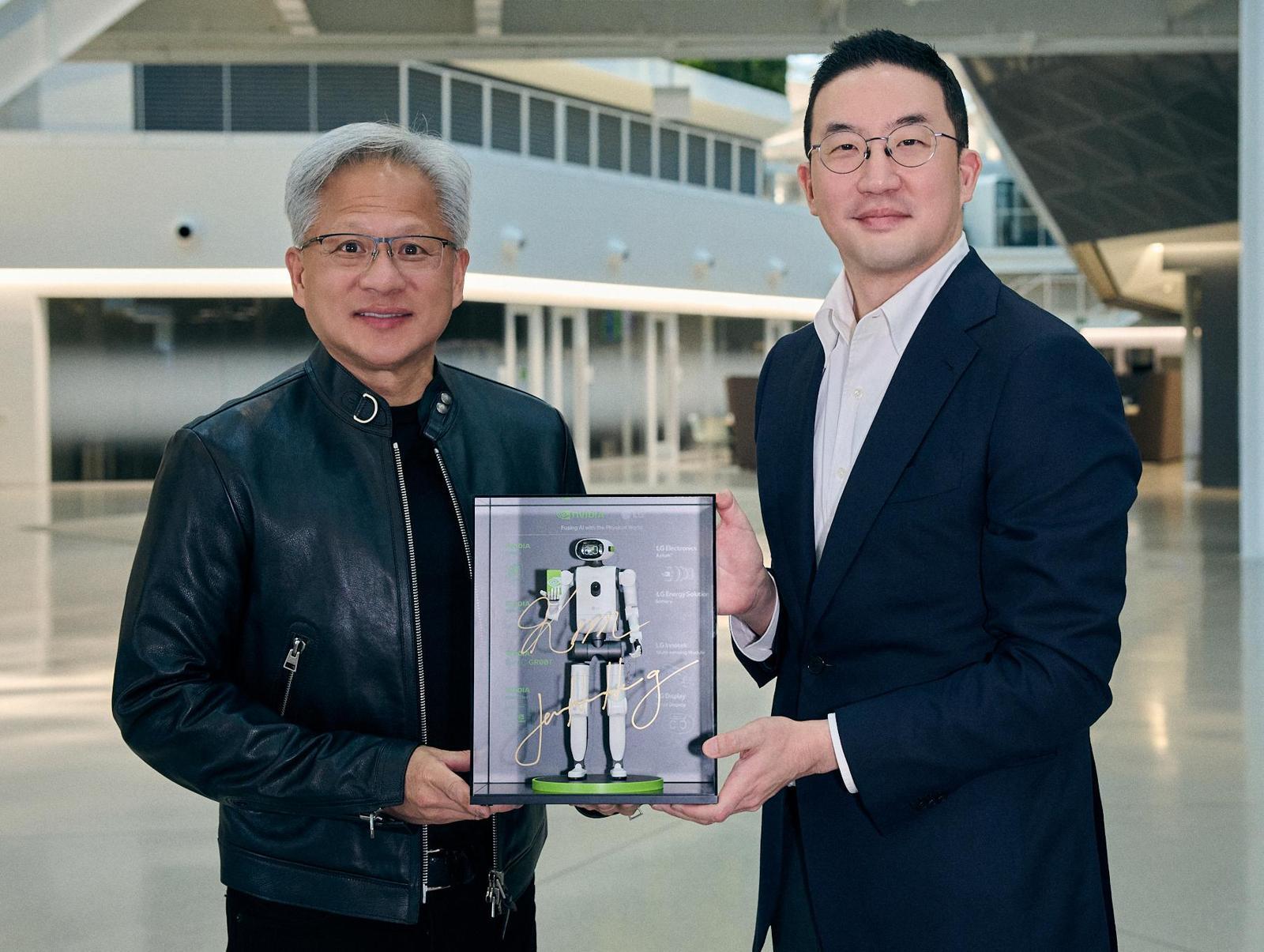
Koo Kwang-mo, Chairman of LG Group (right), and Jensen Huang, Chief Executive Officer of NVIDIA, pose with a miniature humanoid robot for a commemorative photo after signing a memorandum of understanding (MOU) for strategic business cooperation at NVIDIA’s headquarters in California, United States, on the 13th (local time). The robot was presented by LG, and the box bears the signatures of Chairman Koo and CEO Huang. Provided by LG Group
LG Group has joined hands with NVIDIA, the world’s No. 1 company in AI semiconductors, to secure leadership in the “physical AI” ecosystem. It is a comprehensive alliance that combines NVIDIA’s software capabilities with LG’s hardware strengths. The two companies plan to present a new global standard for physical AI by unveiling a next-generation humanoid robot in the first quarter (January–March) of next year and jointly building a large-scale AI factory in Korea in the first half (January–June) of 2028.
According to LG on the 14th, LG Group Chairman Koo Kwang-mo met with NVIDIA CEO Jensen Huang at NVIDIA’s headquarters in California, United States, on the 13th (local time) and signed a “memorandum of understanding (MOU) for strategic business cooperation.” This concretizes a cooperation plan just two months after Chairman Koo and CEO Huang met at LG’s headquarters in Yeouido, Seoul, in June this year and formalized group-level collaboration. To seize hegemony in the era of physical AI, which brings AI from virtual space into the real world, the two companies will embark in earnest on cooperation in three key areas: △robots △AI factories △mobility.
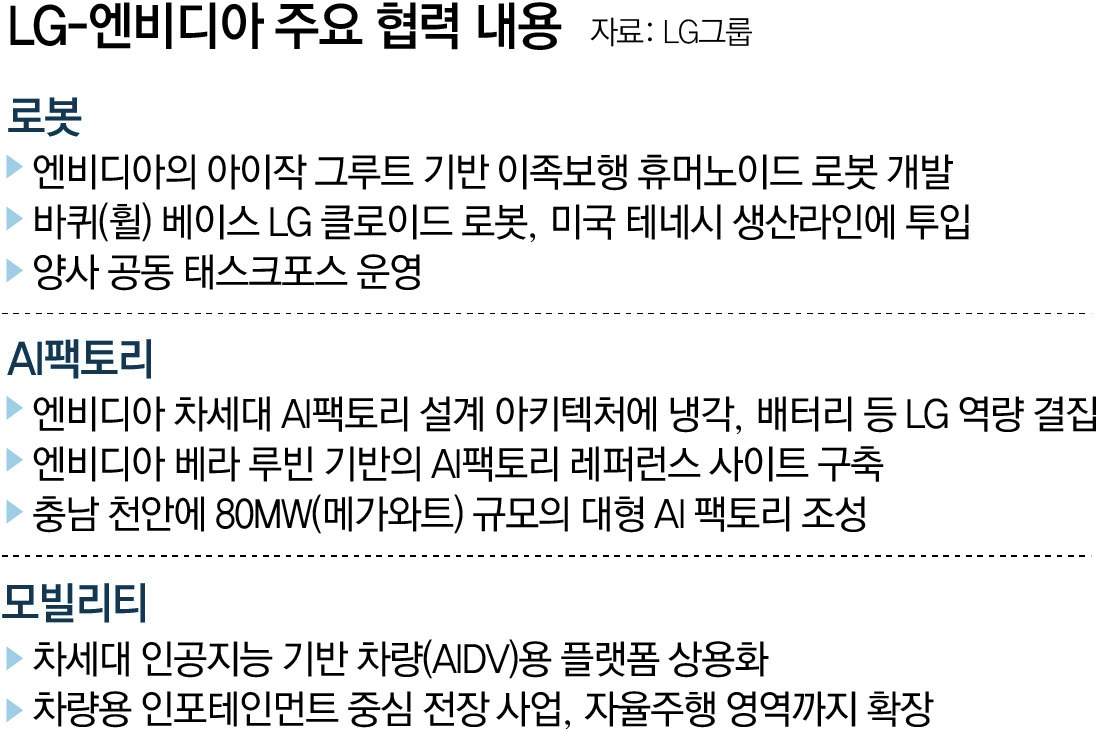
First, in the robotics field, they will jointly develop a next-generation bipedal humanoid robot based on NVIDIA’s general-purpose AI brain “Isaac Groot,” targeting a public unveiling in the first quarter of next year. NVIDIA will handle information processing and control with its “Jetson Thor” AI brain chip for robots, while LG will take charge of hardware by pooling its key component capabilities: actuators (robot joints) from LG Electronics, sensors from LG Innotek, and batteries from LG Energy Solution. In addition, LG plans to deploy the wheeled robot “LG Cloyd,” unveiled earlier this year, to its Tennessee plant in the United States within this year for on-site validation, and then expand its use to commercial and household applications.
The companies will also cooperate in parallel to advance robot-related data and strengthen execution capabilities. Using LG CNS’s “Physical Works,” they will train on-site data to build up their Robot Foundation Model (RFM) capabilities. In addition, they plan to establish a joint task force (TF) involving employees from both LG and NVIDIA to accelerate the entire process from research and development (R&D) to field validation and commercialization.
The two sides will also move forward with building AI factories. Leveraging NVIDIA’s AI data center design platform “DSX,” they will mobilize the so‑called “One LG” infrastructure capabilities, including LG Electronics’ cooling technology, LG Energy Solution’s batteries, and LS’s power solutions. After constructing an initial form of an AI factory ahead of schedule in the first half of 2027 to verify related technologies, they plan to build a large-scale AI factory with a capacity of 80 MW (megawatts) in Cheonan, South Chungcheong Province, in the first half of 2028. By adopting a modular assembly method, they aim to shorten construction time by more than 20%, and, based on this, actively pursue orders for AI factory solutions from global big tech companies.
In the mobility sector, they will enhance competitiveness in the autonomous driving market. By combining LG’s in-vehicle infotainment (IVI) capabilities with NVIDIA’s in-vehicle computing platform “DRIVE Hyperion,” they will work on commercializing a next-generation platform for “AI-driven vehicles (AIDV).” This is intended to extend LG’s automotive electronics capabilities, which have traditionally focused on IVI, into the autonomous driving domain.
Chairman Koo stated that “as collaboration between the two companies accelerates, the tasks to be jointly pursued in AI factories, physical AI, and mobility have become clear,” adding, “LG will accelerate the spread of AI by building industry-leading references.” CEO Huang responded, “By combining LG’s manufacturing leadership with NVIDIA’s technology, the two companies are bringing forward a new era of robots, AI factories, and autonomous vehicles.”
ⓒ dongA.com. All rights reserved. Reproduction, redistribution, or use for AI training prohibited.
Popular News