Breaking ground on the first electric-powered “Louisiana Steel Plant”
US$5.8 billion investment on a site 2.5 times the size of Yeouido… First fully integrated steel mill built in the U.S. in 60 years
Kickoff to Hyundai Motor’s US$26 billion investment in America… Vertical integration in the U.S. from molten steel to finished cars
Chung Euisun: “We will expand supply to robots and rockets as well”
On the 4th (local time) in Donaldsonville, Louisiana, United States. In the middle of an enormous sugar cane field about an hour and a half from New Orleans, a banner announcing the groundbreaking ceremony for the “Hyundai Steel–POSCO Louisiana Electric Arc Furnace Steel Plant (HPLS)” was displayed.
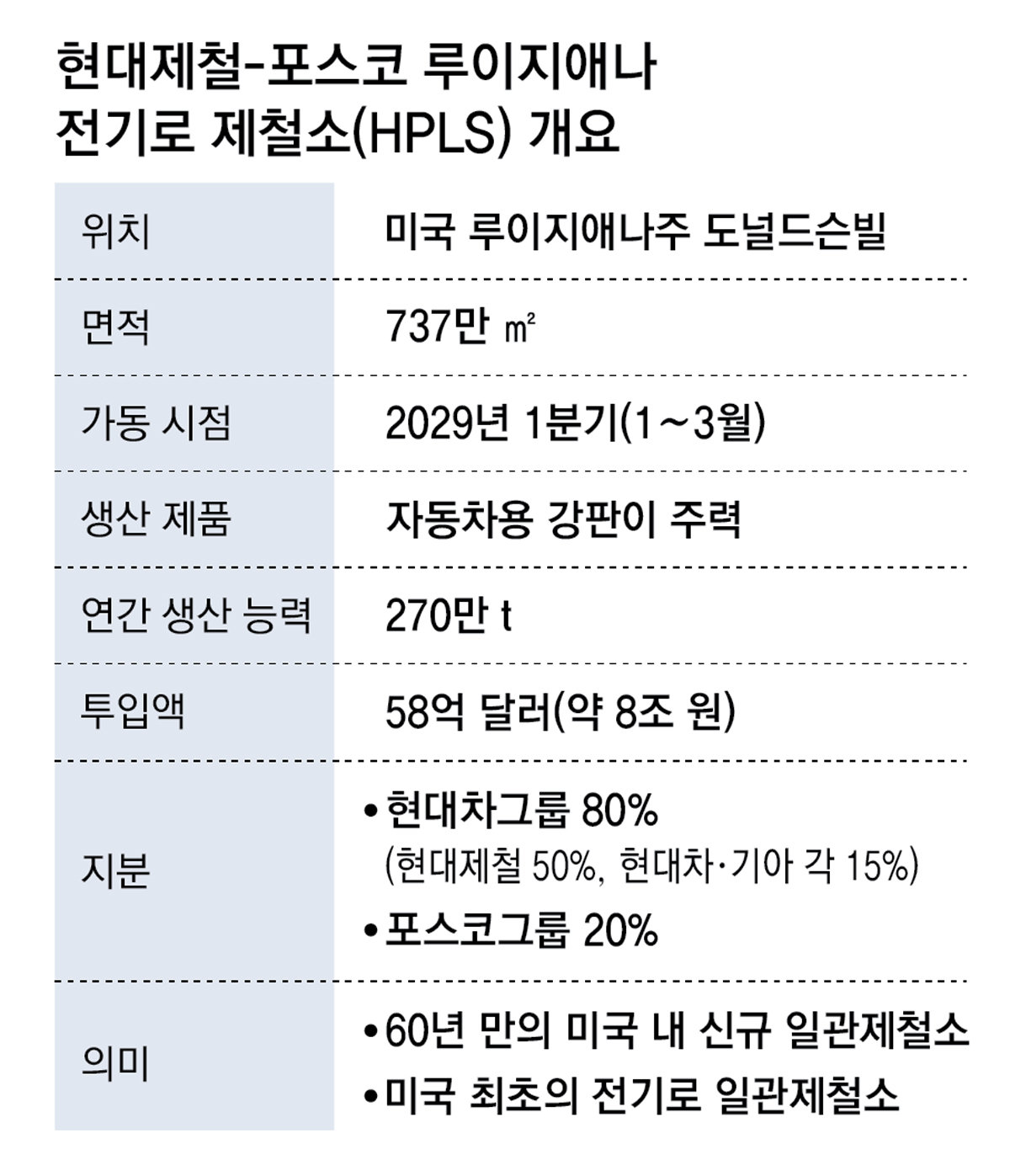
The steel plant, breaking ground on this sugar cane field, is the first production base that Hyundai Steel and POSCO have ever built in the United States, and it is also the first new integrated steel mill the U.S. has constructed in more than 60 years. On a 7.37 million ㎡ site—2.5 times the size of Yeouido in Seoul—a total of USD 5.8 billion (about KRW 8 trillion) will be invested for a large-scale project targeting an annual production capacity of 2.7 million tons.
The two leading Korean steelmakers have taken the unusual step of joining forces in a strategic joint venture to avoid steel tariffs of up to 50% and strengthen the supply chain within the United States. Hyundai Steel will hold a 50% stake, Hyundai Motor and Kia will each own 15%, giving Hyundai Motor Group a total 80% share, while POSCO will take the remaining 20%.
In his welcome address at the groundbreaking ceremony, Chung Eui-sun, Chairman of Hyundai Motor Group, stated, “Today is a very important milestone not only for Hyundai Motor Group and POSCO, but also for the future we will build together here in Louisiana,” adding, “Steel will become a key driving force opening a new chapter in the revitalization of U.S. industry.”
● First U.S. production base for Korea’s two top steelmakers
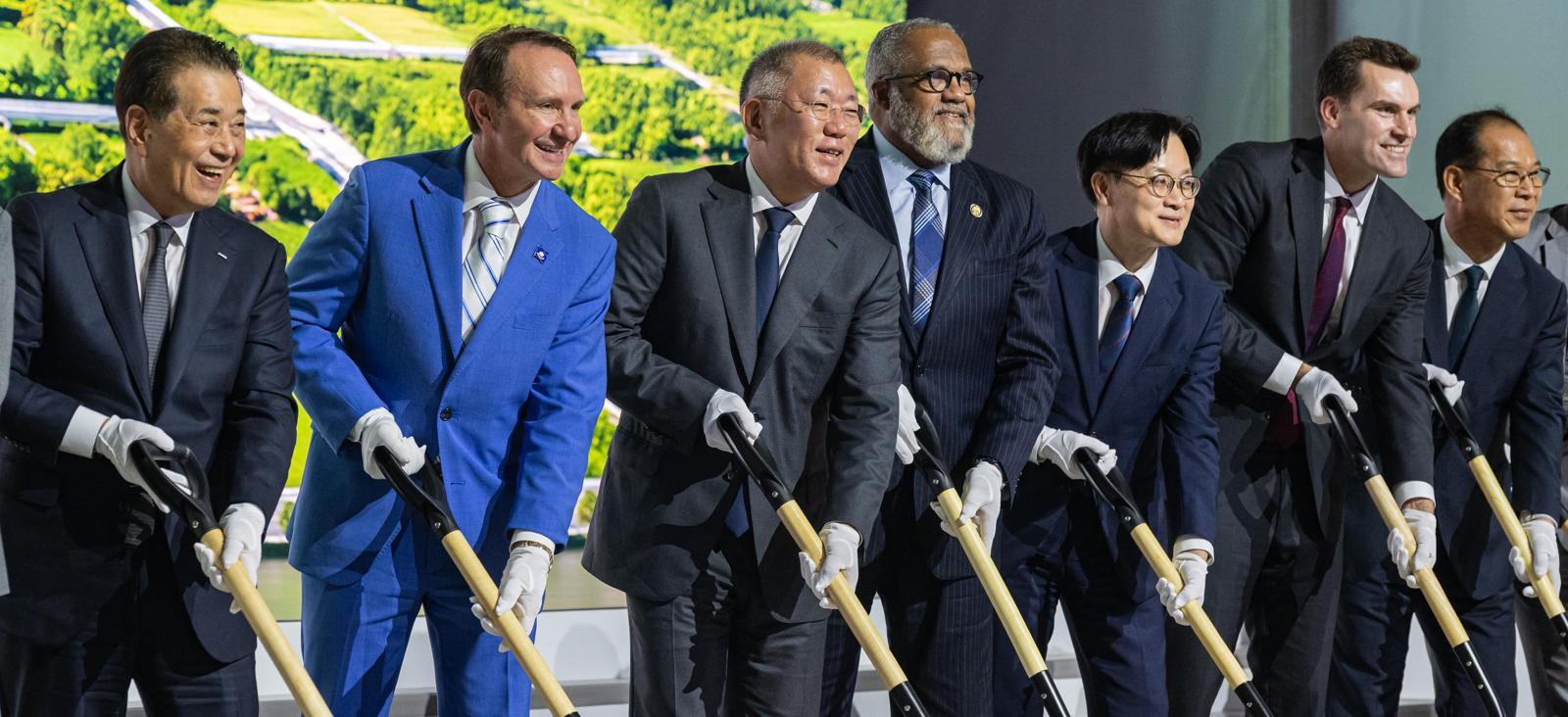
At the groundbreaking ceremony for the “Hyundai Steel–POSCO Louisiana Electric Arc Furnace Steel Plant (HPLS)” held on the 4th (local time) in Donaldsonville, Louisiana, United States, key figures turn the first shovels of earth to mark the start of construction. From left: POSCO Group Chairman Chang In-hwa; Louisiana Governor Jeff Landry; Hyundai Motor Group Chairman Chung Eui-sun; U.S. Representative Troy Carter; Minister of Trade, Industry and Energy Kim Jung-kwan; U.S. Under Secretary of Commerce for International Trade William Kamet; and Hyundai Steel President Lee Bo-ryong. Photo provided by Hyundai Steel.
In a reflection of Korea-U.S. economic cooperation, a large number of key figures from both countries attended the groundbreaking ceremony. From the Korean side, Minister of Trade, Industry and Energy Kim Jung-kwan, Korean Ambassador to the U.S. Kang Kyung-wha, Chairman Chung, and POSCO Group Chairman Chang In-hwa were present. From the U.S. side, attendees included Louisiana Governor Jeff Landry, U.S. Under Secretary of Commerce for International Trade William Kamet, and U.S. Representatives Troy Carter and Julia Letlow.
Governor Landry highlighted the significance by saying, “HPLS is the first greenfield steel mill to be built in the United States in 60 years,” while Under Secretary Kamet underscored the project’s importance, stating, “A country that cannot produce steel cannot be a great power.”
HPLS, scheduled to begin initial operations in the first quarter (January–March) of 2029, will be the world’s first integrated electric arc furnace-based steel plant specializing in automotive steel sheet, and also the first electric arc furnace steel mill in the United States. Compared with traditional blast-furnace-based processes, it will produce low-carbon, high value-added steel with 70% lower carbon emissions, manufacturing everything from raw material to finished product in a single location. Hyundai Steel stated that the investment is expected to create about 1,300 direct jobs and more than 4,100 indirect jobs.
The United States remained a steel powerhouse until the 1960s but has since seen its industry shrink due to the overseas relocation of its own automotive production bases and the rise of Japan’s and Korea’s steel industries. Steel and automobiles have long been emblematic sectors of the so-called “Rust Belt,” representing the decline of U.S. manufacturing regions. This is why the Donald Trump administration imposed tariffs of up to 50% on steel products over its first and second terms as part of policies to revive U.S. manufacturing.
Hyundai Motor Group and POSCO are seen as having undertaken this unusual “collaborative investment” in U.S. production based on the expectation that Washington’s protectionist stance toward domestic manufacturing will continue. Under the Trump administration’s high tariff regime, Korea’s steel exports to the U.S. fell to 2.54 million tons last year, down 8% from 2.76 million tons a year earlier.
The decision was also influenced by the fact that the U.S. is considered the world’s largest steel-consuming country, and that automakers, key customers for steelmakers, have been increasing their production bases in the U.S. to avoid steep tariffs. U.S. steel investment is also expanding, with Nippon Steel-owned U.S. Steel pledging to build new steel mills in the United States, among other moves.
● “From molten steel to cars and robots” in the U.S. as wellThis project is regarded as the first step in a total of USD 26 billion (about KRW 35 trillion) in U.S. production facility investments that Chairman Chung pledged in a meeting with President Trump in March last year. For Hyundai Motor Group, the HPLS investment will enable the Group to establish a local vertical integration structure in the U.S., from “molten steel” to finished automobiles. In effect, “zero tariffs” will be realized. With local production of automotive steel sheet commencing in 2029, the high tariffs currently imposed on steel used in vehicles produced and sold in the U.S.—including those manufactured at Hyundai’s Alabama plant and Kia’s Georgia plant—will be reduced.
Hyundai Motor Group plans to develop HPLS into a steel hub for the U.S. next-generation mobility market. “We are already in discussions with some local finished vehicle manufacturers,” said José Muñoz, President and Global COO of Hyundai Motor, on the day. Candidate customers include General Motors’ Texas plant, Volkswagen’s Tennessee plant, and Honda’s Alabama plant, all of which are easily accessible from Louisiana.
The Group also plans to expand its customer base beyond automobiles to robots and rockets. Speaking to reporters after the groundbreaking ceremony, Chairman Chung said, “We will ensure that steel produced at the HPLS steel mill is applied to (the humanoid robot) Atlas, and going forward, we hope our products can also be supplied for the manufacture of SpaceX rockets.”
ⓒ dongA.com. All rights reserved. Reproduction, redistribution, or use for AI training prohibited.
Popular News