Hyundai Motor Group is evolving beyond an automobile manufacturer into a high-tech company engaged in a wide range of areas including artificial intelligence (AI), robotics, smart factories, and defense. Mobility remains the core pillar, but a closer look at each business shows they share a common direction: redefining human life and space beyond simple means of transportation. Although still in the early stages, this diverse next-generation business portfolio is already having a positive impact on actual management. It can be seen as a key factor behind the group’s continued growth despite various uncertainties such as tariffs, exchange rates, and supply chain issues, as it overcomes the traditional limits of manufacturing. This article examines the secrets behind Hyundai Motor Group’s leap from an automotive kingdom to a cutting-edge technology company.
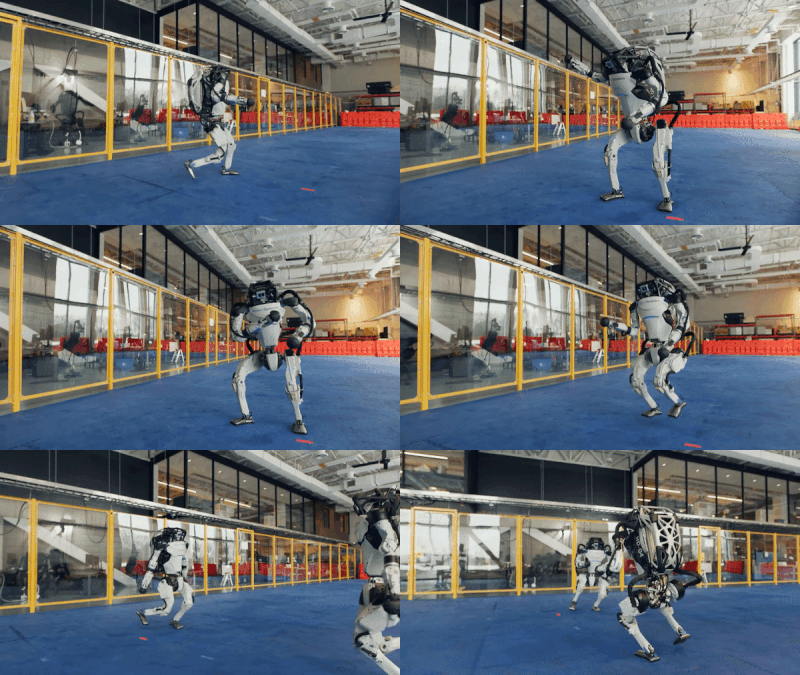
“Do You Love Me?”This is the title of a video uploaded to YouTube in December 2020. The video features Boston Dynamics’ bipedal robot Atlas and quadrupedal robot Spot dancing. Within just one day of its release, the video attracted more than 1 million views.
Boston Dynamics’ YouTube video of Atlas dancing
Boston Dynamics began in 1992 as a venture founded within the Massachusetts Institute of Technology (MIT). Having developed advanced capabilities in bipedal and quadrupedal robots, Boston Dynamics was acquired by Alphabet, Google’s parent company, and carried out robot development projects with the U.S. Department of Defense. It was later acquired by SoftBank Group in 2017.
Boston Dynamics became widely known in Korea after Hyundai Motor Group acquired it in 2021. Hyundai Motor Group purchased an 80% controlling stake in Boston Dynamics, valued at USD 1.1 billion (approximately KRW 1.2 trillion at the time), from Japan’s SoftBank Group.
Chung Euisun, Executive Chair of Hyundai Motor Group
Because neither Alphabet nor SoftBank had provided a clear answer on how to monetize Boston Dynamics, there were concerns in the industry. In particular, many questioned, “Why is a car company buying a robot firm?” However, Executive Chair Chung Euisun’s vision was clear. His plan was for robots to become a core pillar within an ecosystem spanning manufacturing, logistics, and mobility.
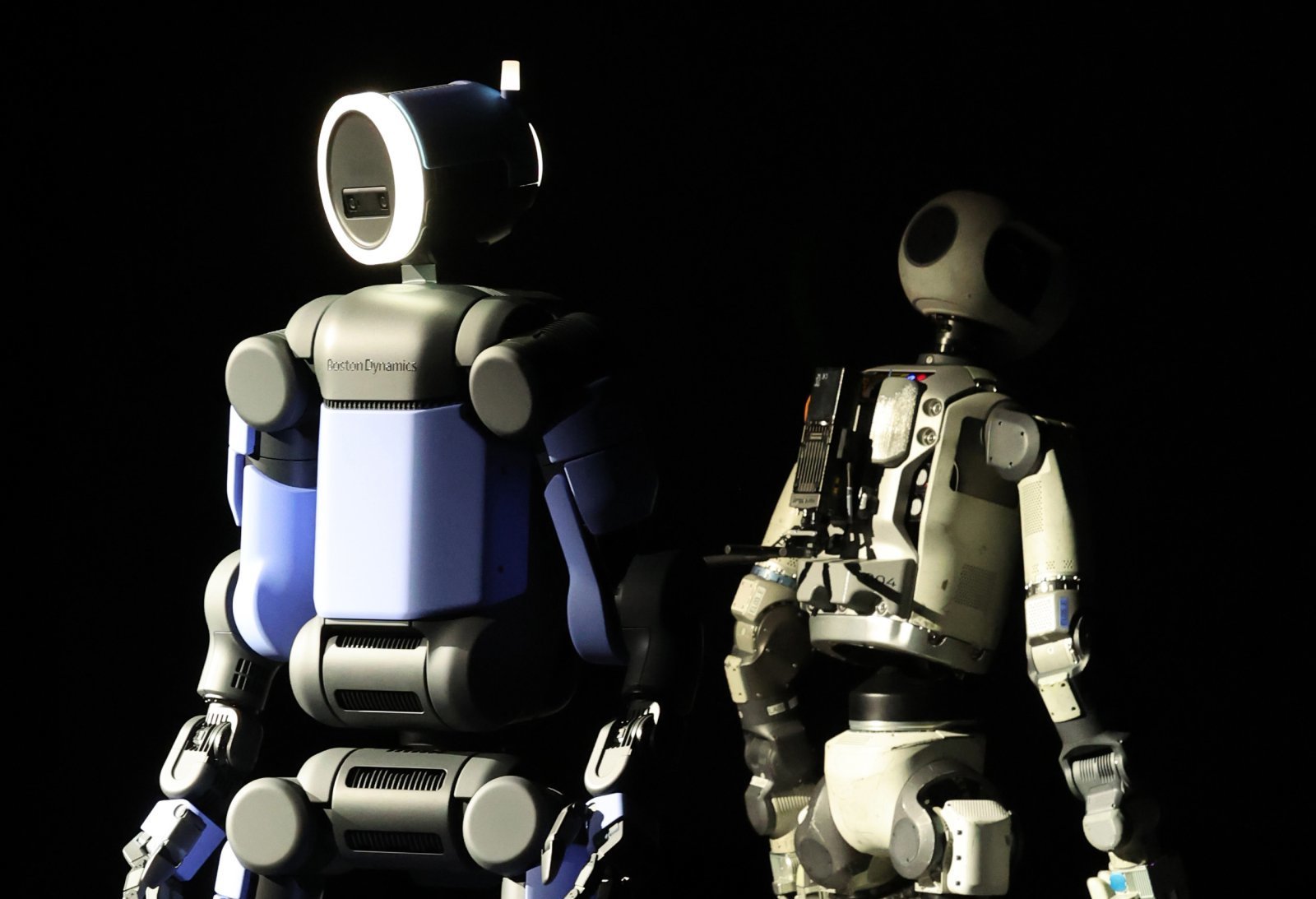
Since coming under Chung’s leadership, Boston Dynamics has again astonished the world this year. At CES 2026, held in January in Las Vegas, Atlas met hundreds of people and demonstrated full rotational freedom in its joints. It was a moment when a humanoid robot previously regarded only as a “dancing robot” emerged as a symbol of “innovation.”
If CES 2024 was the year of “generative AI” and CES 2025 the year of “AI agents,” CES 2026 was the year of “physical AI.” The era has truly begun in which AI goes beyond generating text and images to move, make decisions, and act in the physical world. Nvidia CEO Jensen Huang declared in his keynote address that “the ChatGPT moment of physical AI has arrived.” In fact, more than 40 humanoid robot companies participated in the CES 2026 exhibition hall.
A humanoid robot unveiled by Hyundai Motor Group at its press conference in Las Vegas, Nevada, U.S., on the 5th (local time) during CES 2026. Las Vegas = News1
The core innovation in the mass-production version of Atlas presented by Boston Dynamics at CES 2026 is motor standardization. By standardizing more than 50 existing types of motors down to three core types, the company maximized mass-production efficiency. A three-finger gripper, field-replaceable limbs, and autonomous battery swapping have significantly extended operating time.
Boston Dynamics is currently regarded as a frontrunner in “physical AI.” This year’s production run has already sold out, with all units to be supplied to Hyundai Motor and Google DeepMind. In addition, the USD 26 billion U.S. manufacturing investment plan announced last year includes the construction of a robot plant capable of producing 30,000 robots annually. This signals the beginning of the era of mass-produced humanoid robots.
The price of Atlas is expected to be USD 130,000 per unit (about KRW 180 million). While it may appear expensive, it is not necessarily so. In a report titled “Current Status and Risk Factors of the Automotive Industry’s Entry into the AI Robotics Sector” published recently, the Korea Eximbank Overseas Economic Research Institute projected that if Atlas is introduced into actual automobile plants, the investment cost could be recouped in two years. Production efficiency in assembly processes is expected to reach up to three times that of humans.
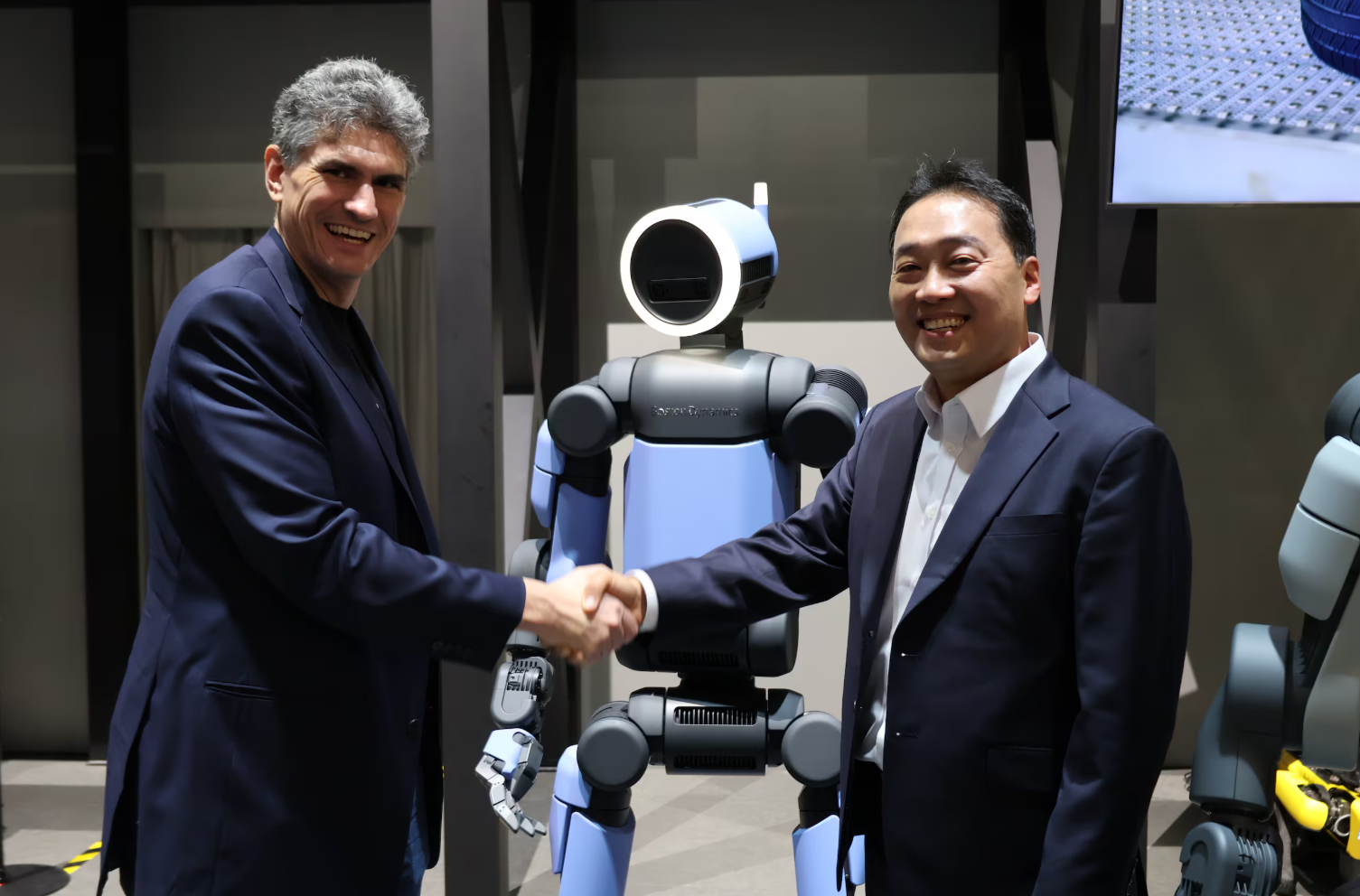
Oh Se-uk (right), Executive Director of the Robotics Business Promotion Office at Hyundai Mobis, and Jack Jakowski, head of Atlas development at Boston Dynamics, shake hands after concluding discussions on actuator supply at the Hyundai Mobis booth at CES 2026 in Las Vegas on the 7th.
Hyundai Mobis has made a major contribution to establishing a robot mass-production system. At CES 2026, Hyundai Mobis announced it would build a cooperation framework with Boston Dynamics and supply actuators at the time of Atlas mass production. Actuators are core components that serve as the joints of robots and account for roughly 60% of robot manufacturing. Starting with the development of actuators to be applied to Atlas, Hyundai Mobis plans to expand its robotics business scope to include robot hand grippers, sensors, and controllers.
CNET, a tech media outlet and official CES partner, awarded Atlas the “Best Robot” prize. CNET evaluated that “Atlas is the best among the many humanoid robots seen at CES,” adding, “In terms of both technological sophistication and readiness for mass production for actual factory deployment, it proves Hyundai Motor Group’s robotics vision.”
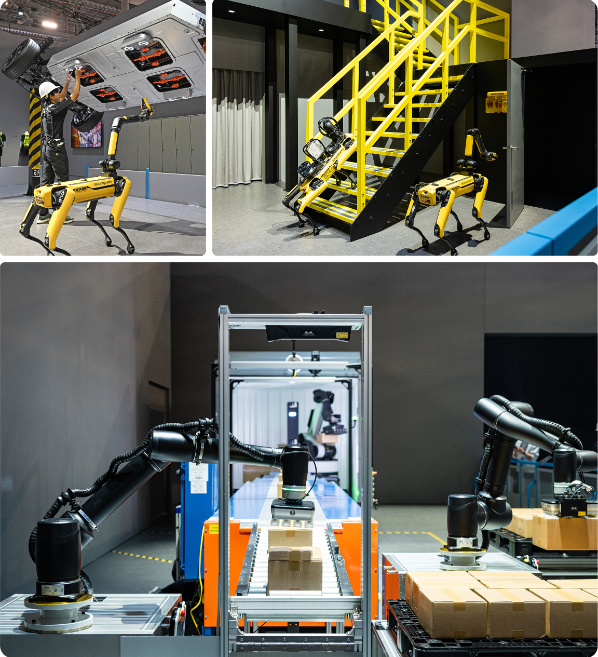
Boston Dynamics’ quadrupedal robot Spot and logistics robot Stretch
At CES 2026, Hyundai Motor Group not only showcased Atlas but also revealed Spot in actual operation using the Orbit AI solution. Spot climbed up and down stairs, moved between facilities, and carried out inspection tasks. This was not a simple demonstration, but a concrete presentation of the roles robots will play in industrial environments. With the addition of Hyundai AutoEver’s control and integration solutions, Spot is expected to become even more advanced.
The group also demonstrated a seamless flow of unloading, loading, and transport, with Boston Dynamics’ Stretch, Hyundai WIA’s collaborative robots, and autonomous logistics robots operating together. Such organic connectivity was made possible through close role-sharing and collaboration among group companies. Each affiliate participates in robotics development and verification by maximizing its own area of expertise.
Boston Dynamics has also emerged as a key pillar in the establishment of a national strategy for securing U.S. leadership in the robotics industry. It has decided to participate as a representative physical AI-based robotics company in the National Security Commission on Advanced Manufacturing Robotics launched by the private U.S. think tank Special Competitive Studies Project (SCSP). The commission includes not only Boston Dynamics but also global tech giants such as Nvidia, AMD, and GM, as well as numerous academic experts from institutions such as MIT and the University of Michigan.
In terms of corporate value, the company is already achieving overwhelming results. Boston Dynamics’ corporate value is currently estimated at around KRW 30 trillion, roughly 23 times higher than when Hyundai Motor Group completed its acquisition. Some securities firms believe Boston Dynamics’ value could be even higher, following the confirmation of Atlas’ technological capabilities at CES 2026. Immediately after CES 2026, KB Securities and Hanwha Investment & Securities projected that Boston Dynamics could grow into a company worth KRW 128 trillion and KRW 146 trillion, respectively.
Of course, Boston Dynamics is still loss-making. While it supplies quadrupedal robot Spot and logistics robot Stretch to industrial sites, robot development costs remain substantial. Last year alone, it recorded a net loss of KRW 528.4 billion, bringing cumulative losses close to KRW 2 trillion.
Hyundai Motor Group is expected to inject external capital through an initial public offering (IPO). The listing could take place as early as the end of this year or early next year. Industry observers expect that in the first half of this year (January–June), the company may apply for a preliminary review for a Nasdaq listing and proceed with underwriter selection.
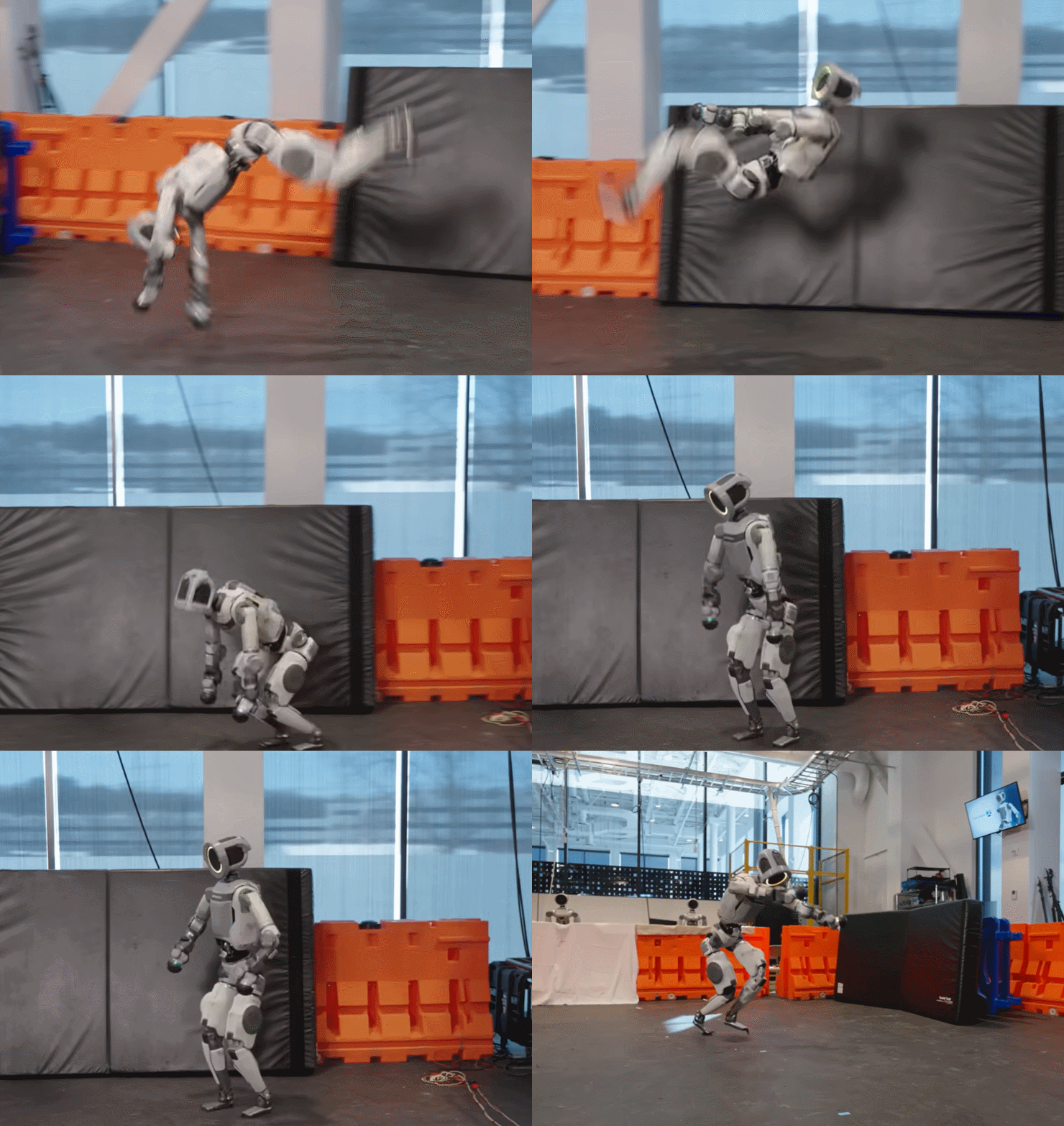
Last month, Boston Dynamics released a YouTube video showing Atlas successfully performing a cartwheel and a backflip in succession like a gymnast.
Boston Dynamics is no longer a company that makes “dancing robots.” After encountering Hyundai Motor Group, a manufacturing giant, it is ushering in the era of “working robots.” All of this has taken place 34 years after it began in an MIT laboratory in 1992 and just five years after its acquisition by Hyundai Motor Group.
Going forward, Hyundai Motor Group plans to deploy Atlas at global production bases, including Hyundai Motor Group Metaplant America (HMGMA), and gradually expand its application scope via step-by-step validation for each process unit. At HMGMA, sequence operations for parts sorting are scheduled to begin in 2028, with deployment into more complex processes such as assembly expected by 2030.
In addition, the group intends to establish a virtuous cycle in which on-site data is digitized for AI training and then reapplied to products. By affiliate, Hyundai Motor and Kia will provide manufacturing infrastructure, process control, and production data, while automotive parts maker Hyundai Mobis will be responsible for developing precision actuators. Logistics company Hyundai Glovis plans to work on optimizing logistics and supply chain flows. In particular, Hyundai Mobis will fully enter the global robot parts market by partnering with Boston Dynamics to supply actuators for Atlas.
Understanding Hyundai Motor Group’s Robotics Business through Q&A
Q. What is physical AI?
A. It is technology that enables autonomous systems such as robots, self-driving cars, and smart spaces to perceive and understand objects in the real physical world and perform complex actions. Whereas conventional AI was largely confined to generating text or images on computer screens, physical AI is embodied in physical forms such as robots and autonomous vehicles that perceive and judge the real environment and then act accordingly.
The core is a cyclical structure of “perception–understanding–action.” Sensors detect the surrounding environment, AI analyzes the situation, and the system then moves directly via robot arms, wheels, and other mechanisms. It goes beyond simple execution of commands to make its own judgments and respond even in unexpected situations. Depending on technological maturity and form, physical AI systems are classified into humanoid, autonomous vehicle, drone, and AGV & AMR types, and are deployed in forms optimized for various industrial settings.
Q. How large is the robotics market?
A. The global robotics market is growing rapidly. As of last year, its size is estimated at around KRW 150 trillion. It is forecast to continue expanding at an annual rate of 20–30%. In particular, professional service robots, logistics robots, cleaning robots, and medical robots are maintaining high growth in the 30% range.
According to global consulting firm McKinsey, the general-purpose robotics market is expected to reach USD 370 billion (approximately KRW 550 trillion) by 2040.
Q. What robot models does Boston Dynamics have?
A. Boston Dynamics’ official portfolio currently consists of three models: Atlas, Spot, and Stretch.
Atlas is a next-generation electric humanoid that concentrates Boston Dynamics’ technological prowess. It has now graduated from the research prototype stage and transitioned to a mass-production product. The final commercial version was unveiled at CES 2026, and the entire 2026 production run has been pre-allocated to Hyundai Motor’s RMAC facility and Google DeepMind.
Spot is Boston Dynamics’ flagship commercial product, a patrol and inspection robot that roams industrial environments that are difficult for humans to access. Equipped with 360-degree cameras and various sensor modules, it is deployed for factory equipment inspection, power plant patrols, construction site monitoring, and public safety tasks in hazardous areas. It has also been deployed in Hyundai Motor Group plants, where it detects facility abnormalities and conducts safety inspections, and is supplied to global companies such as DHL and BMW.
Stretch is a dedicated logistics robot designed to automatically pick up and move heavy boxes in warehouses and distribution centers. It features a high-degree-of-freedom robot arm and vacuum gripper mounted on a mobile base and performs tasks such as truck unloading, container unloading, and palletizing within warehouses. Although its appearance may seem simpler than that of Spot or Atlas, Atlas’ balance control technology is fully incorporated inside.
Q. What is the Special Competitive Studies Project (SCSP) in which Boston Dynamics participates?
A. SCSP is a think tank founded in 2021 by former Google CEO Eric Schmidt. It studies the impact of advanced technologies such as AI, robotics, and semiconductors on national security, the economy, and society, and advises on mid- to long-term competitiveness strategies. The newly launched National Security Commission on Advanced Manufacturing Robotics is co-chaired by influential lawmakers including U.S. Republican Senator Ted Budd and Democratic Representative Elissa Slotkin.
As global competition intensifies in physical AI and robots following software-based AI, the U.S. government is showing a strong will to foster the robotics industry. Brendan Schulman, Vice President of Boston Dynamics, who attended a recent U.S. Department of Commerce meeting that gathered representatives of robot manufacturing companies, commented afterward that “the government is expected to actively support the robotics industry and move quickly to establish related policies.”
The U.S. is believed to be looking beyond Boston Dynamics to also factor in the infrastructure of its parent, Hyundai Motor Group. Hyundai Motor Group operates highly automated plants such as Hyundai Motor Group Metaplant America (HMGMA) in Georgia and the Hyundai Motor Group Innovation Center in Singapore (HMGICS), providing environments where Atlas can work in real-world operations 24 hours a day and accumulate data.
Q. What is Boston Dynamics’ current ownership structure?
Immediately after Hyundai Motor Group acquired Boston Dynamics, the shareholding structure was Chung Euisun (20%), Hyundai Motor (30%), Hyundai Mobis (20%), and Hyundai Glovis (10%).
Currently, HMG Global, the U.S. investment vehicle of Hyundai Motor Group (Hyundai Motor, Kia, and Hyundai Mobis), is the largest shareholder with a 54.7% stake. Executive Chair Chung Euisun (21.9%) and Hyundai Glovis (11.25%) are also major shareholders, and the combined stake of Hyundai Motor Group and related parties is estimated to approach 90%.

ⓒ dongA.com. All rights reserved. Reproduction, redistribution, or use for AI training prohibited.
Popular News