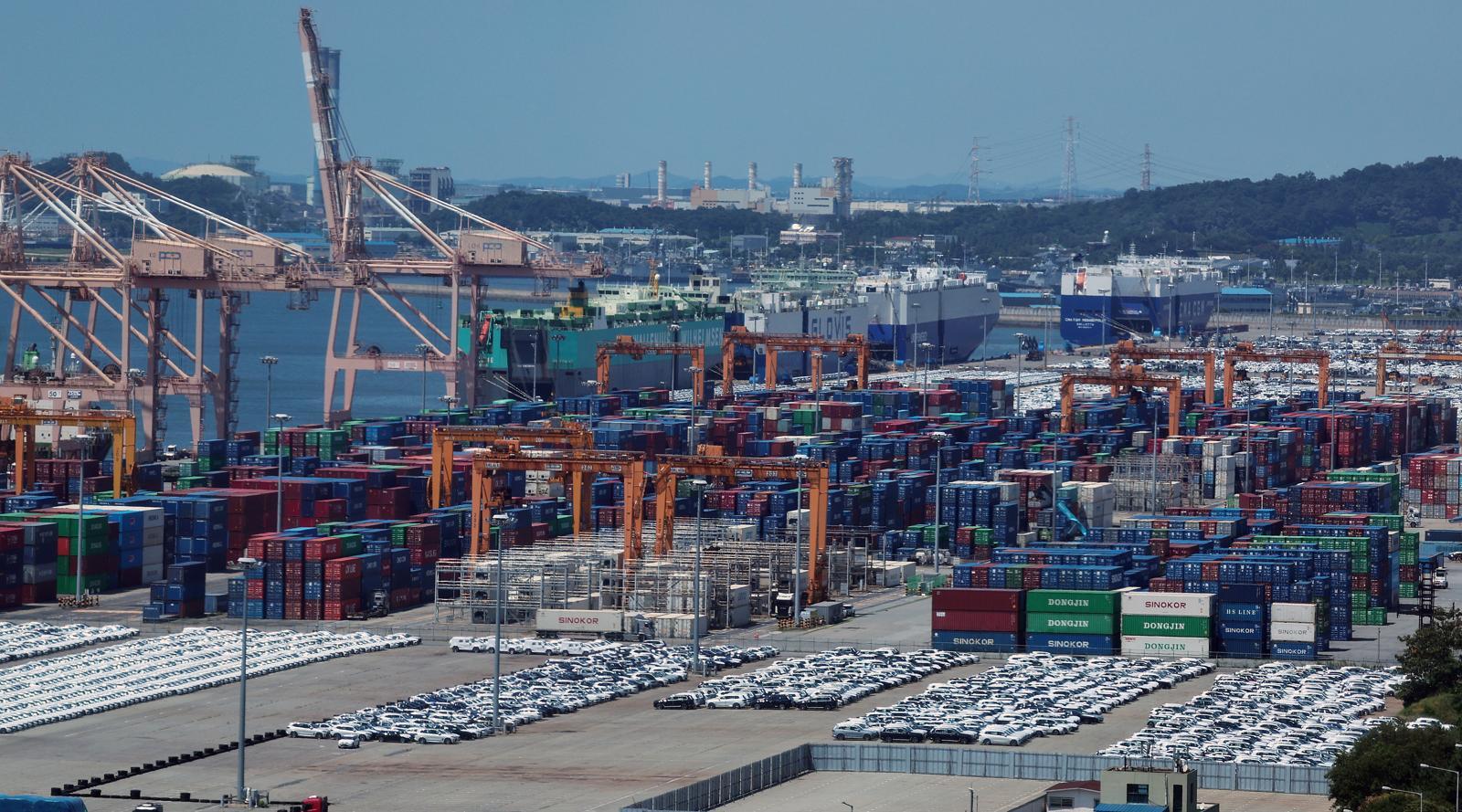
On the 11th, export containers and vehicles wait to be loaded at Pyeongtaek Port in Gyeonggi Province. 2026.8.11 News1
Semiconductor exports reached an all-time high. It is assessed that export values rose sharply as global demand increased for high value-added memory semiconductors such as high bandwidth memory (HBM). Backed by the upward trend in semiconductor exports, total exports exceeded USD 90 billion for the third consecutive month. There are also projections that total annual exports could reach USD 1 trillion this year.
According to the “Export and Import Trends for August 2026” released by the Ministry of Trade, Industry and Energy on the 1st, last month’s exports were tallied at USD 98.25 billion (approximately KRW 134.4551 trillion), up 68.7% from a year earlier. Imports amounted to USD 63.51 billion (approximately KRW 86.9452 trillion), an increase of 22.5% year-on-year.
As a result, the trade balance posted a surplus of USD 34.75 billion (approximately KRW 47.7 trillion), up USD 28.34 billion from the same month a year earlier. This marked a USD 30 billion-range surplus for the third consecutive month. The cumulative trade balance from January this year recorded a surplus of USD 202.5 billion (approximately KRW 277.9 trillion), an increase of USD 162.2 billion compared with the same period last year.
Semiconductors again drove export performance in August. Semiconductor exports came to USD 46.65 billion (approximately KRW 64.027 trillion), up 209% from a year earlier. This is the largest monthly export value on record. Semiconductor exports have set new monthly records five times this year, starting with USD 25.1 billion in February, followed by USD 32.8 billion in March, USD 37.2 billion in May, and USD 44.8 billion in June. Since June, monthly exports have exceeded USD 40 billion for three consecutive months.
Exports of items directly and indirectly linked to semiconductors also rose sharply in value due to higher semiconductor prices. Computer exports amounted to USD 6.24 billion (approximately KRW 8.6 trillion), a 419.5% increase year-on-year. This surge is attributed to strong growth centered on enterprise solid-state drives (SSDs) amid expanded investment in artificial intelligence (AI) infrastructure by big tech companies. Exports of wireless communication devices were USD 1.88 billion (approximately KRW 2.6 trillion), up 21.2% from a year earlier. Driven by so-called “chipflation,” which pushed up prices, higher sales of new smartphone models have sustained a trade surplus for 10 consecutive months.
Although semiconductor exports hit a record high, the overall export value was the third highest on a monthly basis due to declines in exports of key items such as automobiles and ships.
Automobile exports fell to USD 3.85 billion (approximately KRW 5.3 trillion), down 29.8% from the same month last year. This temporary decline was explained by fewer working days due to major exporters’ summer holidays and production disruptions caused by partial strikes. Ship exports also decreased 45.9% year-on-year to USD 1.69 billion (approximately KRW 2.3 trillion) as delivery volumes declined.
Despite lower export volumes, exports of petroleum products and petrochemical products rose 65.3% and 12.2%, respectively. This was because export unit prices remained high amid instability in navigation through the Strait of Hormuz.
Minister of Trade, Industry and Energy Kim Jung-kwan stated, “While the strength in semiconductor exports continues, the export base is expanding, with non-semiconductor items also recording a high growth rate of 20%,” but added, “Given the high level of uncertainty in the trade environment due to reinforced protectionism in major countries and the restructuring of global supply chains, the ministry will closely examine how changes in the trade environment affect companies.”
ⓒ dongA.com. All rights reserved. Reproduction, redistribution, or use for AI training prohibited.
Popular News