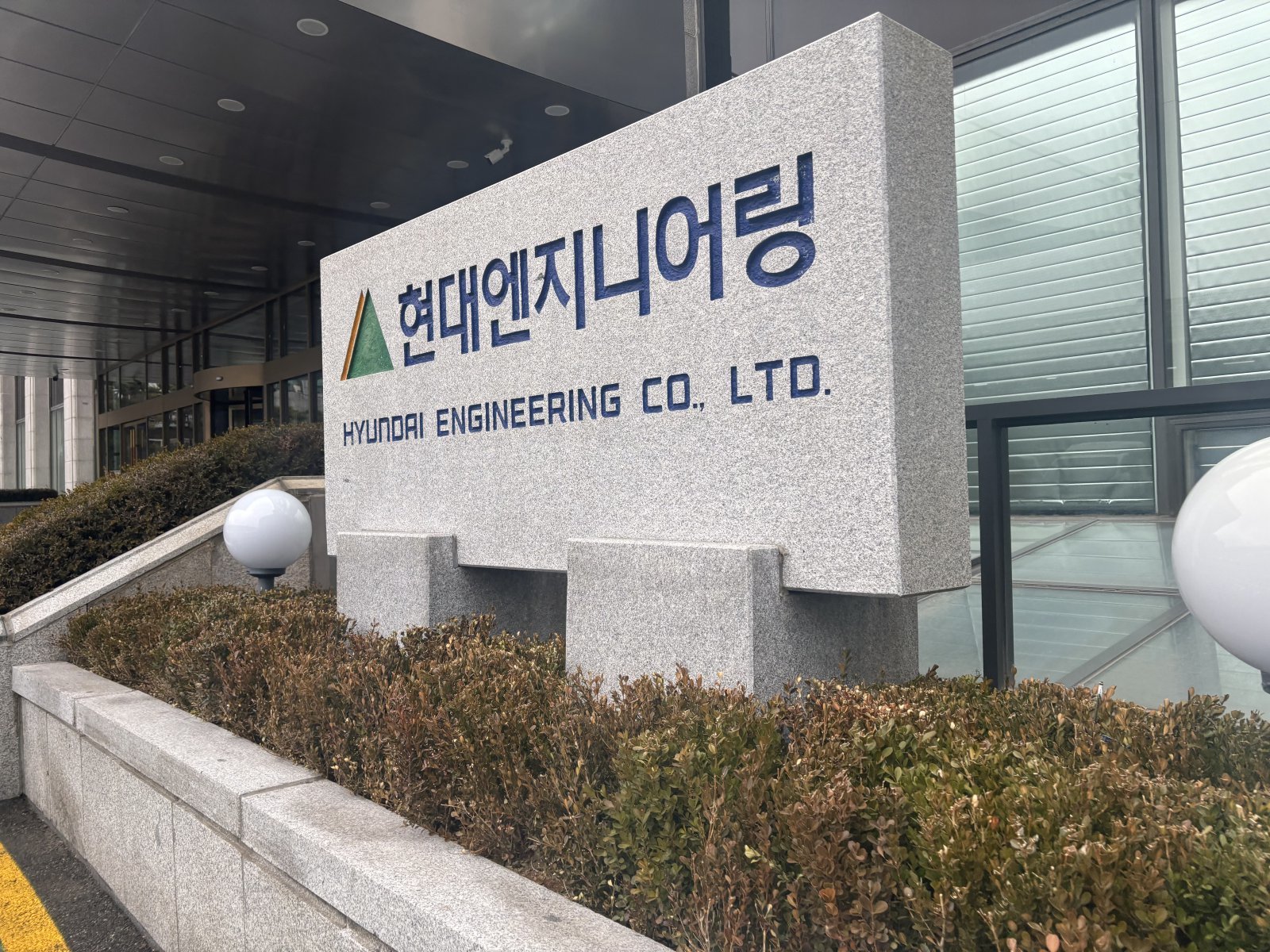
Hyundai Engineering headquarters. Photo by reporter Hwang So-young, fangso@donga.com
Hyundai Engineering announced on the 20th that its board of directors had resolved a proposal to merge and absorb Korea Electric Vehicle Charging Service (Hancharging). The effective date of the merger is November 1. Hyundai Engineering will remain as the surviving entity and Hancharging will be dissolved.
This merger aims to consolidate within Hyundai Motor Group the electric vehicle (EV) charging business capabilities that had been dispersed, by integrating them into Hyundai Engineering. The plan is for Hyundai Engineering, which has handled construction, operation, and maintenance of charging facilities, to combine these with Hancharging’s member base and platform operation capabilities so that a single company manages the entire value chain of the charging business.
Hyundai Engineering has been engaged in the construction, operation, and maintenance of EV charging facilities since 2022. It has built around 12,000 charging units to date and also operates the “EVC Integrated Control Center,” which manages the condition of charging facilities.
Hancharging has been operating charging services and platforms based on approximately 240,000 members and about 4,000 charging units. While Hyundai Engineering’s strength lies in installing and managing chargers, Hancharging has played the role of securing users and providing charging services.
Once the two companies are combined, a single entity will be able to handle everything from the construction of charging facilities to operation and maintenance, member management, customer service, and platform operation. After the merger, Hyundai Engineering plans to develop its own customer-facing EV charging platform and continue to expand both charging facilities and its member base.
The rapid expansion of the EV market also underpins the merger. According to Hyundai Engineering, as of April 15, the cumulative number of registered EVs in Korea exceeded 1 million. The share of EVs in new car purchases also rose from 9.2% in 2023, 8.9% in 2024, and 13.0% in 2025 to 23.2% in the first half of this year.
The merger ratio is 1 to 0.3132476. The valuation per share was set at KRW 58,101 for Hyundai Engineering and KRW 18,200 for Hancharging. Hyundai Engineering plans to issue new merger shares and allocate them to existing Hancharging shareholders in proportion to their current holdings.
The reason Hyundai Engineering is merging Hancharging is not solely to expand the charger business. In the long term, it aims to treat EV batteries as an energy resource and extend its business scope into the power market.
Hyundai Engineering is currently participating in Hyundai Motor Group’s Vehicle-to-Grid (V2G) pilot project in the Jeju region, which utilizes electricity stored in EV batteries by connecting them to the power grid.
V2G is a system in which EV batteries are charged when electricity is in surplus, and electricity stored in the batteries is fed back into the grid during periods of high power demand. It uses EVs not merely as a means of transportation but as an energy resource that can store electricity and supply it when needed.
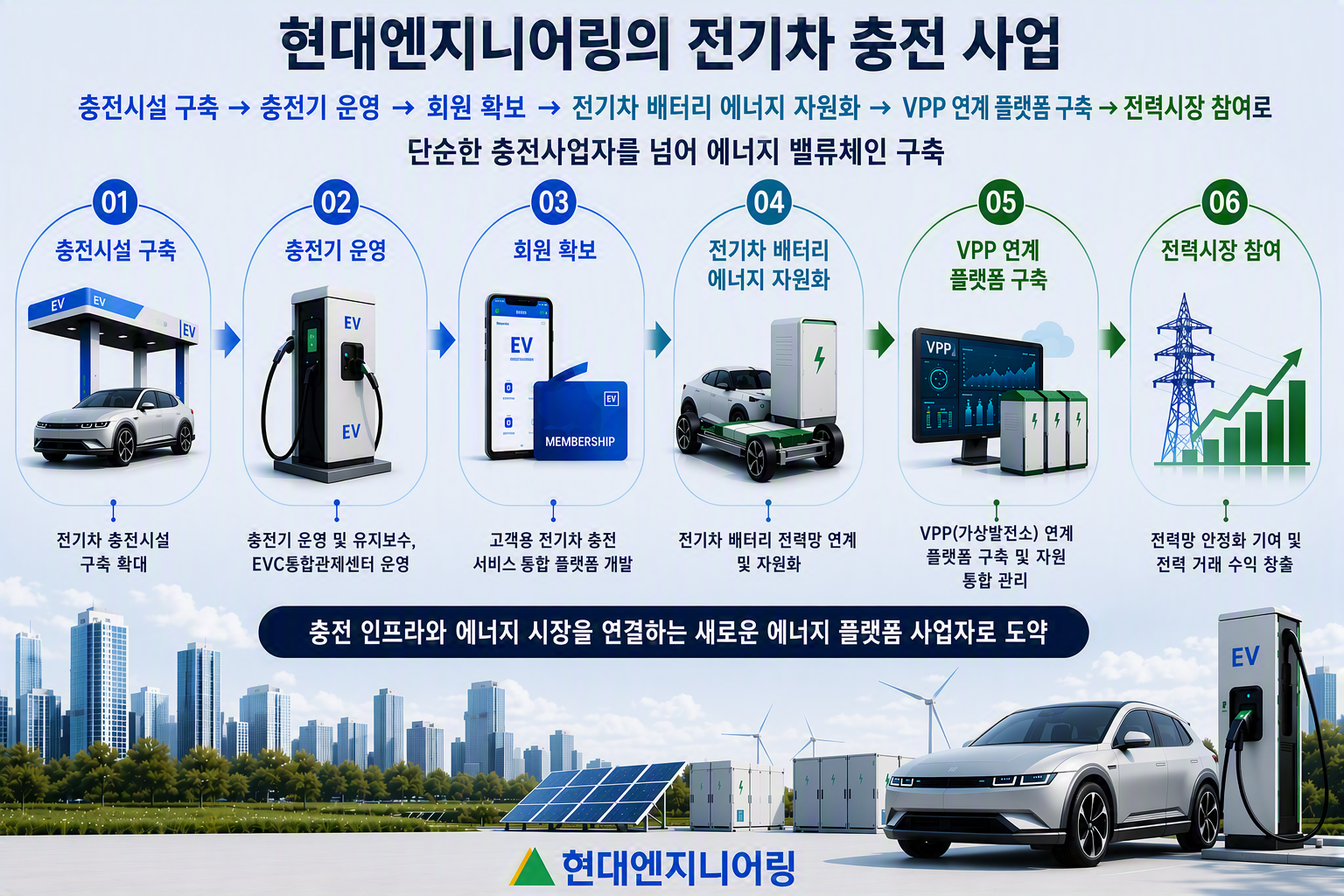
Conceptual diagram of Hyundai Engineering’s EV charging business model. Provided by Hyundai Engineering.
Going forward, the company plans to build a virtual power plant (VPP) platform that aggregates multiple EV batteries and operates them like a single power plant. Through this, Hyundai Engineering intends to participate in the power brokerage market and create power trading as a new revenue source.
In this process, the value of Hancharging’s members and platform will also increase. The more vehicles and users connected to the charging platform, the greater the pool of EV batteries that can be utilized. For Hyundai Engineering, this effectively secures not only charger installation capabilities but also a foundation for directly connecting with customers and vehicles.
The company is also promoting a business that uses retired EV batteries as energy storage systems (ESS). Together with group affiliates, Hyundai Engineering is carrying out the UBESS business, which repurposes used batteries as ESS, and is reviewing an EV charging station model that combines ESS with renewable energy sources such as solar power.
The business trajectory envisioned by Hyundai Engineering starts with the construction of charging facilities and extends to charger operation, member acquisition, utilization of EV batteries, VPP platform development, and participation in the power market. Through this merger with Hancharging, the company aims to expand its role from an infrastructure builder for charging networks to an energy platform provider that connects customers, EV batteries, and the power market.
A Hyundai Engineering official stated, “After comprehensively considering the growth potential of the EV charging business, business synergies, and operational efficiency, it was concluded that Hyundai Engineering’s absorption-type merger of Hancharging was the most rational approach,” adding, “The company will provide customers with more convenient charging services and further develop an integrated EVC business model that links charging infrastructure with future energy businesses.”
ⓒ dongA.com. All rights reserved. Reproduction, redistribution, or use for AI training prohibited.
Popular News