Article at a GlanceThe core success factor behind the KBO opening an era of 10 million spectators for two consecutive years lies in starting from a sense of crisis over declining attendance and the departure of younger generations, and completely redesigning game operations, content, and the overall IP business from the fan’s perspective. KBO innovated its game operation systems by reflecting fans’ demands, introducing the pitch clock to increase game immersion and adopting the Automated Ball-Strike System, or ABS, with consideration for younger generations who are highly sensitive to fairness. Outside the stadium, the KBO expanded its baseball IP business into the realm of everyday consumption, centered on its marketing subsidiary, KBOP. Going beyond simply using club logos, it strengthened product competitiveness through collaborations with lifestyle brands with proven design and quality, such as Odense and CASETiFY, allowing baseball to naturally blend into fans’ daily lives. In addition, during negotiations over new media broadcasting rights, the KBO insisted on conditions allowing the use of secondary works such as short-form videos, effectively opening the digital gate and building a structure in which game footage could rapidly spread across diverse platforms, thereby broadening the base of the KBO League.
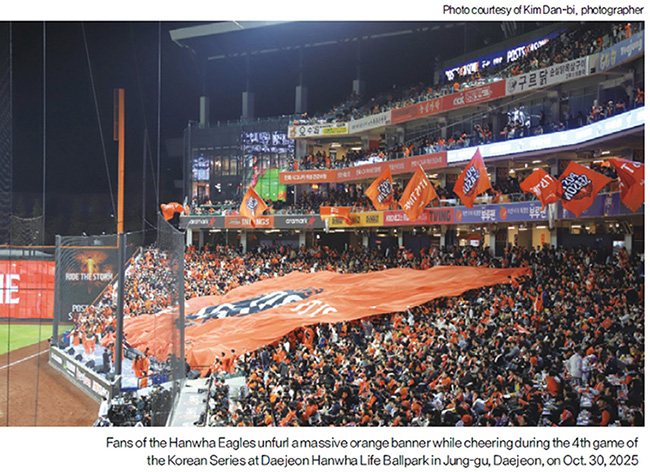
On Oct. 30, 2025, at Daejeon Hanwha Life Ballpark in Jung-gu, Daejeon, where the 4th game of the Korean Series was held, the chant “Mighty Hanwha!” shook the stadium as the Hanwha Eagles began their offense in the bottom of the eighth inning. In the first-base cheering section, orange flags rippled like waves, and Hanwha Eagles fans raised towels to amplify the fervor of their support. As the atmosphere surrounding the home team reached its peak, the mood suddenly shifted. In the top of the ninth inning, the LG Twins completed a comeback. Roars poured out from the third-base cheering section, where fans wearing glossy jackets emblazoned with large LG Twins logos energetically sang along to the team’s fight song.
The game ended with the LG Twins securing a 7-4 comeback victory. What was just as striking as the result that day was the density of baseball fans who filled the stadium. A foreign spectator interviewed at the ballpark said that although he had watched many Major League Baseball games and the World Series, he had never seen a fan culture in which everyone sang and shouted together like this, adding that it was truly beautiful and gave him goosebumps. The crowd included a woman in her 20s waving a cheering stick while holding her 10-month-old baby, an elementary school student selecting merchandise at the in-stadium souvenir shop, and a father in his 40s saying that there was more to buy every time he came to the ballpark. The baseball stadium was no longer a space for a specific age group or gender. As the in-stadium experience itself became a reason to attend, ballparks expanded into everyday leisure spaces that cut across generations and tastes.
These changes are also confirmed by the numbers. The KBO League surpassed 10 million spectators for the second consecutive year following 2024. This is a symbolic achievement showing that the KBO League is moving beyond a simple rebound in popularity and transforming from a sport people watch into an industry where experiences are consumed. In particular, the Korea Baseball Organization, which oversees the KBO League, is transforming baseball into a comprehensive entertainment industry through measures such as introducing the pitch clock system to reduce game time and ease the burden of watching, diversifying merchandise and food products using player and club IP, and adopting media strategies that repackage game footage into short-form content and distribute it widely across digital platforms. How was the KBO able to innovate the fan experience and broaden the base of the KBO League? Based on interviews with KBO officials, Dong-A Business Review analyzed the key success factors that enabled the KBO to open an era of 10 million spectators by turning a sense of crisis over declining attendance and changes in the viewing environment into a driver of innovation.
Copyright Ⓒ 동아비즈니스리뷰. All rights reserved. 무단 전재, 재배포 및 AI학습 이용 금지





 경제·경영 질문은