Artificial intelligence (AI) has been followed by quantum technology as the next national strategic technology. Moves to preempt the quantum industry, which is regarded as an innovative technology with an impact comparable to AI, are gaining momentum. On 29 January, the government announced the “1st Comprehensive Plan for Fostering Quantum Science and Technology and the Quantum Industry” (hereinafter the Comprehensive Plan) and the “1st Basic Plan for Quantum Clusters,” centered on achieving the status of the world’s No. 1 quantum chip manufacturing country by 2035 and nurturing 2,000 quantum companies and 10,000 professionals.
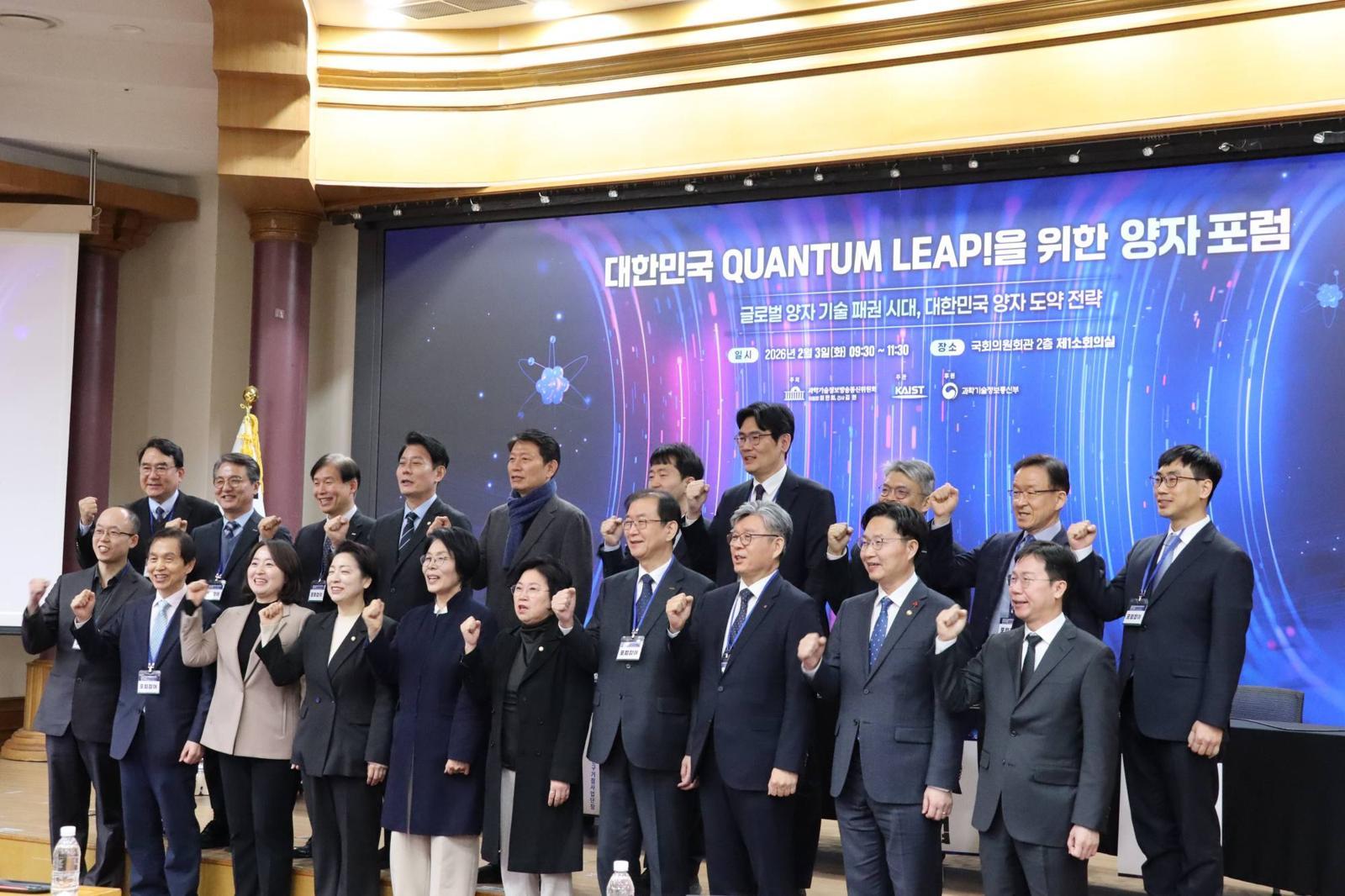
On 3 February, the “Quantum Forum for Korea’s Quantum Leap!” was held at the National Assembly / Source=IT Donga
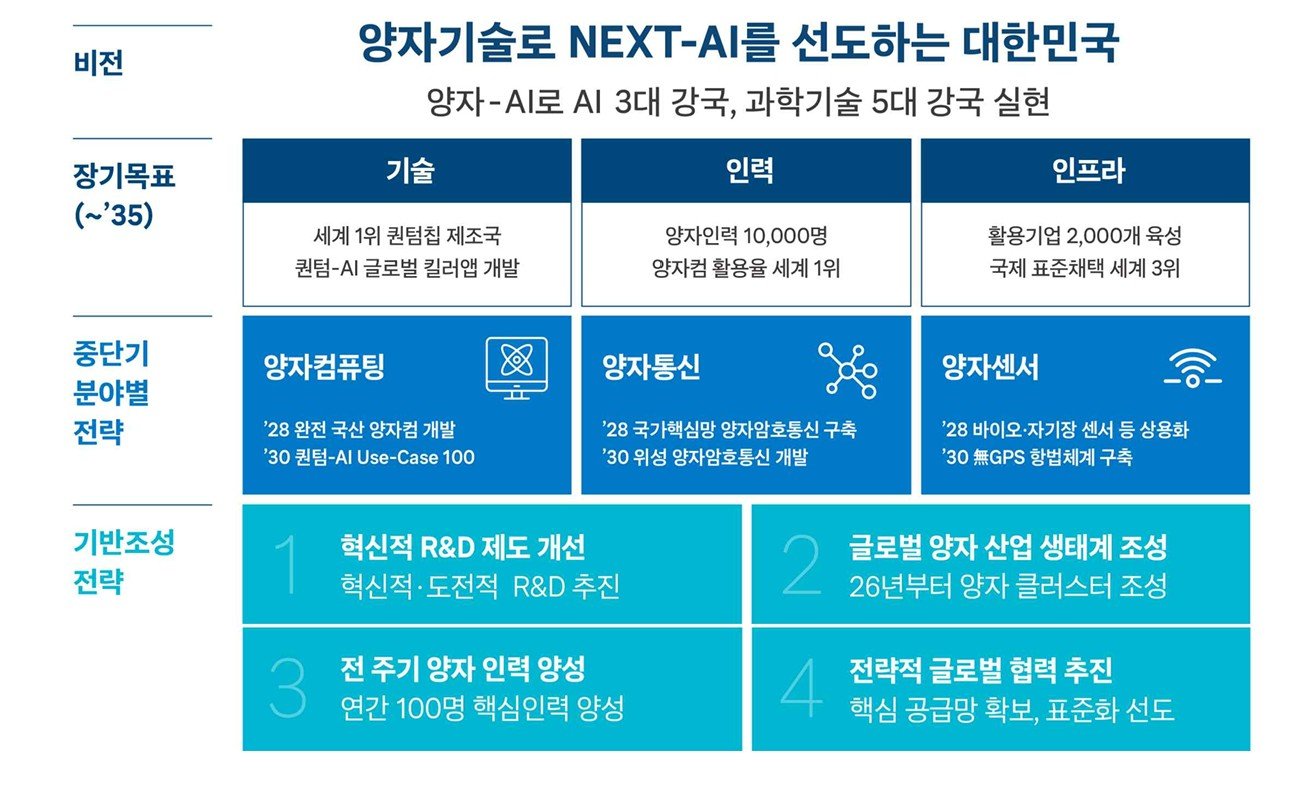
Nurturing 2,000 quantum companies and 10,000 professionals by 2035The Comprehensive Plan announced by the government expressed a determination to overcome the limitations of being a latecomer by leveraging the strength of the nation as a semiconductor and ICT powerhouse. In the field of “quantum computing,” the government will promote a “Manufacturing Grand Challenge” to develop a domestically produced quantum computer by 2028 and aims to preempt the application market by building a quantum-AI convergence infrastructure. In cooperation with global companies such as NVIDIA, IBM, and IonQ, the government will establish a “Quantum Algorithm Center” and actively identify “industrial use cases” to solve industrial challenges in sectors such as automotive, pharmaceuticals, and finance by 2030.
This year, the Ministry of Science and ICT will introduce the latest quantum computer and build a hybrid infrastructure linked to the supercomputer of the Korea Institute of Science and Technology Information (KISTI). IonQ will establish a joint research center in Korea and invest USD 5 million (approximately KRW 7.2 billion) annually for three years. In addition, the government will seek to create an initial market through a “Quantum Technology Council” in which national flagship companies by sector participate, including ▲ manufacturing (Samsung Electronics, LG Electronics) ▲ telecommunications (SKT, KT) ▲ finance (KB, Shinhan) ▲ defense (Hanwha, LIG).
1st Comprehensive Plan for Fostering Quantum Science and Technology and the Quantum Industry / Source=Ministry of Science and ICT
Commercialization in the security and sensor fields will also accelerate. In the quantum communication sector, the government plans to build a nationwide quantum cryptographic communication network by 2028 and apply quantum key distribution (QKD), an unhackable quantum cryptography technology, to defense and financial networks. Going forward, this will be expanded into a quantum communication network connecting ground and satellites, in parallel with post-quantum cryptography (PQC) technologies. In the quantum sensor field, to speed up industrialization, the government will select promising projects in sectors such as healthcare and defense and support them from prototype development to commercialization. For example, it plans to develop a “non-GPS navigation system” that can accurately determine the position of submarines and aircraft without GPS by 2030. In addition, it will identify sector-specific industrial use cases in bio and semiconductors, such as medical diagnosis of the brain and heart using quantum sensing, and semiconductor defect detection.
The government is focusing its policy on linking these technological achievements to industrialization. The core is the establishment of quantum clusters. In July this year, it will create quantum clusters in five key areas (quantum computing, communications, sensors, materials and components, and algorithms) in connection with regional specialized industries. The goal is to foster them as global quantum hubs by converging existing flagship industries with quantum technologies and turning them into “quantum transformation (QX)” bases. Furthermore, by 2035, the government plans to establish funds and introduce a 30-year long-term basic research system to nurture 2,000 quantum start-ups and produce 10,000 key talents.
“Private investment and securing talent will determine success or failure”
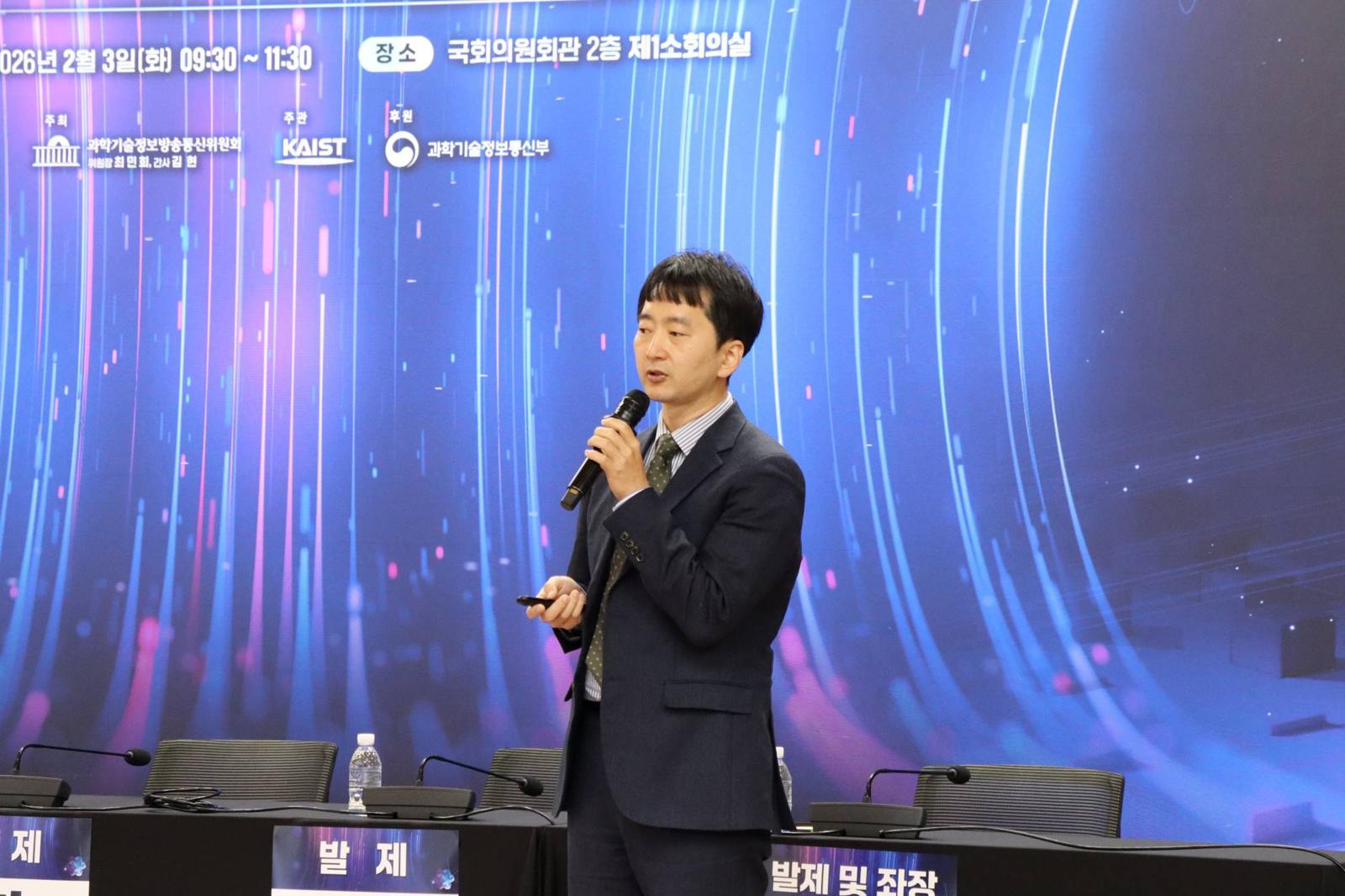
Shim Ju-seop, Director at the Ministry of Science and ICT / Source=IT Donga
At the “Quantum Forum for Korea’s Quantum Leap!” held at the National Assembly on 3 February, government officials and experts from industry, academia, and research institutes gathered to discuss concrete strategies. Choi Min-hee, Chair of the Science, ICT, Broadcasting, and Communications Committee of the National Assembly, said in her congratulatory remarks, “Quantum technology is a disruptive innovation that will determine national competitiveness in the post-AI era,” adding, “Legislative and policy foundations will be prepared so that it does not remain confined to laboratories.”
Shim Ju-seop, Director at the Ministry of Science and ICT, noted, “Major countries such as the United States and China are racing to connect technology development and industrialization through quantum clusters,” and explained, “Korea can also create synergies by building regional clusters centered on strongholds of flagship industries, such as semiconductors and bio, where convergence with quantum is easy.” He added that the government would operate open infrastructure and rapidly link the results of public-private collaborative research projects to industry.
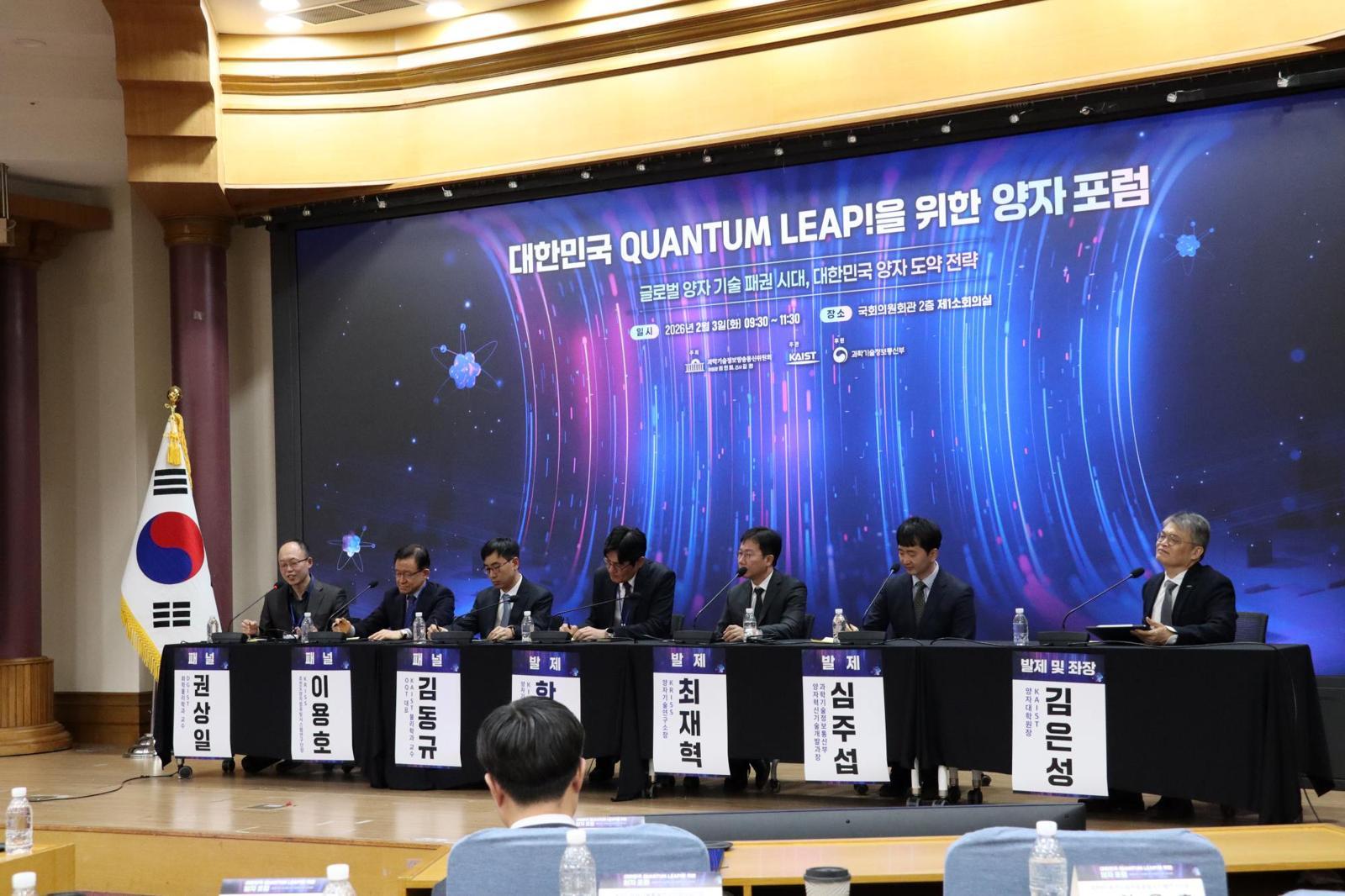
A panel discussion was held at the Quantum Forum / Source=IT Donga
On site, the expansion of private investment and the development of talent were cited as urgent tasks. Han Sang-wook, Director at the Korea Institute of Science and Technology (KIST), said, “The real reason quantum is attracting attention lies in the innovative added value it will generate through convergence with other industries,” analyzing that, “This is an opportunity for Korea, which has global competitiveness in semiconductor processes and manufacturing technologies.” He further suggested, “While continuing to invest in basic and fundamental technologies, Korea should vitalize research hubs focused on related areas where it has strengths, and create an environment in which industry, academia, and research institutes can collaborate.” Since last year, KIST has been building the “Quantum Platform” with the Korea Research Institute of Standards and Science (KRISS) to foster hubs for applied and basic research.
Kim Eun-sung, Dean of the KAIST Graduate School of Quantum Science & Technology, argued that the outcome of the competition for technological supremacy ultimately depends on whether innovative talent can be secured. He said, “In quantum technology, those who develop the core technologies become the key players in the industry,” urging the cultivation of talent at a global level. In particular, he emphasized, “If there is a lack of domestic industrial ground where talent can thrive, it will lead to brain drain,” and called for infrastructure such as a national quantum fab research institute where students can devote themselves to research without fear of failure. KAIST is jointly operating the Graduate School of Quantum Science & Technology with KRISS, ETRI, and others, and is preparing to establish a quantum convergence research building in 2029. It is also seeking to expand the global ecosystem through a comprehensive partnership with MIT that includes academic and human exchanges.
Meanwhile, Kim Dong-gyu, CEO of quantum start-up OQT, who participated in the discussion, provided advice on practical directions for industrialization, saying, “Rather than the traditional approach in which engineering follows basic science, a system-centered approach where they proceed in tandem is needed.” OQT is developing a Korea-style neutral atom-based quantum computing technology based on this system-centered perspective and its actual global field experience.
Quantum technology has the potential to become a game changer in virtually all industries, including bio, defense, finance, manufacturing, and telecommunications. Quantum computers, which can solve problems in a few seconds that would take conventional computers millions of years, are expected to change the paradigm of all industries, including new drug development, new material design, and financial investment optimization. The reason the government has declared quantum technology as “NEXT AI” is also due to the step-change performance improvements that will result from the convergence of quantum and AI.
The tasks presented that Korea must address to overcome the limitations of being a latecomer and emerge as a leading quantum economy by 2035 are clear: ▲ continuous investment in basic and fundamental technologies without being preoccupied with short-term outcomes ▲ policy incentives that draw private sector participation ▲ the establishment of a virtuous cycle structure centered on clusters where industry, academia, research, and regions communicate organically. As a world that has been dominated by the AI era now turns its eyes to the quantum era, the success or failure of the quantum industry is expected to directly determine Korea’s future competitiveness.
IT Donga staff reporter Kim Ye-ji (yj@itdonga.com)
ⓒ dongA.com. All rights reserved. Reproduction, redistribution, or use for AI training prohibited.
Popular News