Robot performance evaluated directly with equipment data, not financial statements
Implemented via six-axis joint torque sensors, with no additional hardware required
Phased rollout from TUM student team to full commercial deployment
peaq (left) and Doosan Robotics (right) logos. Photo credit = Doosan Robotics
Doosan Robotics announced on the 17th that it has signed a “Physical AI Innovation Partnership” with peaq, a machine economy infrastructure company.
Doosan Robotics plans to promote a business that converts robots’ actual operating histories into data that can be verified externally, to be used for financing and insurance assessment. The first robot has already been connected, and the range of equipment to which the system is applied will be expanded sequentially over the coming months.
At present, financing for industrial robots is based on the financial statements of the companies that purchase the equipment, rather than the equipment itself. This is because there is no external method to verify how much the robot has operated and what performance it has delivered, as such information remains only in the operator’s log files. The two companies plan to record the utilization rate, work details, operating conditions and maintenance history of each individual piece of equipment in a verifiable form, enabling financial institutions to assess the condition, residual value, and risk of each unit.
Doosan Robotics’ collaborative robots are equipped as standard with torque sensors on all six joints, enabling them to directly detect force, contact and cycle behavior at the joint level. Unlike conventional methods that estimate this via motor current, the company explained that its approach allows application without adding separate sensors.
Data processing is carried out only at the equipment and edge level, and only verified proof values are shared externally, in line with the policy of minimizing the exposure of customer production processes or sensitive operational information. Based on the fact that industrial robots are purchased to meet peak demand while costs accrue 24 hours a day, the companies are also testing the potential to generate additional revenue by using computational resources during idle, non-operating hours.
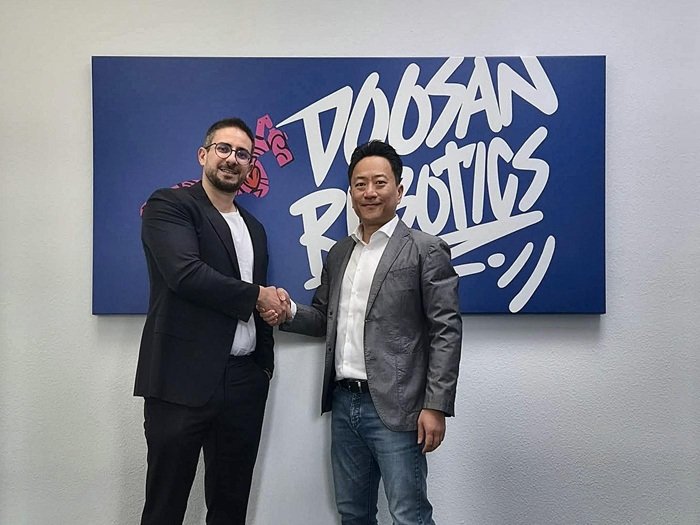
Martin L. Köury, peaq Chief Business Officer (left), and Michael Ryu, Head of European Business at Doosan Robotics, pose for a commemorative photo at the Frankfurt, Germany office. Photo provided by Doosan Robotics
peaqOS is currently being test-applied on Doosan’s A-Series robots. The first robot has been deployed to a student team at the Technical University of Munich (TUM), where they will carry out a joint project through the end of October for a hackathon. The two companies plan to subsequently expand the scope of application to operating equipment at commercial sites and training centers, and jointly pursue a financing pilot based on equipment performance records.
Michael Ryu, Head of European Business at Doosan Robotics, said, “Customers purchase robots based on their busiest single hour, but costs are incurred during all the remaining hours as well,” adding, “Robots must be able to prove their own performance and create value even during idle time.”
Martin L. Köury, peaq Chief Business Officer (CBO), said, “A robot that can prove what it has done is a completely different asset from one that cannot,” adding, “Once performance records pass external verification, robots can become assets that financial institutions can evaluate, rather than merely cost items.”
ⓒ dongA.com. All rights reserved. Reproduction, redistribution, or use for AI training prohibited.
Popular News