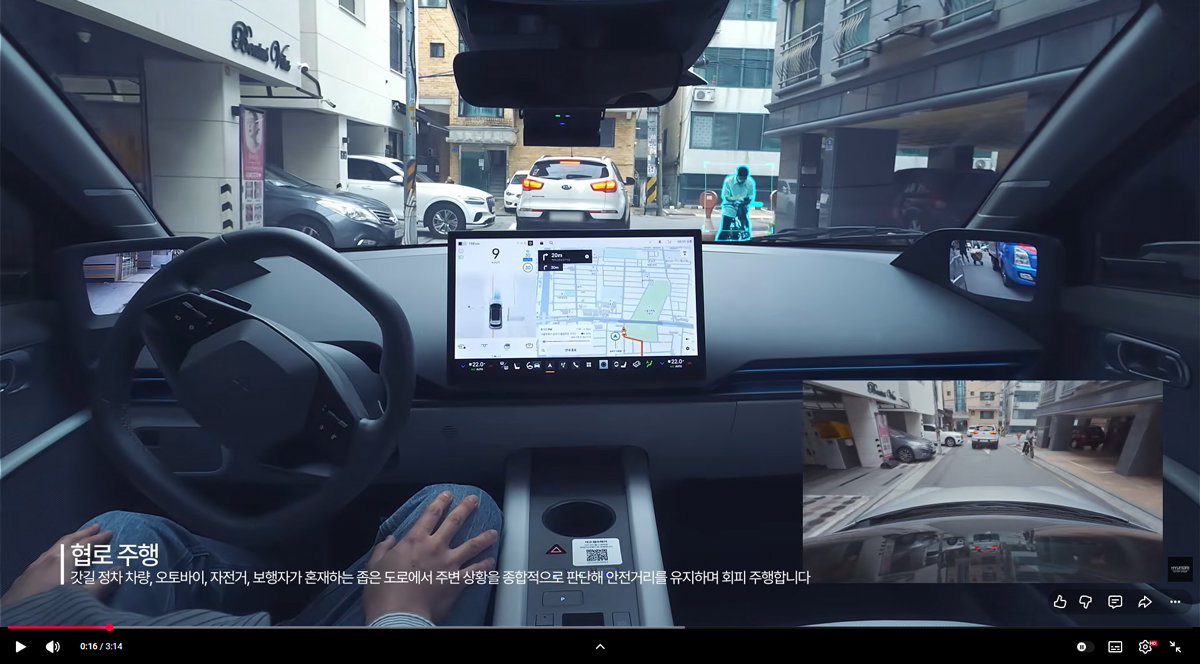
Hyundai Motor Group also released on YouTube footage of an Ioniq 6 test vehicle equipped with its in-house developed autonomous driving system ‘Atria’ driving autonomously. The video shows the system distinguishing between vehicles and pedestrians moving together in a narrow residential alley. Captured from Hyundai Motor Group’s YouTube channel
“In 2028, mass production of autonomous vehicles based on Nvidia systems will begin, and in the second half of 2029 (July–December), vehicles equipped with the independently developed ‘Atria’ autonomous driving system will be launched in the market.”
Hyundai Motor Group presented its future autonomous vehicle development roadmap at an autonomous driving press briefing held on 11 September at the headquarters of 42dot in Seongnam, Gyeonggi Province. To enhance autonomous driving technology and accelerate market entry, the group plans a “stair-step” development approach: utilizing Nvidia systems through 2028 and then transitioning to its in-house developed system starting in 2029.
● Accelerating autonomous driving with a stair-step development approachPark Min-woo, head (President) of Hyundai Motor Group’s Advanced Vehicle Platform (AVP) Division and CEO of 42dot, who took office in February this year and had not previously appeared at an official media event, personally led the briefing. Park cited two main reasons why Hyundai Motor Group’s autonomous driving development progress has lagged behind competitors in the United States and China: the limited volume of data that can be accumulated on public roads in Korea, and the lack of standardized autonomous driving data within the group.
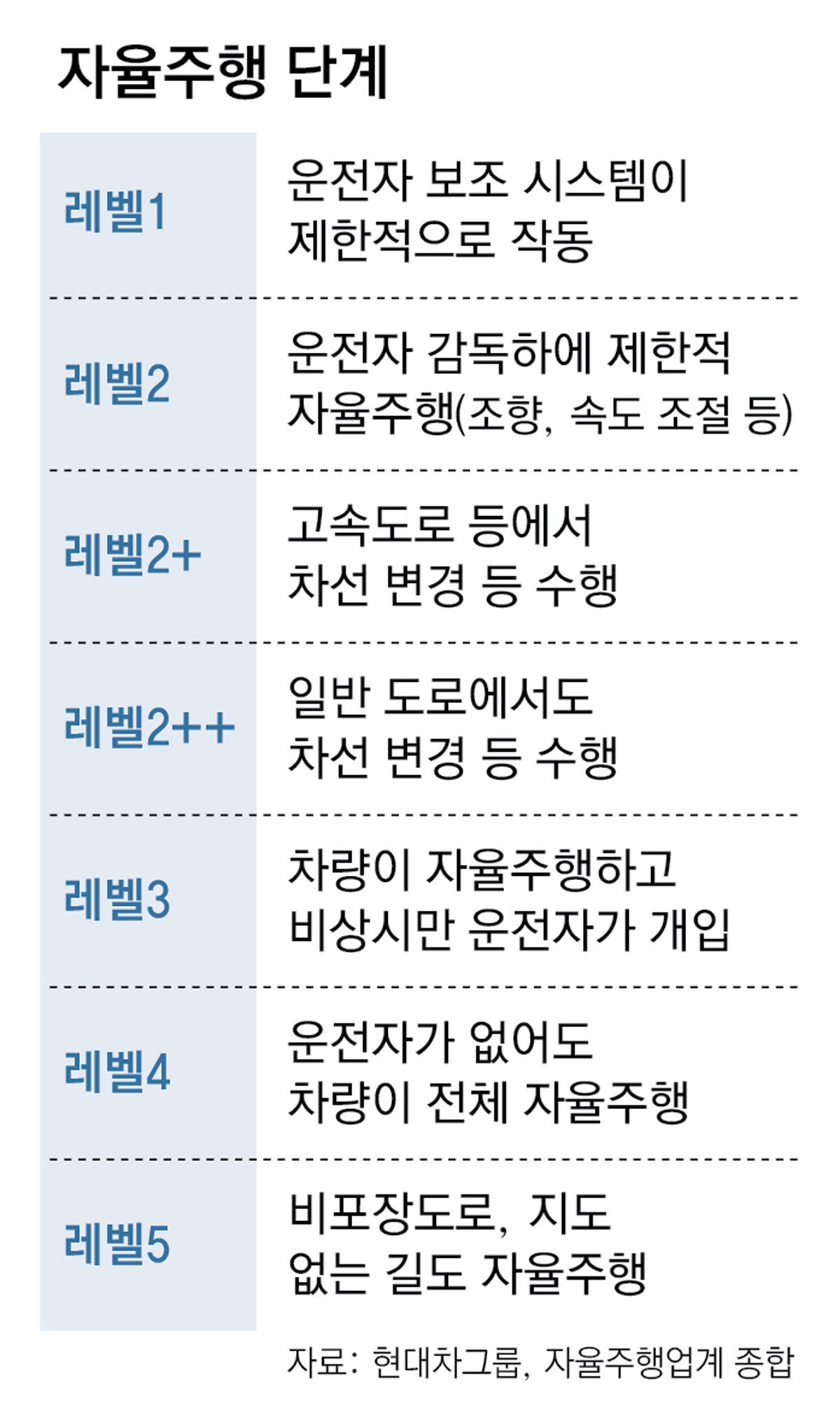
Industry observers assess that the advanced driver-assistance systems (ADAS) currently installed in Hyundai Motor Group’s mass-produced vehicles are between Level 2 and Level 2+. In contrast, in the United States and China, Level 4 autonomous vehicles, in which no driver is on board, are already operating in urban areas.
Hyundai Motor Group plans to overcome the disadvantages of being a latecomer through its Gwangju demonstration project and “sensor standardization.” First, it aims to secure as much Level 4 (driverless autonomous driving) data as possible through the Gwangju demonstration project. Park stated, “As the group’s AVP Division, 42dot, Motional, and other autonomous driving research organizations within the group have developed autonomous driving at different times and for different purposes, there has been an issue of differing sensor specifications, such as for cameras and radars,” adding, “We will standardize these under Nvidia’s ‘Hyperion 10’ architecture and share each organization’s data for artificial intelligence (AI) training and development.”
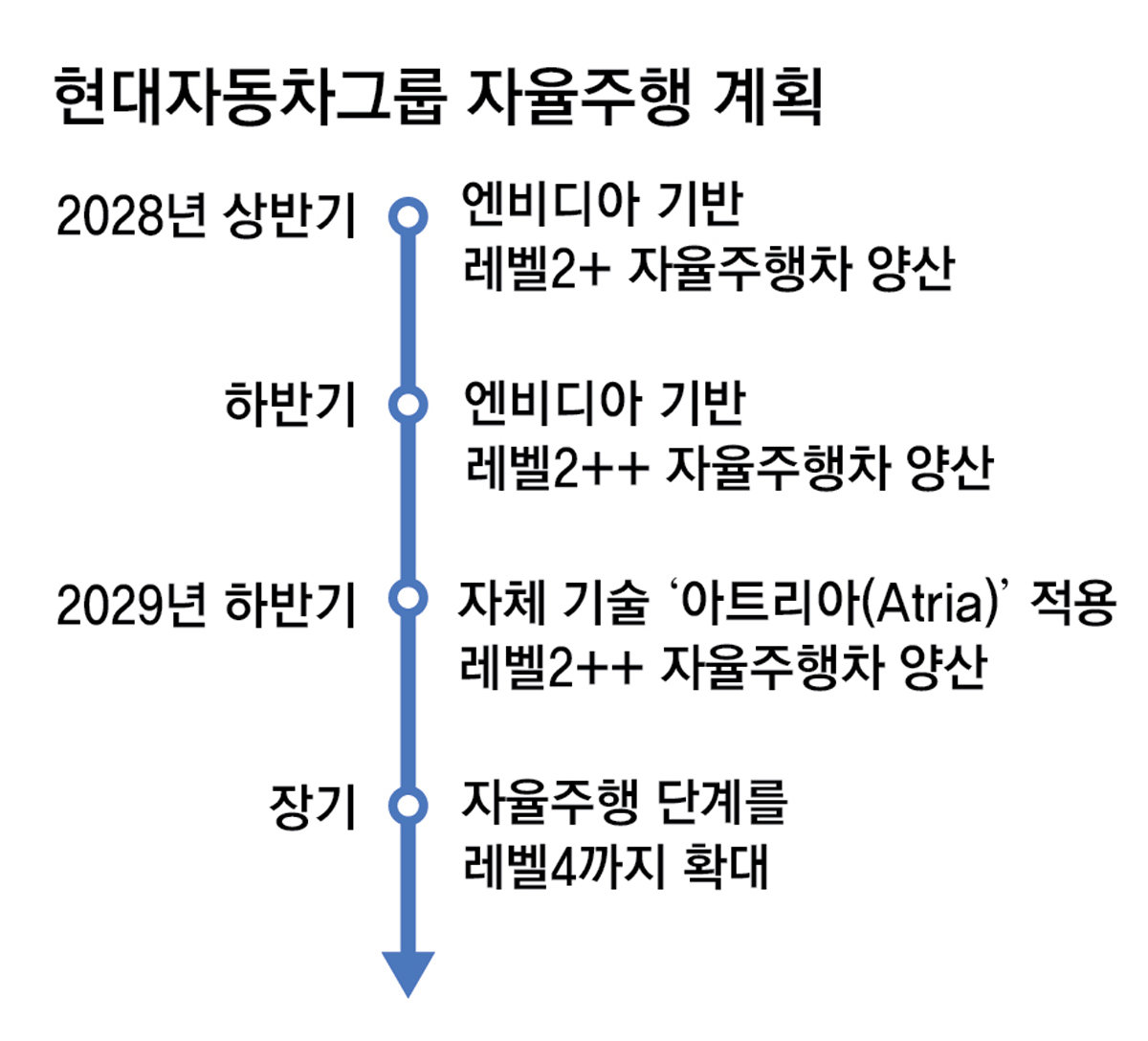
Mass production of autonomous vehicles will begin in 2028 with vehicles equipped with Nvidia systems. The group plans to mass-produce Level 2+ vehicles in the first half of that year (January–June) and Level 2++ vehicles in the second half. Using the data obtained from these vehicles, it intends to launch vehicles equipped with its in-house autonomous driving system Atria in the second half of 2029.
Explaining why the launch timing for Atria has been set three years later, in 2029, Park said, “If we rush to mass-produce a half-baked Level 2++, our development capability could end up being tied down,” adding, “This reflects our intention to secure the level of technology we ultimately aim for.” He continued, “Hyundai Motor Group sells 7 million–8 million vehicles annually worldwide,” and assessed, “Once a positive data cycle (flywheel), in which collected data is reapplied to development and training, starts to operate, the enormous scale will create an amplification effect and allow us to gain an advantage over competitors.”
● In-house autonomous driving footage also releasedHyundai Motor Group also released for the first time a video showing Park riding together with Jeong Sung-gyun, head of the Atria Group at 42dot, in an Ioniq 6-based test vehicle equipped with the in-house developed Atria system, driving through dense urban areas such as Gangnam and Jamsil in Seoul.
In the demonstration video, the test vehicle was shown navigating roads with various variables naturally and safely. Even in narrow residential alleys where vehicles and pedestrians were mingled in space barely wide enough for a single car to pass, the system recognized them accurately.
In the video, Park candidly pointed out both strengths and weaknesses of Atria. When the system recognized a vehicle stopped across lanes and safely avoided it, or detected an aggressively cutting-in vehicle and maintained a safe distance, he commented that it was “working well.” However, when the vehicle failed to change lanes in advance or did not start even after all pedestrians had finished crossing the crosswalk, he remarked that it was “disappointing.”
ⓒ dongA.com. All rights reserved. Reproduction, redistribution, or use for AI training prohibited.
Popular News