Joint establishment of a new drug research center by both companies
“Automating experiments through simulation”
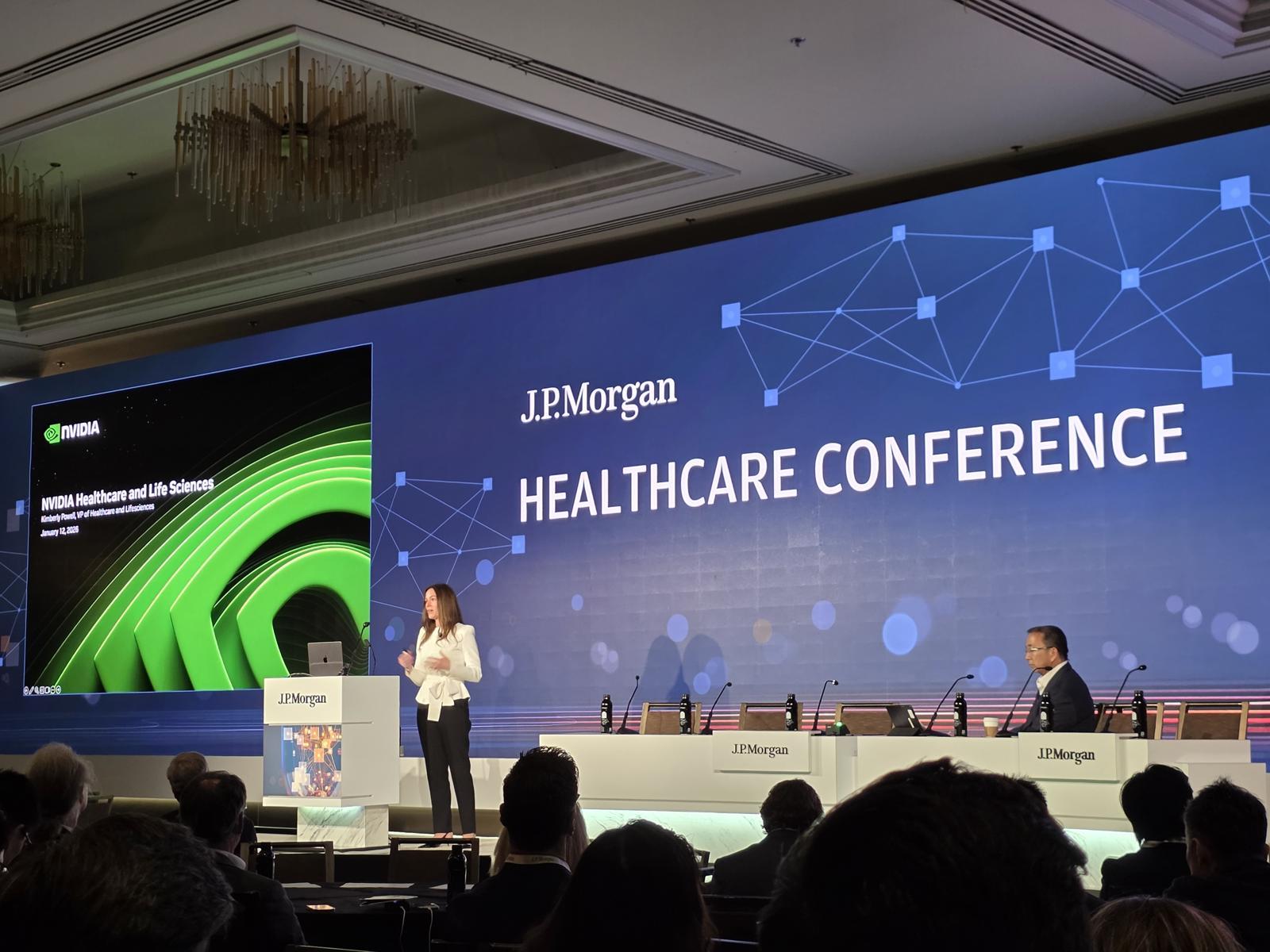
Kimberly Powell, Vice President of Healthcare and Life Sciences at NVIDIA, announced on the 12th (local time) during the corporate presentation session at the “J.P. Morgan Healthcare Conference” held at the Westin St. Francis Hotel in San Francisco, United States, that NVIDIA will establish an “AI Joint Innovation Lab” with Eli Lilly. Provided by NVIDIA
“The healthcare industry is adopting artificial intelligence (AI) at three times the pace of the overall U.S. industrial average. AI will completely transform the paradigm of the pharmaceutical research and development (R&D) industry, which is worth about USD 300 billion (approximately KRW 442 trillion).”
NVIDIA signaled an impending “AI boom” in the pharmaceutical and biotech sectors by announcing plans to set up an AI-driven drug discovery lab in partnership with Eli Lilly, the largest pharmaceutical company in the United States. Kimberly Powell, Vice President of Healthcare and Life Sciences at NVIDIA, made the announcement on the 12th (local time) at the “J.P. Morgan Healthcare Conference (JPMHC)” held at the Westin St. Francis Hotel in San Francisco, United States.
JPMHC, which runs for four days starting that day, is the world’s largest pharmaceutical and biotech investment event. With more than 1,500 pharmaceutical and biotech companies and over 8,000 industry participants in attendance, the key theme at this venue showcasing 2026 trends in the pharmaceutical and biotech industry was, without question, “AI.”
As hundreds of stakeholders crowded in to hear NVIDIA’s presentation, Powell announced that NVIDIA would establish an “AI Joint Innovation Lab” with Eli Lilly, the world’s largest pharmaceutical and biotech company by market capitalization. The two companies stated that they will invest USD 1 billion (approximately KRW 1.46 trillion) over five years in infrastructure development and talent recruitment for this initiative. The lab will be equipped with “Vera Rubin,” NVIDIA’s latest graphics processing unit (GPU) to be supplied from the second half of this year (July–December). The lab is scheduled to be established in the San Francisco Bay Area by the end of March. NVIDIA also announced that it has entered into a collaboration with global medical device company Thermo Fisher Scientific on AI-based laboratory automation.
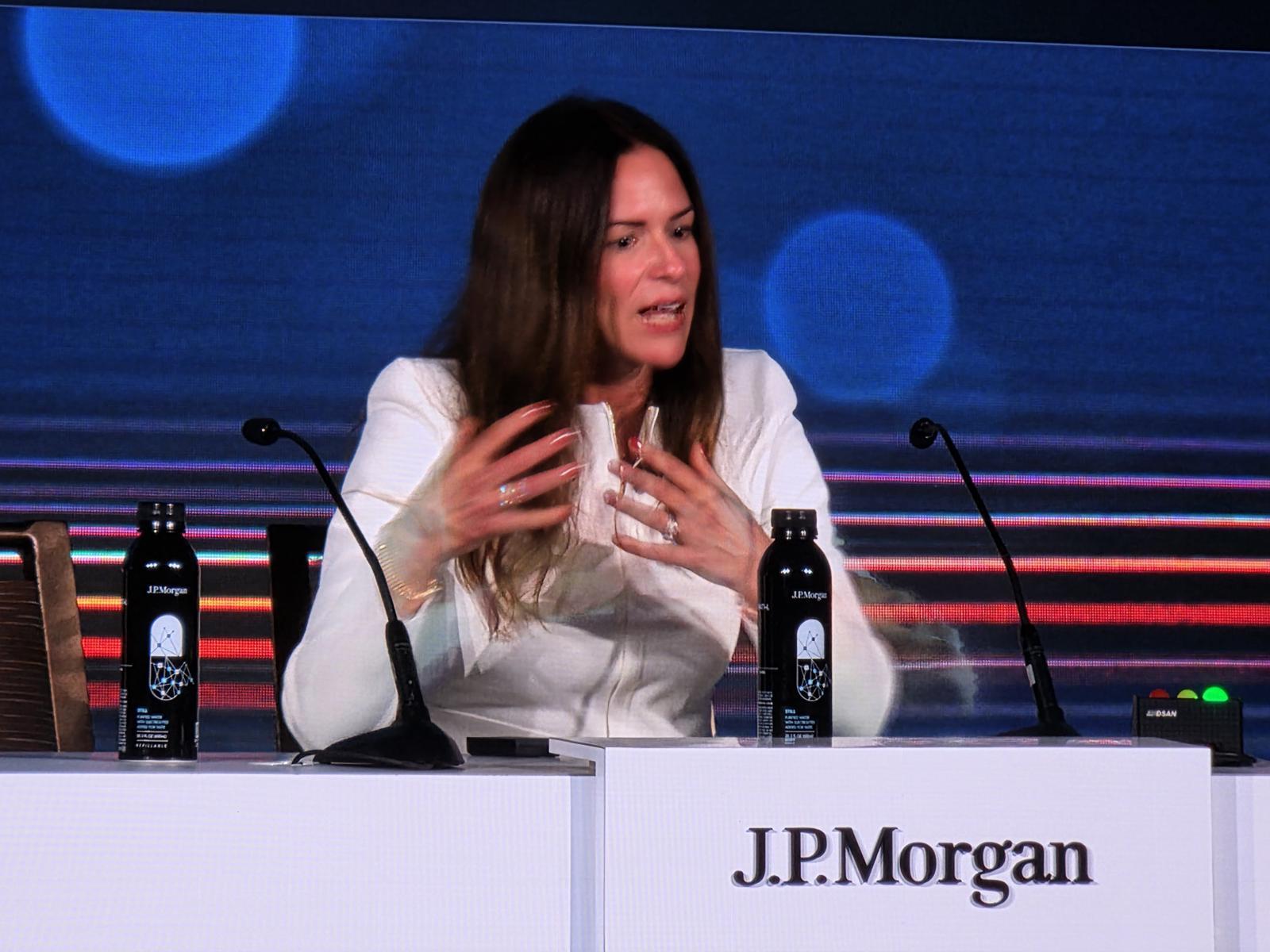
Kimberly Powell, Vice President of Healthcare and Life Sciences at NVIDIA, announced on the 12th (local time) during the corporate presentation session at the “J.P. Morgan Healthcare Conference” held at the Westin St. Francis Hotel in San Francisco, United States, that NVIDIA will establish an “AI Joint Innovation Lab” with Eli Lilly. Provided by NVIDIA
The core of the collaboration between NVIDIA and the two companies is automation of experiments through “simulation.” In her presentation, Powell stated that a “‘ChatGPT moment’ is now occurring in ‘physical AI’ as well,” emphasizing that physical AI can bring about tremendous advances in the biotech field. While many companies have so far focused on developing AI used for discovering drug candidates, NVIDIA’s strategy is to automate the entire experimental process itself, thereby significantly reducing time and cost. Citing the example of Multiply Labs, a biotech manufacturing automation company that uses NVIDIA’s AI platform, Powell said, “We reduced the manufacturing cost of cell therapies from USD 100,000 (approximately KRW 100 million) to USD 30,000, a reduction of more than 70%.”
Cross-sector alliances between biotech firms and AI companies are spreading across the pharmaceutical and biotech industry as a whole. Novartis, which also presented at JPMHC on the same day, announced plans to strengthen its collaboration with Isomorphic Labs, an AI drug discovery startup spun out from Google DeepMind. Vasant Narasimhan, Chief Executive Officer (CEO) of Novartis, said, “We have deep partnerships with Isomorphic Labs, Schrödinger, Generate Biomedicines and others (AI companies for drug development),” adding, “AI has now become a standard tool for optimizing drug candidates.” Albert Bourla, CEO of Pfizer, which has begun collaborating with Chinese AI company XtalPi, also said, “Expanding AI across our entire business is extremely important,” noting that “AI has made a major contribution to helping us reduce costs by USD 5.6 billion (approximately KRW 8.22 trillion).”
Meanwhile, according to U.S. broadcaster CNBC and others on the same day, OpenAI has acquired healthcare startup Torch for USD 60 million (approximately KRW 88.4 billion). Torch is a platform that aggregates and provides patients’ health data, which are dispersed across multiple locations, in one place. Previously, OpenAI had entered the healthcare business by launching its “ChatGPT Health” service.
ⓒ dongA.com. All rights reserved. Reproduction, redistribution, or use for AI training prohibited.
Popular News