[Public Enterprise Value Management] Korea Electric Power Corporation
Signs three power supply agreements for semiconductors
Builds three LNG power plants in the Yongin industrial complex
Leverages new technologies such as modular power facilities
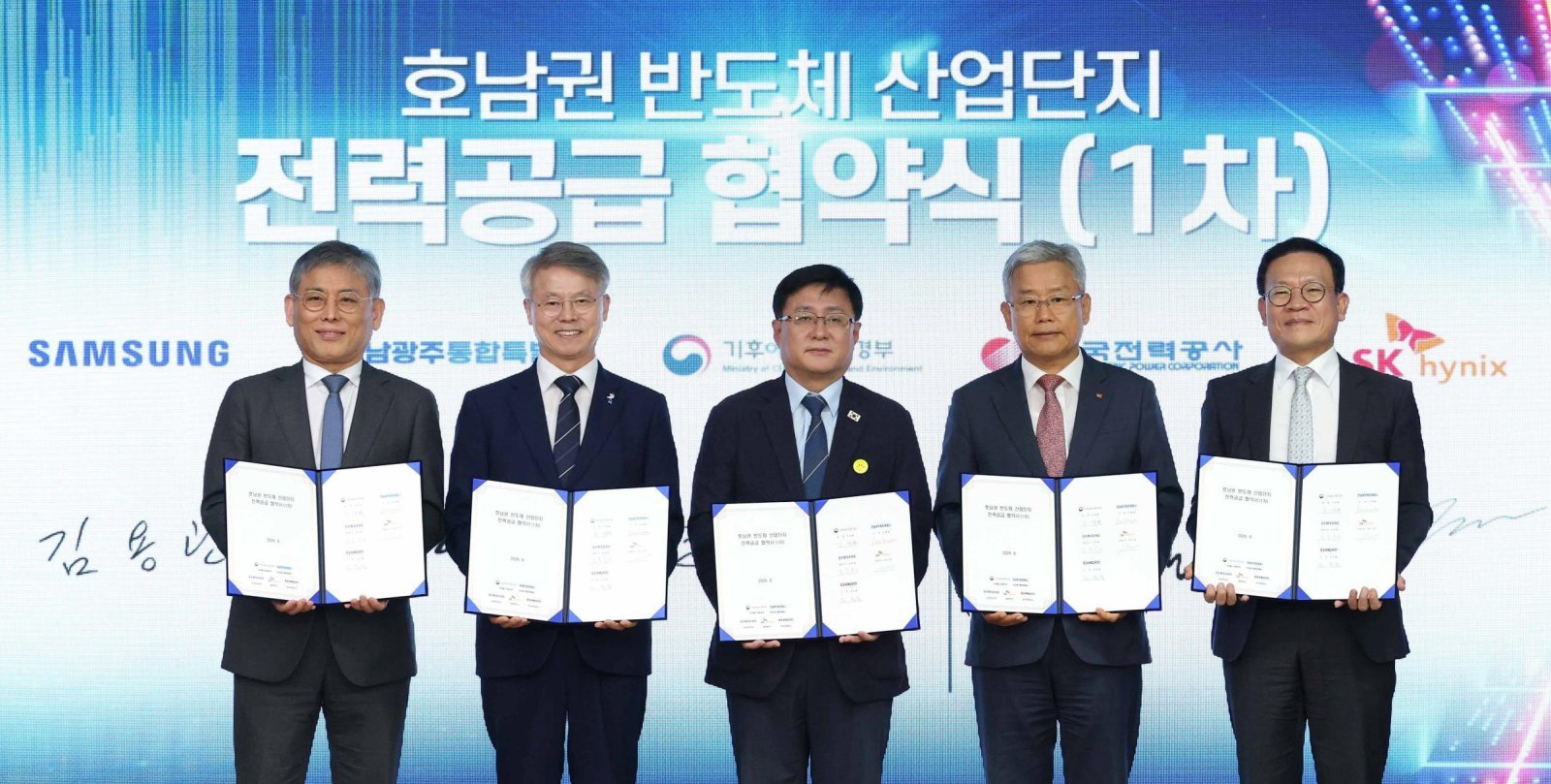
On the 12th, Korea Electric Power Corporation held the “Honam Region·Yongin Semiconductor Mega Project Power Supply Agreement Ceremony” at KEPCO’s Gyeongin Construction Headquarters and signed an agreement for the timely supply of power to semiconductor industrial complexes. Provided by Korea Electric Power Corporation
Korea Electric Power Corporation (President Kim Dong-cheol, hereinafter KEPCO) held the “Honam Region·Yongin Semiconductor Mega Project Power Supply Agreement Ceremony” at KEPCO’s Gyeongin Construction Headquarters on the 12th and signed an agreement for the timely supply of power to semiconductor industrial complexes.
The agreement ceremony was attended by the Ministry of Climate, Energy and Environment, Jeonnam-Gwangju Integrated Metropolitan City, Samsung Electronics, SK hynix and KEPCO, which concluded a total of three agreements: one for power supply to the Honam region semiconductor industrial complex, and two for power supply to the Yongin semiconductor national industrial complex and general industrial complex.
This has established an implementation basis for the timely power supply to the Honam region industrial complex and the Yongin national and general industrial complexes, which are core tasks of the “Korea Great Leap Forward: Three Mega Projects” announced on June 29.
Under this agreement, participating institutions agreed to fully mobilize their respective capabilities necessary for timely power supply. In particular, Jeonnam-Gwangju City, which joined the Honam region semiconductor industrial complex power supply agreement, decided to actively cooperate so that permits and approvals required for building power supply facilities can be processed expeditiously.
Power supply agreement for the Honam region semiconductor industrial complex
Power demand at the Honam region industrial complex is expected to reach more than 6 GW (gigawatts). Taking into account the timing required by companies, approximately 3 GW will first be supplied from 2029 through initial power supply facilities, and subsequently, after additional facilities are constructed, power of more than a cumulative 6 GW will be supplied to the Honam region complex.
For the Honam region complex, the power supply plan will first pursue branching from the Sinjangseong–Singwangju transmission line to connect into the complex, and any additional transmission lines will be specified based on detailed technical reviews and consultations with companies and relevant institutions. In addition, one substation will initially be built within the complex, followed by the construction of an additional substation at a later stage.
The initial power supply facility costs will be shared between the public and private sectors in proportion to their usage. For a portion of the private-sector contribution, the government plans to promote national fiscal support in accordance with the “Special Act on Semiconductor Industry Promotion,” which took effect on the 11th, following consultations with relevant ministries.
Power supply agreement for the Yongin semiconductor industrial complexes For the Yongin national industrial complex and general industrial complex, the announcement of the Three Mega Projects set a target of advancing the final fab completion timelines by seven and twelve years, respectively, in order to double memory production capacity within five years.
Under this agreement, some provisions of the power supply agreement for the Yongin general industrial complex signed in November 2024 were revised and supplemented, and a new agreement was concluded for Phase 2 power supply to the Yongin national industrial complex, thereby strengthening the framework for timely power supply.
In practice, the Yongin national and general industrial complexes are projected to generate large-scale power demand totaling more than 14 GW by 2041, starting with power supply to the general industrial complex in July 2026.
For the Yongin national industrial complex, power will be supplied in stages to a total of six fabs by 2041. In Phase 1, initial demand will be met by 2032 using short-distance transmission lines near the complex and three 1 GW-class LNG power plants within the complex that will replace aging coal-fired power plants. In Phase 2, by 2035, capacity on existing lines will be expanded to accommodate increasing demand. Ultimately, transmission lines will be constructed to carry generation from the East Coast and central regions, with details to be finalized through technical reviews and consultations with companies and relevant institutions.
For the Yongin general industrial complex, initial power will be supplied through a transmission line connecting the newly completed Sinanseong Substation (completed in July) to the Dongyongin Substation, and transmission lines near the complex will be built ahead of schedule between 2031 and 2032.
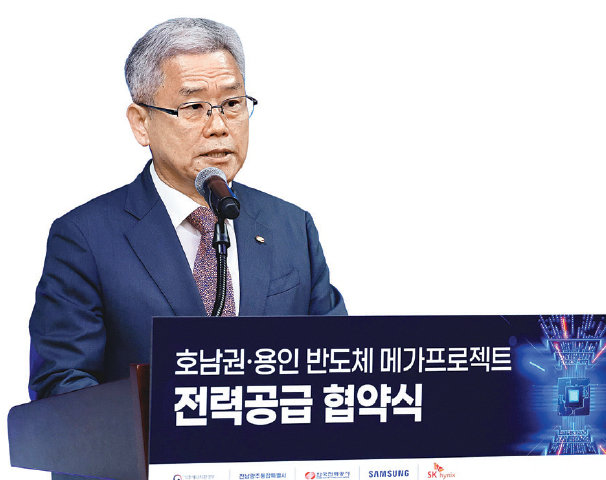
KEPCO President Kim Dong-cheol delivers remarks at the “Honam Region·Yongin Semiconductor Mega Project Power Supply Agreement Ceremony.”
Shortening construction schedules and securing public acceptance through power grid technology innovationKEPCO also plans to actively introduce new technologies and construction methods to ensure the timely supply of power to the Honam region semiconductor industrial complex, simultaneously shortening the power grid construction timeline and securing construction quality.
To overcome the limitations of conventional construction methods, KEPCO has established a “Power Grid Timely Construction Technology Innovation Plan.” Through this, it will fully introduce a range of new technologies and methods that can shorten construction periods, reduce project costs, and enhance public acceptance.
In particular, to enable the timely operation of the Honam region semiconductor complex, KEPCO has developed and is applying: △ a “trenchless construction method” that minimizes environmental damage by installing dedicated bridges in river-crossing sections; △ a “long-distance cable laying method” that reduces cable joints by increasing the distance that can be installed in a single operation; and △ the expanded application of “prefabricated underground power conduits,” thereby pursuing optimal measures to shorten construction schedules.
To ensure the quality and safety of these new technologies and methods, KEPCO plans to gradually expand their application based on sufficient technical verification and field demonstrations, thereby achieving both timely power grid construction and high-quality works.
In addition to shortening construction periods, KEPCO will also continue to pursue technological innovation to ensure safe construction of power facilities and secure public acceptance, including the introduction of “mechanized vertical shaft excavation equipment for underground power conduits,” which enables low-noise and vibration-free construction.
KEPCO President Kim Dong-cheol stated, “As the institution responsible for the national power infrastructure, KEPCO plans to concentrate all of its capabilities on supplying power in a timely manner in line with rising corporate power demand,” adding, “KEPCO will continue to drive technological innovation to support the success of the government’s mega projects and will focus all capabilities to ensure that the Honam region semiconductor complex is developed as planned.”
ⓒ dongA.com. All rights reserved. Reproduction, redistribution, or use for AI training prohibited.
Popular News