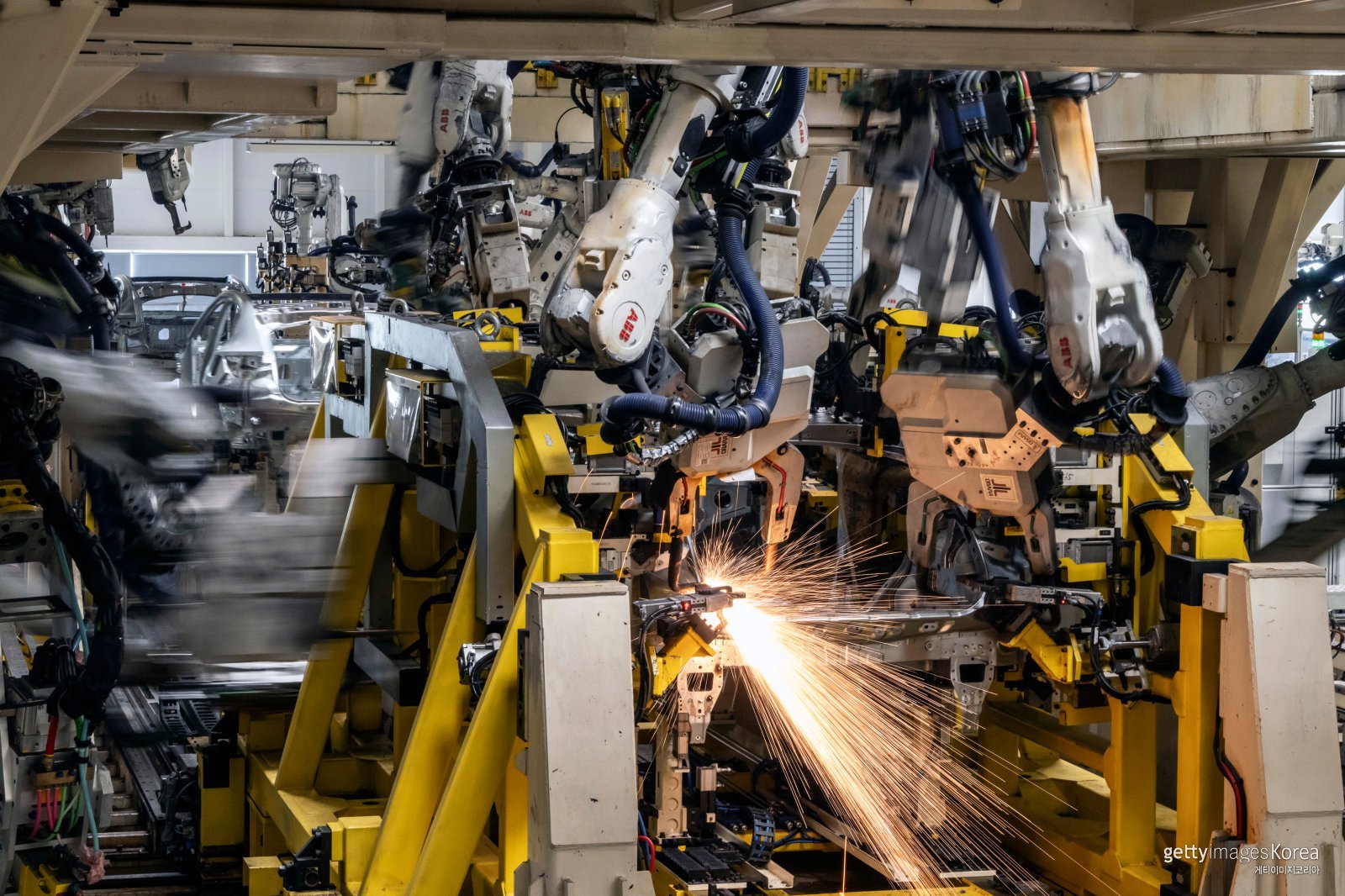
April 29, 2025. A robotic arm is operating on the body assembly line at a Zeekr plant. Photo=Getty Images Korea
Artificial intelligence (AI) is rapidly permeating manufacturing plants. AI is taking over a growing range of tasks, from repetitive work that converts documents into data, to worker safety management and logistics involving the transport of heavy materials.
The AI adoption rate in domestic manufacturing remains at around 4%, but as complete vehicle makers, parts suppliers, and logistics companies build and pilot AI systems one after another, AI transformation (AX) on the manufacturing floor is becoming more concrete.
● Reading documents, detecting risks… AI enters every corner of industrial sitesOne of the areas where AI is being adopted quickly is document processing. Korea Deep Learning announced on the 29th that it will participate in the AI implementation project for global automotive parts specialist Seoyon E-Hwa. This project is led by JisanSoft, with Konantech and Korea Deep Learning participating together.
Korea Deep Learning will supply AI optical character recognition (OCR) and parser solutions that convert unstructured documents into data. The core is to turn in-house documents accumulated in various formats such as PDF, images, Excel, and PowerPoint into data that can be searched and analyzed.
On manufacturing sites, information on processes and designs is often scattered across different types of files. If AI reads and structures this information as data, it can reduce repetitive tasks in which employees must manually check documents or re-enter information.
AI utilization has also begun in the field of safety management. Kia developed and introduced an “AI LOTO system” at Autoland Gwangju and has completed on-site verification. This system combines fingerprint- and NFC-based automatic authentication and a lock structure on safety door handles with an AI vision function that detects workers inside equipment.
When a worker is inside the equipment and an operation command is issued from outside, the system automatically blocks it. It compares access records with the actual number of people inside the equipment in real time and sends immediate alerts to prevent accidents. Kia plans to design this in a standard module form and expand its application to other plants and business sites.
AI technology adoption is also active in logistics sites. Hyundai Movex has introduced and is operating the digital safety management solution “Super Safe” at smart logistics equipment construction sites. It is a system that identifies and manages risk factors in the workplace in advance.
Hyundai Movex is also participating in a national R&D project to demonstrate in a U.S. shipyard a technology that autonomously transports large ship blocks in a shipyard. The project, which involves government support funding of KRW 19.0 billion, includes eight institutions such as Samsung Heavy Industries.
● Manufacturing AI adoption rate at 4%… why is diffusion slow?Although AI adoption cases at individual companies are increasing, AI transformation is still in its early stages across the manufacturing sector as a whole.
According to a report released last year by the Sustainable Growth Initiative (SGI) under the Korea Chamber of Commerce and Industry, the AI adoption rate of domestic companies stood at 6.4% as of 2023. In manufacturing, the rate was around 4%, showing a large gap compared with 26% in the information technology (IT) sector.
To introduce AI in manufacturing, existing production facilities must be connected with new systems, and high-quality data that AI can learn from and use for decision-making must be secured. Because production facilities and processes differ by company, it is difficult to resolve issues simply by adopting off-the-shelf AI services; separate system development also requires additional cost and time.
Nonetheless, the scope of areas where AI can be deployed on the shop floor is expected to continue expanding. While adoption to date has focused on relatively easy tasks such as document processing and data analysis, the application range is broadening into areas directly linked to actual operations, such as safety management, logistics, and production equipment.
The government is also accelerating AI transformation in manufacturing. It plans to promote “Manufacturing AX (AI Transformation)” by investing KRW 20 trillion through public-private cooperation by 2030, supporting AI adoption on the manufacturing floor and building the related ecosystem.
Minister of Trade, Industry and Energy Kim Jung-kwan stated, “AI transformation in manufacturing is a core task that will determine the future competitiveness and survival of our manufacturing industry,” adding, “Through the Manufacturing AX Alliance, the Ministry of Trade, Industry and Energy will support better decision-making by various stakeholders, thereby contributing to safer and more efficient manufacturing sites.”
ⓒ dongA.com. All rights reserved. Reproduction, redistribution, or use for AI training prohibited.
Popular News