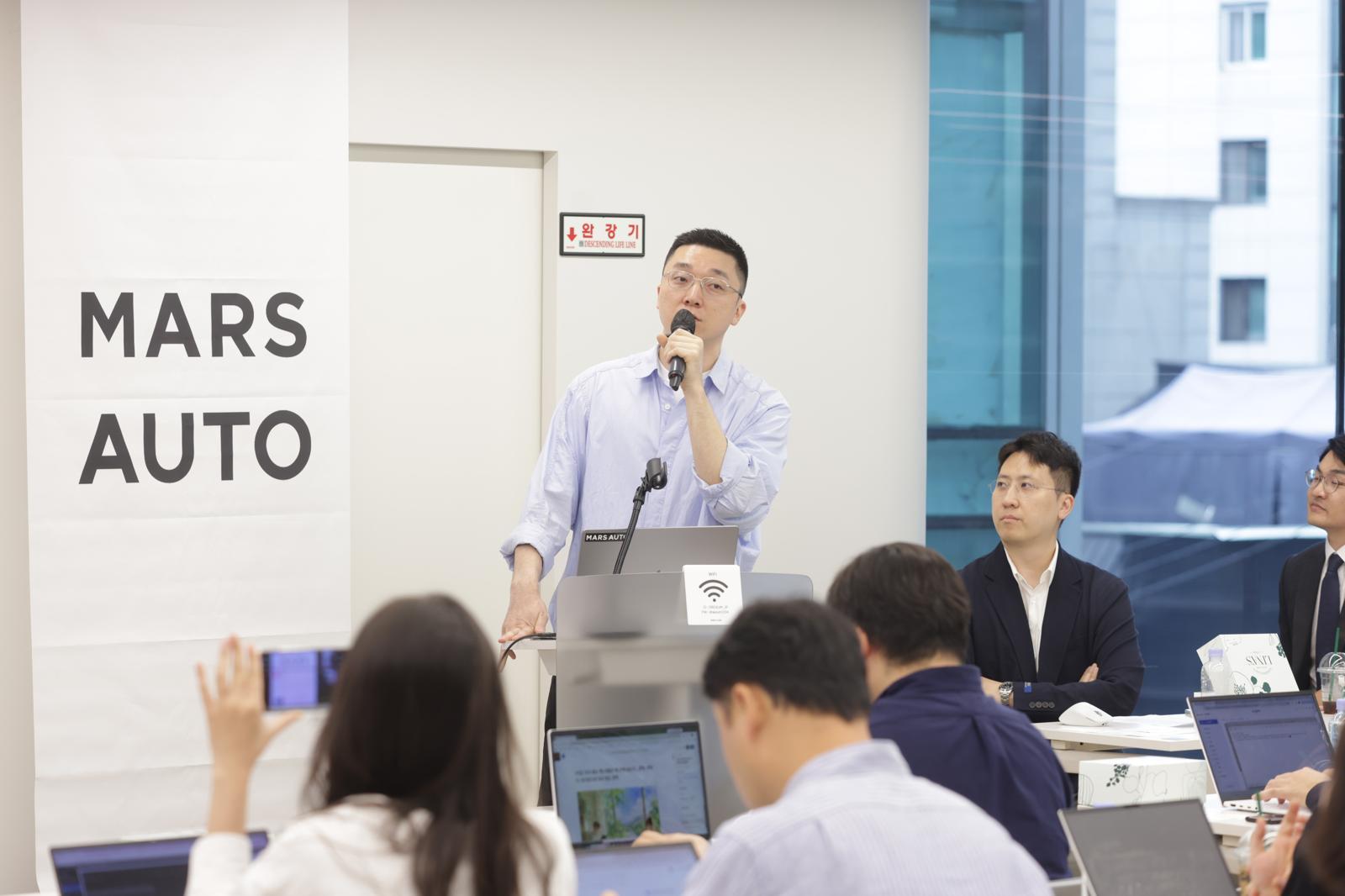
On 1 July, MarsAuto CEO Park Il-su presents the company’s E2E artificial intelligence (AI)-based autonomous driving technology and business strategy at a press briefing held at Dream co-working space in Gangnam-gu, Seoul. Photo courtesy of MarsAuto.
MarsAuto, a heavy truck autonomous driving startup, is launching the nation’s first autonomous trailer transport service.
At a press conference held on 1 July at the Dream co-working space in Gangnam-gu, Seoul, MarsAuto announced that it will begin the nation’s first paid autonomous trailer transport service in the third quarter of this year (July–September), leveraging its end-to-end (E2E – a method in which a vehicle’s artificial intelligence is responsible for both situational judgment and control) AI-based autonomous driving technology.
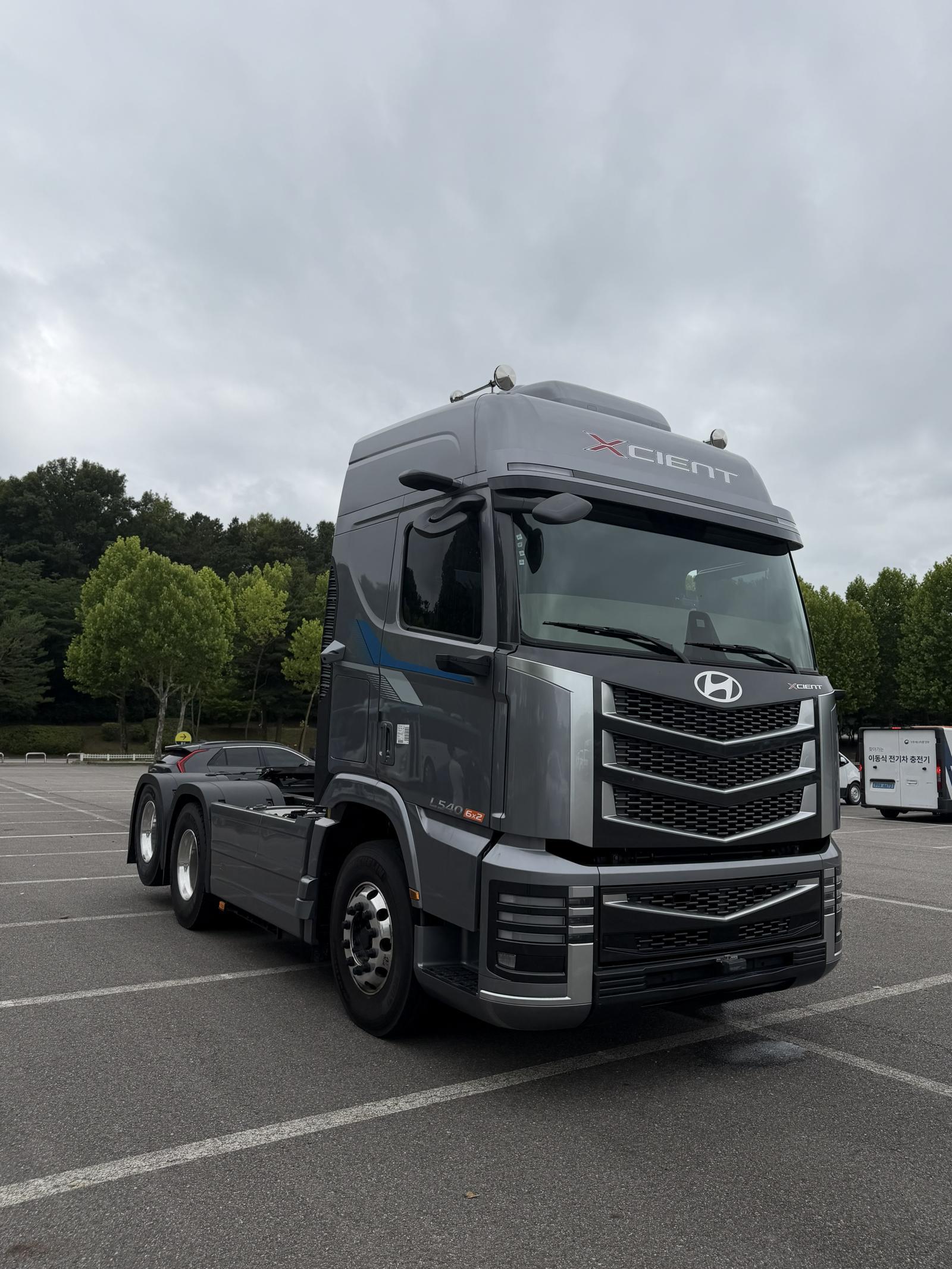
To begin with, the company will deploy Hyundai Motor’s Xcient-based autonomous trailers on routes transporting cargo from three client logistics centers in Asan, South Chungcheong Province; Cheonan, South Chungcheong Province; and Uiwang, Gyeonggi Province, to Busan Port. Although the departure points differ, a significant portion of the main highway sections leading to Busan Port overlap. MarsAuto plans to repeatedly operate on the same sections to accumulate autonomous driving data and then expand the operating range to other clients’ transport routes to Busan Port.
A Hyundai Motor Xcient-based trailer that MarsAuto plans to deploy in the third quarter of this year for the nation’s first paid autonomous transport service. Photo courtesy of MarsAuto.
MarsAuto also unveiled its next-generation Level 4 autonomous driving AI model “MarsNet3” on the same day. Level 4 refers to a stage where a vehicle can drive itself in designated areas without driver intervention. Unlike conventional autonomous vehicles that rely on pre-produced high-definition maps (HD maps), MarsNet3 operates by having vehicle-mounted cameras recognize lanes, signals, surrounding vehicles, and other elements in real time. It is characterized by the ability to drive autonomously not only on highways, which account for most long-haul freight transport, but also on regular roads connecting logistics centers and highways. After completing performance verification by the end of this year, the company plans to conduct beta testing on freight transport routes in the United States.
The company also introduced “CoPilot,” a subscription-based Level 2 (automated driving with a human responsible onboard) autonomous driving service for heavy truck drivers. CoPilot is a service in which AI supports optimal driving to reduce fatigue and fuel consumption for long-distance drivers. The company stated that pilot operations in Korea and overseas confirmed fuel cost savings of more than 10%.
Park Il-su, CEO of MarsAuto, said, “We will move away from traditional autonomous driving methods that cost several hundred million KRW per vehicle and build an economical and safe freight transport ecosystem using E2E AI technology that can be practically scaled in logistics operations,” adding, “By expanding autonomous trailer operations in Korea and the United States, we aim to achieve full unmanned operation of middle-mile long-distance freight transport by 2028.”
ⓒ dongA.com. All rights reserved. Reproduction, redistribution, or use for AI training prohibited.
Popular News