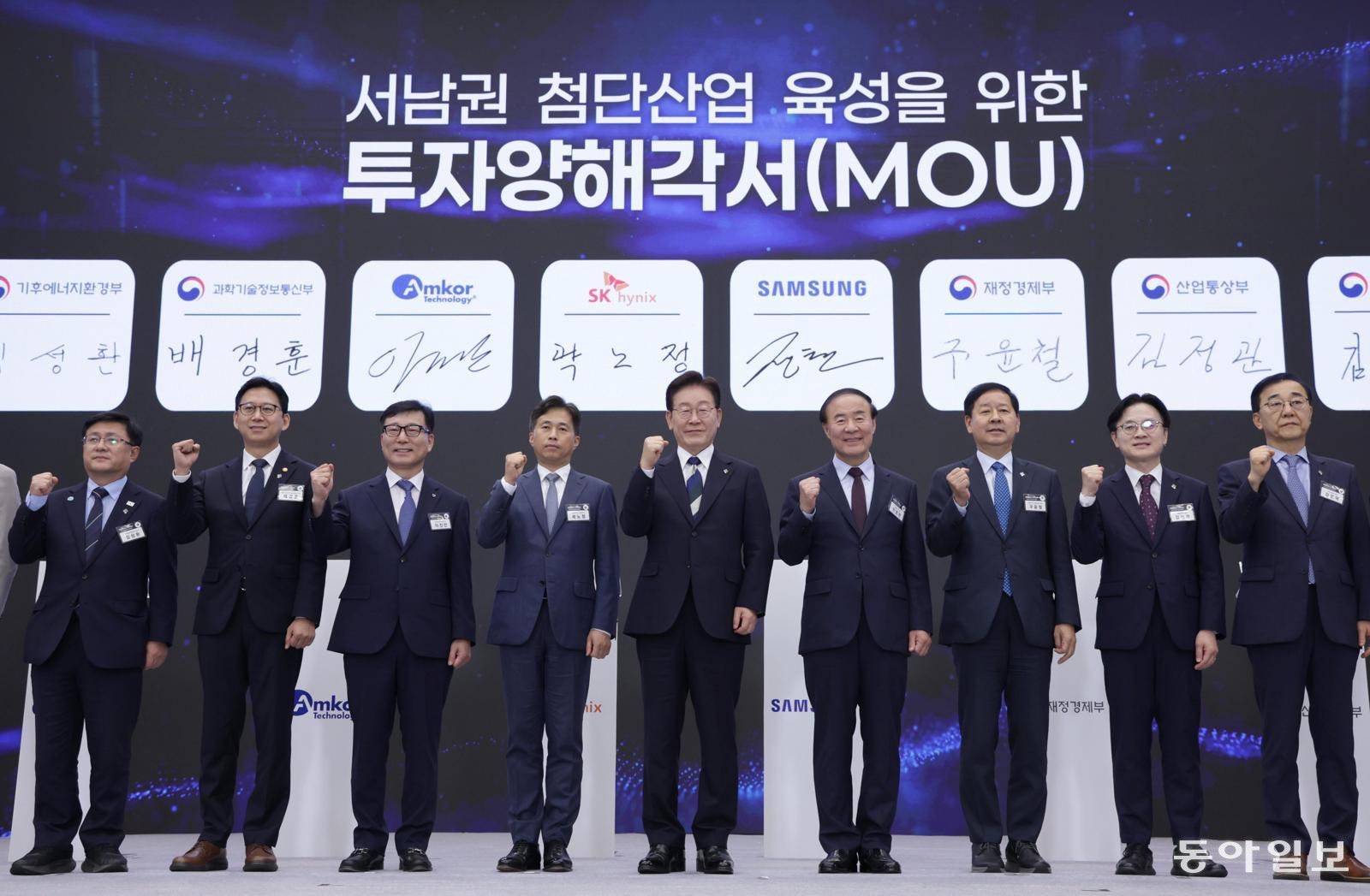
President Lee Jae-myung on the 30th poses for a commemorative photograph after concluding the signing ceremony for a “Memorandum of Understanding (MOU) on Investment for Fostering High-Tech Industries in the Southwest Region” with attendees including Kwak Noh-jung, CEO of SK hynix, Jun Young-hyun, Vice Chairman and CEO of Samsung Electronics, and Lee Jin-an, CEO of Amkor Technology Korea, at the Kimdaejung Convention Center in Seo-gu, Gwangju./2026.6.30. Kim Jae-myung, Reporter base@donga.com
The government will establish a Presidential Commission on Semiconductors, a special committee directly under the President that will serve as a pan-government control tower to support the approximately KRW 900 trillion high-tech industry investment plan in the southwest region announced by Samsung Electronics, SK and others. The government will cover up to 100% of the costs for building key infrastructure, such as power and water supply, and will shorten the development period for semiconductor clusters (industrial complexes) to within five years, about half the current duration. In addition, it will push forward a package of regulatory easing, tax incentives, and talent development to foster the southwest region as a second semiconductor production base following Yongin.
On the 30th, the Ministry of Trade, Industry and Energy held the “National Briefing on the Vision for High-Tech Industry Development in the Southwest Region” at the Kimdaejung Convention Center in Gwangju and announced the “Strategy for Fostering High-Tech Industries in the Southwest Region.” This strategy details the government’s support measures in line with the investment plan totaling KRW 895 trillion announced by Samsung Electronics and SK hynix for the construction in Gwangju of four front-end semiconductor fabrication plants (fabs) and an artificial intelligence (AI) data center, with investments of KRW 425 trillion and KRW 470 trillion, respectively.
First, in accordance with the Special Act on Semiconductors, a Semiconductor Special Committee, chaired by the President, will be established, and within the Ministry of Trade, Industry and Energy, a working-level body called the Semiconductor Innovation Growth Support Team will be formed. The special committee will coordinate various issues that may arise among relevant ministries during the implementation of high-tech industry investments in the southwest region. The support team will draw up detailed support plans for power and water supply, industrial complex development, and permits and approvals, aligned with each company’s investment schedule, and report them to the special committee.
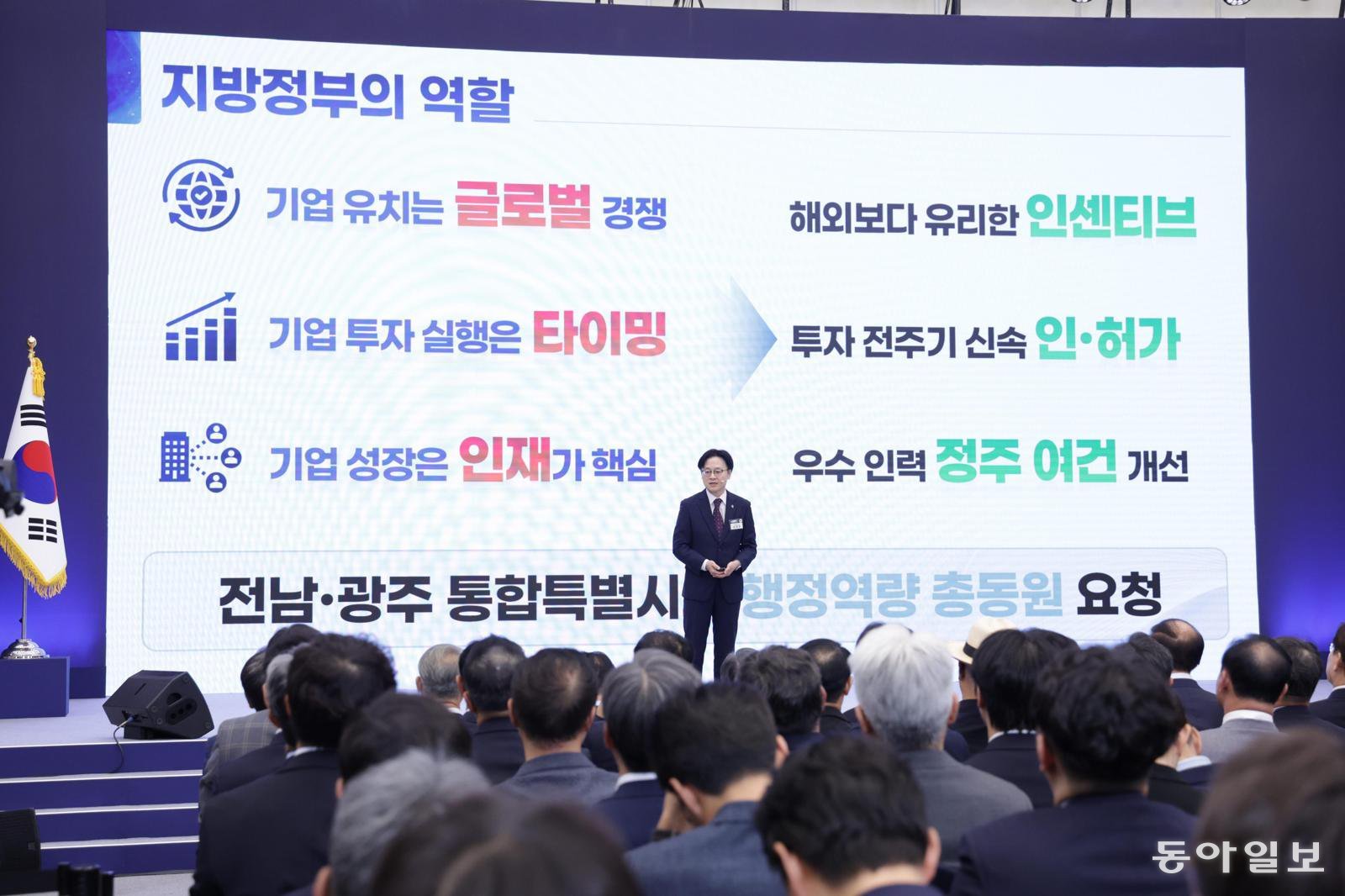
Kim Jeong-gwan, Minister of Trade, Industry and Energy, delivers a presentation at the National Briefing on the Vision for High-Tech Industry Development in the Southwest Region held at the Kimdaejung Convention Center in Seo-gu, Gwangju, on the 30th./2026.6.30. Kim Jae-myung, Reporter base@donga.com
It is estimated that the Gwangju semiconductor industrial complex will require about 650,000 tons of industrial water per day. According to the Ministry of Climate, Energy and Environment, approximately 1.06 million tons per day can be secured by utilizing water from the Dongbok, Juam, Jangheung, Boseong River, and Naju dams, as well as reclaimed water regenerated by treating domestic wastewater (reuse of wastewater).
Given the 24-hour operation of semiconductor plants, the timely construction of power generation facilities and transmission networks to ensure a stable power supply is essential. The government plans to draw up specific measures, including the construction of new nuclear power plants and the expansion of transmission networks, and incorporate them into the 12th Basic Plan for Long-term Electricity Supply and Demand, which is scheduled to be released at the end of this year.
The development period for industrial complexes, which typically takes around 10 years, will be shortened by more than half to a target of within five years. The government also plans to cultivate semiconductor specialists through an “Arm School” that will train 1,400 professionals in semiconductor design and through semiconductor engineering colleges in the southern region.
Measures to create an environment conducive to corporate investment will be promoted in parallel. Under the proposed Mega-Special Economic Zone Act, which the government is working to enact, at least one mega-special economic zone will be designated in the southwest region to resolve, in a one-stop manner, various regulations arising in the course of corporate investment. In particular, the government will assume up to 100% of the costs for building key infrastructure such as power and water supply and introduce differentiated tax regimes by region for companies and workers.
At the briefing, Minister of Trade, Industry and Energy Kim Jeong-gwan stated, “Now that companies have decided to invest, it is time for the central and local governments to respond to that call,” adding, “The government will not stop until corporate commitments become reality and a new heart of Korean industry beats powerfully.”
ⓒ dongA.com. All rights reserved. Reproduction, redistribution, or use for AI training prohibited.
Popular News