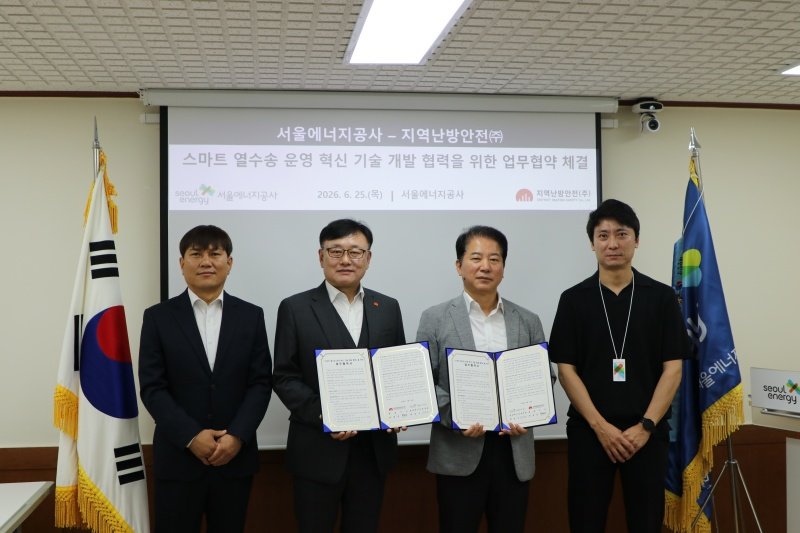
(From left) Jeon Il-pyo, Head of Project Management Office at District Heating Safety, CEO Park Young-jin, Kwak Seung-shin, Head of the District Energy Division at Seoul Energy Corporation, and Choi Soo-geun, Head of Heat Transmission Technology Department. Photo courtesy of District Heating Safety
As underground heat transmission pipelines age, technologies that can detect invisible risks in advance and prevent major accidents are becoming more important than ever. “Data-based smart safety management,” which detects early signs of water leaks or pipeline damage, is an essential task to protect citizens’ everyday safety.
Against this backdrop, District Heating Safety Co., Ltd. announced that on the 25th it signed a “Memorandum of Understanding (MOU) for the Development, Demonstration, and Commercialization of Smart Heat Transmission Operation Innovation Technology” with Seoul Energy Corporation. The signing ceremony, held at Seoul Energy Corporation’s headquarters, was attended by Kwak Seung-shin, Head of the District Energy Division at Seoul Energy Corporation, CEO Park Young-jin of District Heating Safety, and other officials from both sides.
The agreement is significant in that it goes beyond simple technology exchange to jointly verify, in real operating environments, the on-site applicability and commercialization potential of smart safety management technologies. The two institutions will fully launch a pilot project targeting aging and underground heat transmission pipelines to detect abnormal signs at an early stage and enable continuous monitoring.
The project focuses on moving away from the existing post-accident, recovery-centered management approach to building a proactive “prevention-centered management system.” Unlike past methods that applied individual technologies separately, this is an integrated cooperation model that links and validates various advanced diagnostic technologies within a single operational framework.
Under the MOU, the two organizations will combine their core capabilities. District Heating Safety will apply its self-developed IoT-based heat transmission pipeline leak monitoring terminals at demonstration sites. The devices collect real-time data on pipeline temperature, pressure, and flow, and the accumulated data are used through AI learning to assess pipeline integrity and predict potential damage. In addition, District Heating Safety will oversee the establishment of a smart diagnostic platform and provision of solutions, including the development of an “acoustic-based IoT leak location estimation algorithm” using differences in acoustic wave arrival times, and full-section imaging and analysis with drone-mounted thermal cameras.
Seoul Energy Corporation will provide a solid foundation for successful demonstration. It will select pilot complexes and demonstration sections, and supply essential materials for facility diagnostics, such as heat transmission pipeline drawings and records of vulnerable sections. It will also designate target facilities for the development of smart operation technologies for heat-using facilities, provide administrative support, share on-site information including past leak cases, and offer technical advisory services.
A District Heating Safety official stated, “Heat transmission pipelines are core infrastructure closely connected to citizens’ daily lives,” adding, “We will continue to develop technologies that combine IoT continuous monitoring with drones and acoustic technologies to detect risks at an early stage and enhance the efficiency of maintenance and management.”
ⓒ dongA.com. All rights reserved. Reproduction, redistribution, or use for AI training prohibited.
Popular News