Fully equipped production facilities from raw materials to modules Set to receive KRW 1 trillion in U.S. solar tax credits
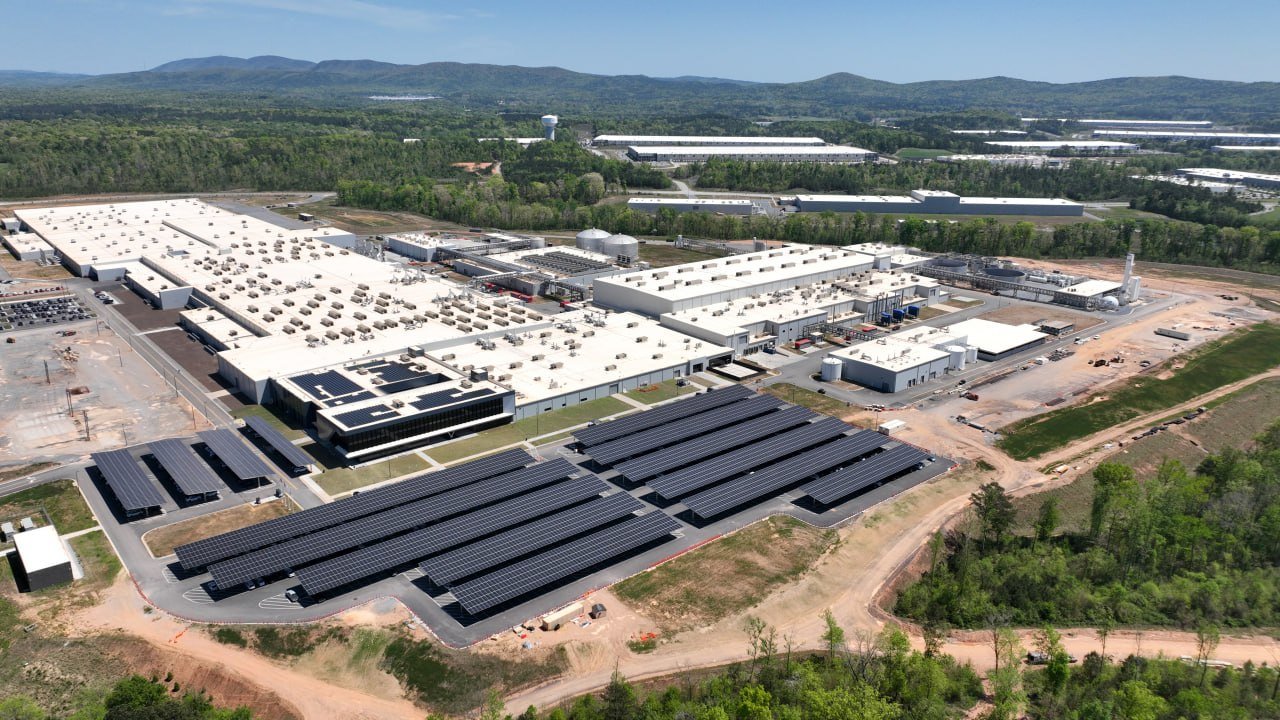
Hanwha Qcells, the solar division of Hanwha Solutions, has completed the cell production line at its Cartersville plant in Georgia, United States, and confirmed the start of mass production in July. With the completion of vertical integration across the solar value chain in the United States for the first time, expectations are rising that the presence of Korean solar companies in the U.S. market will expand.
Hanwha Qcells announced on the 10th (local time) that it had completed the Cartersville plant. It finalized inspections of equipment required for mass cell production by May and is currently conducting test operations. From July, it plans to begin mass production of solar modules, the final-stage product, using cells manufactured at the Cartersville plant.
The solar value chain proceeds in the following order: polysilicon (raw material) → ingot (block of polysilicon) → wafer → cell (solar cell) → module (bundle of cells). The Cartersville plant is the only production facility in the United States that has vertically integrated this entire solar value chain. After sequentially bringing ingot, wafer and module production facilities online, the company has now completed the value chain with the launch of the cell production facility. As a result, Hanwha Qcells’ production capacity in the United States has increased to 3.3GW (gigawatts) each for ingots, wafers and cells, and 8.6GW for modules. This is the largest scale among manufacturers of silicon-based solar modules in North America.
With the completion of the Cartersville plant, Hanwha Qcells is also expected to see an increase in the Advanced Manufacturing Production Credit (AMPC) it receives in the United States. The U.S. government grants tax credits for domestically produced solar products. Hanwha Qcells expects to receive AMPC of USD 675 million (about KRW 1.028 trillion) this year. As production volumes increase, it projects this will grow to USD 879 million in 2027, USD 929 million in 2028, and USD 1.1 billion in 2029. In the United States, investment in solar facilities linked with energy storage systems (ESS) is increasing in line with the expansion of artificial intelligence (AI) data centers.
By establishing a local production system, Hanwha Qcells has positioned itself to minimize the impact of U.S.-origin tariffs going forward. In addition, as the U.S. government pursues policies to exclude Chinese-made solar products, the company also expects to benefit from resulting business opportunities.
According to industry sources, the U.S. government is highly likely to announce this month the results of an investigation under Section 232 of the Trade Expansion Act. Once the ongoing probe into semiconductors and derivative products is concluded, the prevailing view is that additional sanctions will be imposed on the Chinese polysilicon supply chain. In that case, Korean solar companies that have built polysilicon supply chains outside China stand to gain.
Park Jong-min
AI-translated with ChatGPT. Provided as is; original Korean text prevails.
ⓒ dongA.com. All rights reserved. Reproduction, redistribution, or use for AI training prohibited.