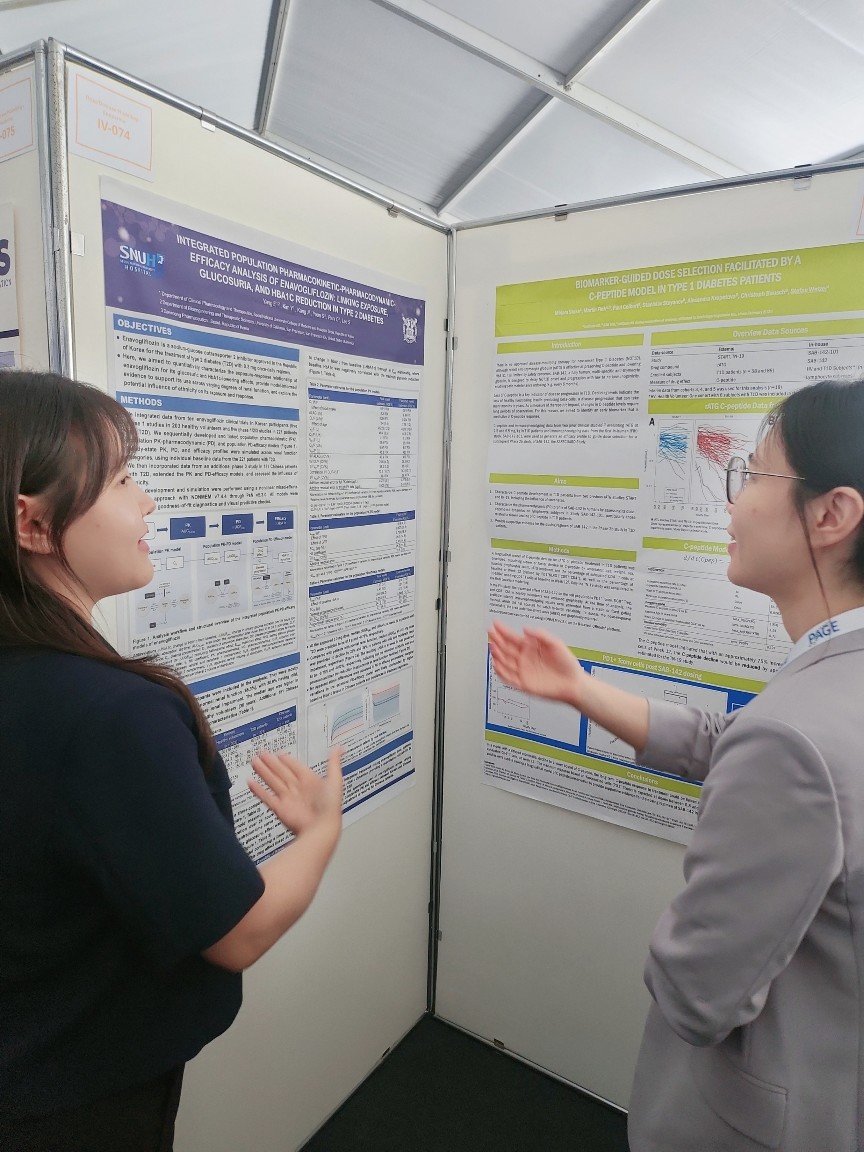
Daewoong Pharmaceutical clinical researcher Yoon Seoyeon explains the integrated model-based study results for Enblo to visitors. Provided by Daewoong Pharmaceutical
Daewoong Pharmaceutical announced on the 8th that it had presented research results analyzing the relationship between drug exposure and blood glucose-lowering efficacy of the type 2 diabetes treatment Enblo at the European Population Pharmacokinetics and Pharmacodynamics Society.
From 2 to 4 June, Daewoong Pharmaceutical presented in a poster session at “2026 PAGE (Population Approach Group Europe)” the results of a study analyzing the relationship between increased urinary glucose excretion after Enblo administration and the reduction in glycated hemoglobin (HbA1c).
Enblo is a type 2 diabetes treatment developed by Daewoong Pharmaceutical belonging to the SGLT-2 inhibitor class, with the generic name inavogliflozin. It has been approved in Korea as the 36th domestically developed new drug. It works by inhibiting the reabsorption of glucose in the kidneys, promoting excretion of glucose in the urine and thereby lowering blood glucose levels.
In this study, Enblo’s systemic drug exposure, urinary glucose excretion, and HbA1c change data were linked within a single mathematical model. The researchers quantitatively analyzed how much urinary glucose excretion increases after the drug is absorbed into the body, and how this change affects the reduction of HbA1c, a long-term blood glucose indicator.
The research team integrated and analyzed data from 224 subjects obtained in 10 clinical trials conducted in Korean participants and Phase 3 clinical data from 151 Chinese patients with type 2 diabetes.
The analysis showed that the greater the increase in urinary glucose excretion after Enblo administration, the greater the HbA1c-lowering effect. The study model also predicted that a certain level of blood glucose-lowering effect would be maintained even in patients with impaired renal function.
However, these results are based on integrated mathematical modeling of data collected from multiple clinical trials, and clinical data from actual patients must also be considered to assess treatment efficacy and safety by level of renal function.
No significant differences were identified in pharmacokinetic characteristics, including systemic exposure and excretion of Enblo, between Korean and Chinese patients. Daewoong Pharmaceutical regards this as evidence that the same approved dose in Korea, 0.3 mg, can be applied to Chinese patients as well.
Daewoong Pharmaceutical plans to utilize these analysis results in overseas approval procedures, including in China, and in further clinical development.
Lead researcher Professor Lee Seunghwan of the Department of Clinical Pharmacology at Seoul National University Hospital stated, “We quantitatively described Enblo’s absorption and metabolism in the body, urinary glucose excretion, and HbA1c-lowering effect by linking them in a single integrated model,” adding, “This provides a basis for understanding the clinical characteristics of Enblo in type 2 diabetes patients with varying degrees of renal function.”
Na Jaejin, Head of the Clinical Medicine Center at Daewoong Pharmaceutical, said, “We confirmed consistent pharmacokinetic characteristics in Korean and Chinese patients,” and added, “We plan to use the study results for entry into overseas markets, including Asia, and for subsequent clinical development.”
PAGE is an international academic conference in the field of quantitative pharmacology, which analyzes the processes of absorption, distribution, metabolism, and excretion of drugs in the body using mathematical models. At last year’s PAGE, Daewoong Pharmaceutical presented a population pharmacokinetic model analyzing Enblo’s absorption and excretion in the body. This year, it additionally released an analysis linking drug exposure, urinary glucose excretion, and HbA1c changes.
ⓒ dongA.com. All rights reserved. Reproduction, redistribution, or use for AI training prohibited.
Popular News