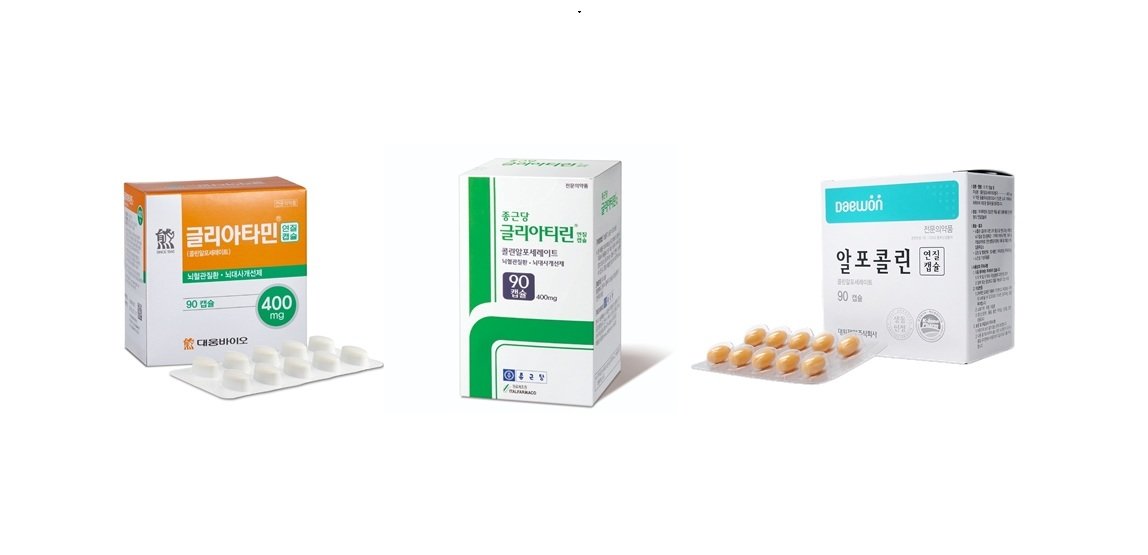
Choline alfoscerate product group.
Results of a clinical re‑evaluation conducted to verify the efficacy of the prescription‑only active ingredient “choline alfoscerate,” which has been used to treat mild cognitive impairment and to improve brain function, have recently been released, drawing renewed attention to the substance’s effects. Although choline alfoscerate has been widely prescribed, debate has continued over its actual therapeutic benefit. The government has implemented a selective reimbursement measure that raises the patient co‑payment rate to 80% for indications such as mild cognitive impairment, where effectiveness is in dispute. Only prescriptions for dementia patients continue to receive existing National Health Insurance coverage.
Mild cognitive impairment is defined as a pre‑dementia stage in which some cognitive functions have declined, but the patient retains a substantial degree of ability to perform activities of daily living. Because symptoms progress slowly and vary widely among patients, it is regarded as a disease for which proof of efficacy is relatively difficult.
Accordingly, under the leadership of the Ministry of Food and Drug Safety (MFDS), a large‑scale clinical re‑evaluation to definitively verify the drug’s efficacy has been underway since 2020.
According to industry sources on the 5th, in the recently submitted clinical re‑evaluation results for choline alfoscerate, the primary endpoints (such as rate of maintenance and improvement of cognitive function), which are the core criteria for demonstrating efficacy, failed to show statistical significance. However, additional analyses and real‑world data–based cohort studies observed that long‑term administration partially reduced the risk of progression to dementia or improved cognitive function. It was also reported that the longer the treatment period and the higher the medication adherence, the greater the degree of symptom improvement tended to be. The trial was conducted on a total of 852 patients, including 426 patients each with degenerative mild cognitive impairment and vascular mild cognitive impairment.
Limits to evaluating symptom improvement in mild cognitive impairment with a 48‑week trial
In particular, the study was designed as a 48‑week clinical trial, and the pharmaceutical and medical communities argue that for diseases such as mild cognitive impairment, where changes are small and progression is slow, a short‑term trial is limited in its ability to evaluate efficacy. The view is that the short duration makes it difficult to meet key endpoint criteria.
Specifically, in the primary analysis of all enrolled patients, the choline alfoscerate group showed better outcomes than the placebo group. However, it fell short of the pre‑specified statistical criteria for the primary endpoints. In other words, it did not meet the thresholds for determining clinical trial success. Nevertheless, an analysis of the per‑protocol set (PPS) of patients who adhered to the trial protocol and took the medication above a certain level reportedly yielded statistically significant effects.
According to PPS analysis by Chong Kun Dang, the proportion of patients whose cognitive function was maintained or improved was 67.83% in the choline alfoscerate group and 60.07% in the placebo group. The treatment group’s rate was 7.76 percentage points higher, with a p‑value of 0.0482, meeting the standard for statistical significance of less than 0.05.
PPS analysis is considered advantageous in that it allows a more intuitive assessment of the effect when the drug is taken as prescribed. However, because it excludes patients who did not take the drug properly or dropped out of the trial, results can appear more favorable than analyses based on the full analysis set. The MFDS plans to review the full set of result reports from all participating pharmaceutical companies and assess the validity of secondary endpoints and related data.
Professor Lee Jae‑hong of the Department of Neurology at Asan Medical Center in Seoul explained, “It is not easy to evaluate maintenance or improvement of cognitive function over 48 weeks in patients with mild cognitive impairment whose cognitive function is relatively well preserved,” adding, “Even in the early stages of Alzheimer’s dementia, a minimum follow‑up of 18 months (78 weeks) is typically required as a standard for primary efficacy evaluation.”
High prescribing demand but persistent calls for proof of efficacy: a dilemma
Choline alfoscerate is an active ingredient that helps generate acetylcholine, a neurotransmitter involved in memory and learning. In Korea, it has been prescribed to improve memory impairment, confusion, loss of motivation, and reduced concentration caused by cerebrovascular disease or degenerative brain disease.
However, despite the annual domestic prescription volume having grown to several hundred billion KRW, it has not been widely used in major overseas treatment guidelines. Criticism has arisen that large amounts of National Health Insurance funds were being spent without sufficient large‑scale clinical trials to prove efficacy.
This is a key reason why, in 2020, the MFDS required pharmaceutical companies to re‑demonstrate efficacy through clinical trials. Chong Kun Dang has been conducting trials in patients with degenerative and vascular mild cognitive impairment, while Daewoong Bio is separately conducting trials in dementia patients. The latest results relate to the trials conducted by Chong Kun Dang. The dementia‑patient trial undertaken by Daewoong Bio is still underway.
The pharmaceutical industry argues that the specific characteristics of the disease should be more precisely reflected when setting key clinical endpoints. For example, many mild cognitive impairment patients, despite having reduced memory and other functions, are still capable of daily activities, and the rate of progression to dementia varies greatly from patient to patient. As a result, they say, it is difficult to prove efficacy that meets endpoint criteria within a short trial period.
Some observers suggest that the new Alzheimer’s drug “Leqembi” (ingredient name: lecanemab), which has been approved by the U.S. Food and Drug Administration (FDA), could serve as a substitute for choline alfoscerate. However, Leqembi demonstrated statistically significant benefit over placebo on the Clinical Dementia Rating–Sum of Boxes (CDR‑SB), a key endpoint that evaluates the degree of decline in cognitive function and ability to perform daily activities. After 18 months, the difference in score change between the two groups was 0.45 points, corresponding to a 27% reduction in disease progression compared with placebo. There has, nonetheless, been ongoing debate over whether a 0.45‑point difference represents a change that patients and caregivers can clearly perceive in daily life. Even so, analysts note that in the early dementia space, the very effect of slowing disease progression, rather than the absolute change in evaluation scores, has been recognized as having therapeutic significance in the assessment. They also point out that Leqembi was approved on the basis of a 78‑week, not a 48‑week, clinical trial.
Viewed under such standards, the latest clinical re‑evaluation of choline alfoscerate is assessed as having clinical significance in that it confirmed statistically meaningful improvement in the PPS population, which adhered to medication criteria, and in secondary endpoints even over a relatively short period.
Professor Kwon Soon‑eok of the Department of Neurology at Asan Medical Center in Seoul also commented, “These results suggest that if long‑term clinical trials are conducted, the effects of choline alfoscerate on maintaining and improving cognitive function may become more pronounced.”
In the case of Leqembi, while its significance lies in being a therapy with a novel mechanism of action, it has limitations in terms of cost burden and patient access, separate from its treatment effect. In Korea, it is prescribed on a non‑reimbursed basis and is reported to cost around KRW 30 million per year. In addition, because it is administered intravenously, patients must visit hospitals repeatedly.
Limited alternatives to choline alfoscerate… “Need to consider practical value”
The pharmaceutical industry argues that, given these circumstances, the practical value of choline alfoscerate must also be considered. As an oral formulation, it offers high convenience in administration and, even after the introduction of selective reimbursement, the cost burden remains lower than that of other high‑priced new drugs. The view is that, at a time when antibody therapies cannot realistically serve as an option for all patients, an oral treatment option suitable for long‑term administration has important significance in the management of patients in the pre‑dementia stage.
In addition, ginkgo biloba preparations and nicergoline are also used in some patients, but they have limitations in terms of target patient groups and clinical evidence. By contrast, choline alfoscerate is increasingly regarded in clinical practice as one of the major treatment options that can be used at the bedside, as clinical and real‑world evidence accumulates. Long‑term data are also assessed as supporting this.
An industry official stated, “Dementia and mild cognitive impairment progress slowly and present with highly varied patterns in each patient, so it is difficult to accurately assess the value of a therapy based on a single clinical endpoint,” and emphasized, “Not all patients can receive high‑cost injectable treatments, so it is necessary to evaluate the accessibility and long‑term use experience of existing oral therapies in parallel.” The official added that, at this point, what is most needed is a treatment option that is realistically feasible for patients in the pre‑dementia stage in a super‑aged society.
Some point out that other dementia treatments such as donepezil, rivastigmine, and galantamine exist, so choline alfoscerate cannot be described as having no alternatives. Nevertheless, since the target populations and approved indications differ, there is an emerging view that the need for choline alfoscerate should be recognized from the perspective of securing a range of treatment options.
ⓒ dongA.com. All rights reserved. Reproduction, redistribution, or use for AI training prohibited.
Popular News