Louisiana FLNG Unit 1 Project Overseeing the entire cycle from financing and construction to operation
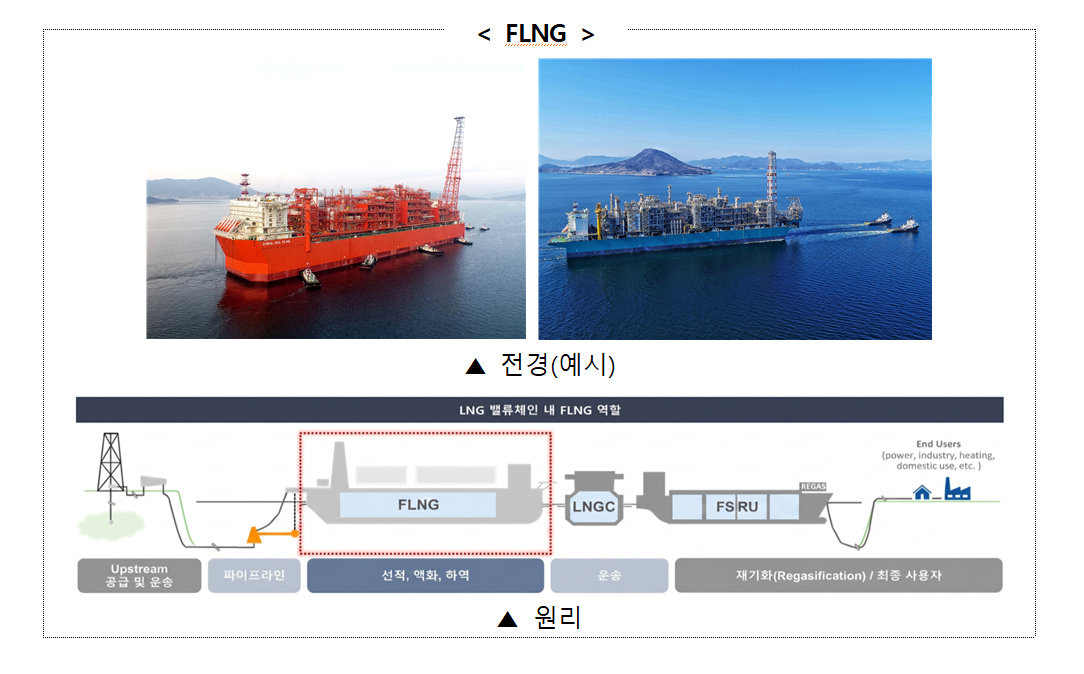
The Ministry of Land, Infrastructure and Transport (Minister Kim Yoon-duk), the Ministry of Climate, Energy and Environment (Minister Kim Sung-hwan), and the Ministry of Oceans and Fisheries (Minister Hwang Jong-woo) announced on the 4th that “Team Korea,” a coalition of the government, corporations, and public institutions, successfully won an order on the 1st (local time) for the construction of the first U.S. Louisiana FLNG (Floating Liquefied Natural Gas) offshore plant, valued at USD 2.8 billion (approximately KRW 4 trillion). The photo shows an example and principle of an FLNG project. 2026.06.04 Provided by the Ministry of Land, Infrastructure and Transport
The Korean government, public institutions, and private companies together have secured an offshore plant project in the United States worth approximately KRW 4 trillion.
On the 4th, the Ministry of Land, Infrastructure and Transport announced, together with the Ministry of Climate, Energy and Environment and the Ministry of Oceans and Fisheries, that it won an order on the 1st (local time) for the construction of the first floating liquefied natural gas facility (FLNG) offshore plant in Louisiana, United States. FLNG is a facility constructed at domestic shipyards and installed in local waters to liquefy, store, and offload natural gas produced from gas fields.
The project is designed to produce 4.4 million t of liquefied natural gas (LNG) per year in waters about 74 km off the coast of Louisiana. The total project cost is USD 4.8 billion (approximately KRW 7 trillion), of which Samsung Heavy Industries has won USD 2.8 billion (approximately KRW 4 trillion) for EPC (engineering, procurement, and construction). The construction period is five years, and the operation period is 25 years.
Korean companies’ eco-friendly design technologies will also be applied to this project. Representative examples include selective catalytic reduction, which reduces emissions by converting nitrogen oxides contained in exhaust gas after fuel combustion into nitrogen and water, and waste heat recovery boilers, which maximize energy reuse by recovering discarded waste heat and using it to produce steam and electricity.
According to the government, this project is an investment-development type that encompasses the entire process, including financing, construction, and operation. A total of USD 150 million (approximately KRW 220 billion) was invested by the Korea Overseas Infrastructure & Urban Development Corporation (KIND), the Green Fund, and the Korea Ocean Business Corporation in a fund led by global asset manager BlackRock.
Kim Eun-ji 기자 eunji@donga.com
AI-translated with ChatGPT. Provided as is; original Korean text prevails.
ⓒ dongA.com. All rights reserved. Reproduction, redistribution, or use for AI training prohibited.