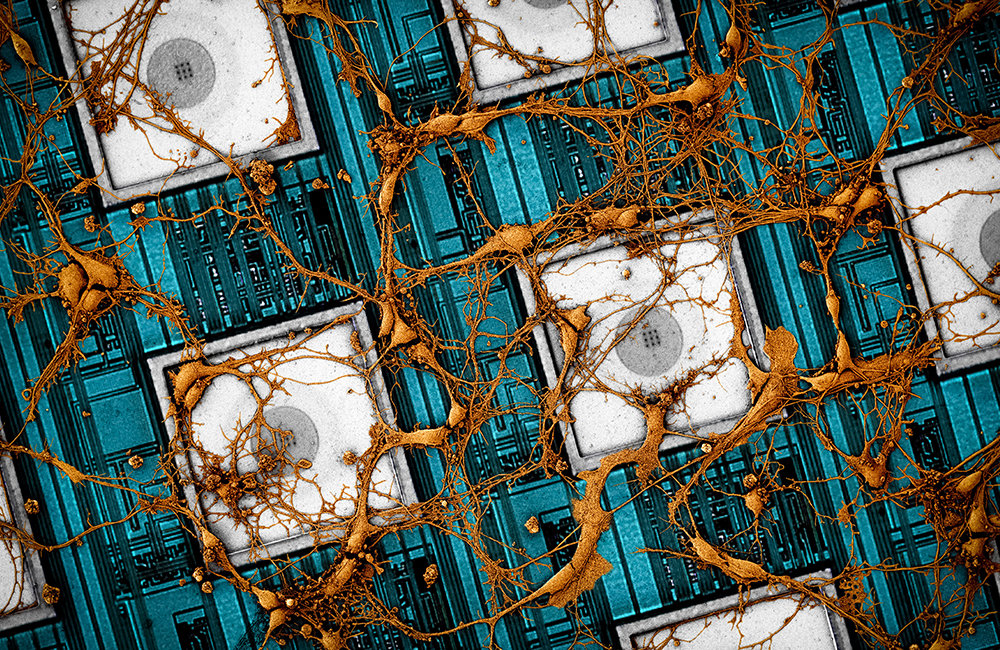
An image related to neuromorphic semiconductors from the paper “Neuromorphic electronics based on copying and pasting the brain” published in Nature Electronics in 2021. Provided by Samsung Electronics
20W versus 1,000W.
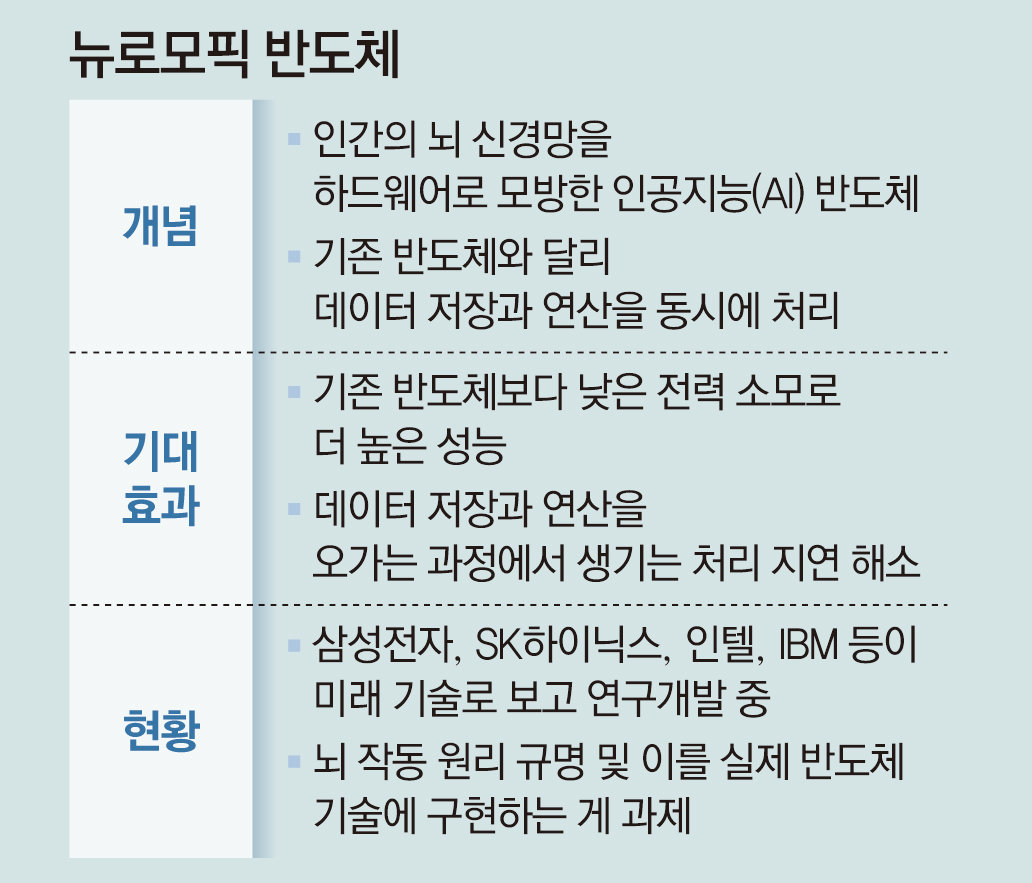
This is the power gap between the human brain and Nvidia’s latest artificial intelligence (AI) chip, Blackwell. The brain requires only about 20W—roughly the level of a single light bulb—to perform specific functions because memory and computation are handled within a single neural network. In contrast, AI chips have separate units for computation (processor) and memory, and data must constantly shuttle between the two. This significantly increases power consumption. In addition, while only the necessary regions of the brain are activated at any given time, semiconductors, regardless of necessity, must supply electricity to all circuits to operate, creating structural inefficiency.
In this regard, the human brain is overwhelmingly more efficient than AI semiconductors. Neuromorphic semiconductors emerged from this perspective. The technology development began with the expectation that computers or semiconductors operating on the same principles as the brain would be far more efficient than current systems. As companies struggle with the limits of advanced process nodes that determine semiconductor performance in the AI era and with infrastructure shortages driven by massive power consumption, neuromorphic semiconductors are drawing attention as a technology that could resolve the recent “bottleneck” in the AI industry.
● Clues emerge for solving major brain science challenges
To realize neuromorphic semiconductor technology, the first question that must be answered is “How does the human brain work?” Despite advances in science and technology, the human brain remains largely uncharted territory.
In this context, a leading scholar in neuromorphic semiconductors recently presented the latest technology trends in Korea. Donhee Ham, Gordon McKay Professor of Electrical Engineering and Applied Physics at Harvard University, said in a special lecture hosted by the Chey Institute for Advanced Studies on May 28 that “a technology capable of simultaneously measuring the electrical signals of thousands of neurons has been developed.” In 2021, Ham authored a paper at SAIT (formerly Samsung Advanced Institute of Technology), Samsung Electronics’ think tank, on how to implement neuromorphic semiconductors, and the paper was published in the world-renowned journal Nature Electronics.
Until now, the field of neuroscience has faced a dilemma in terms of accuracy and scale in technologies for measuring brain signals. Methods offering high accuracy could measure only one or two signals. Conversely, approaches capable of capturing hundreds or more signals suffered from significantly reduced accuracy.
Since 2010, Ham has conducted more than a decade of research to overcome these limitations. He developed a brain signal measurement technology called “iMEA” that achieves both high accuracy and large scale. “It is a new approach that maintains single-cell-level information (accuracy) while analyzing large-scale neural networks,” Ham said, adding, “It is expected to serve as a foundation for elucidating brain principles and developing neuromorphic semiconductors that emulate them.”
● Concerns over theme speculation amid rosy expectationsIf successfully implemented, neuromorphic semiconductors are expected to be a disruptive technology that could transform the paradigm of the existing semiconductor industry. Samsung Electronics and SK hynix, as well as global big tech companies such as Intel and IBM, are conducting research and development with an eye on this as a future technology. An SK hynix official interviewed at the special lecture said, “Because neuromorphic semiconductors are based on the concept of performing computation and memory in one go, they could present a major opportunity for memory semiconductor companies,” but added, “However, the technology is still at a very early stage, so it is too soon to make definitive predictions about its prospects.”
Some observers warn that neuromorphic semiconductors risk becoming mere slogans or “themes” that could be exploited for commercial hype. “No organization has yet achieved a high level of completeness across the entire chain—from deeply measuring and analyzing brain signals to transferring the principles discovered into semiconductors,” Ham pointed out. “The definition of the term ‘neuromorphic’ is currently too broad, and some companies tend to overuse it. There is a need to first establish clear standards,” he said.
ⓒ dongA.com. All rights reserved. Reproduction, redistribution, or use for AI training prohibited.
Popular News