“Next-generation battery materials to be supplied by 2028” Store more than four times the energy of graphite-based materials Moving to secure the premium EV market ahead of rivals
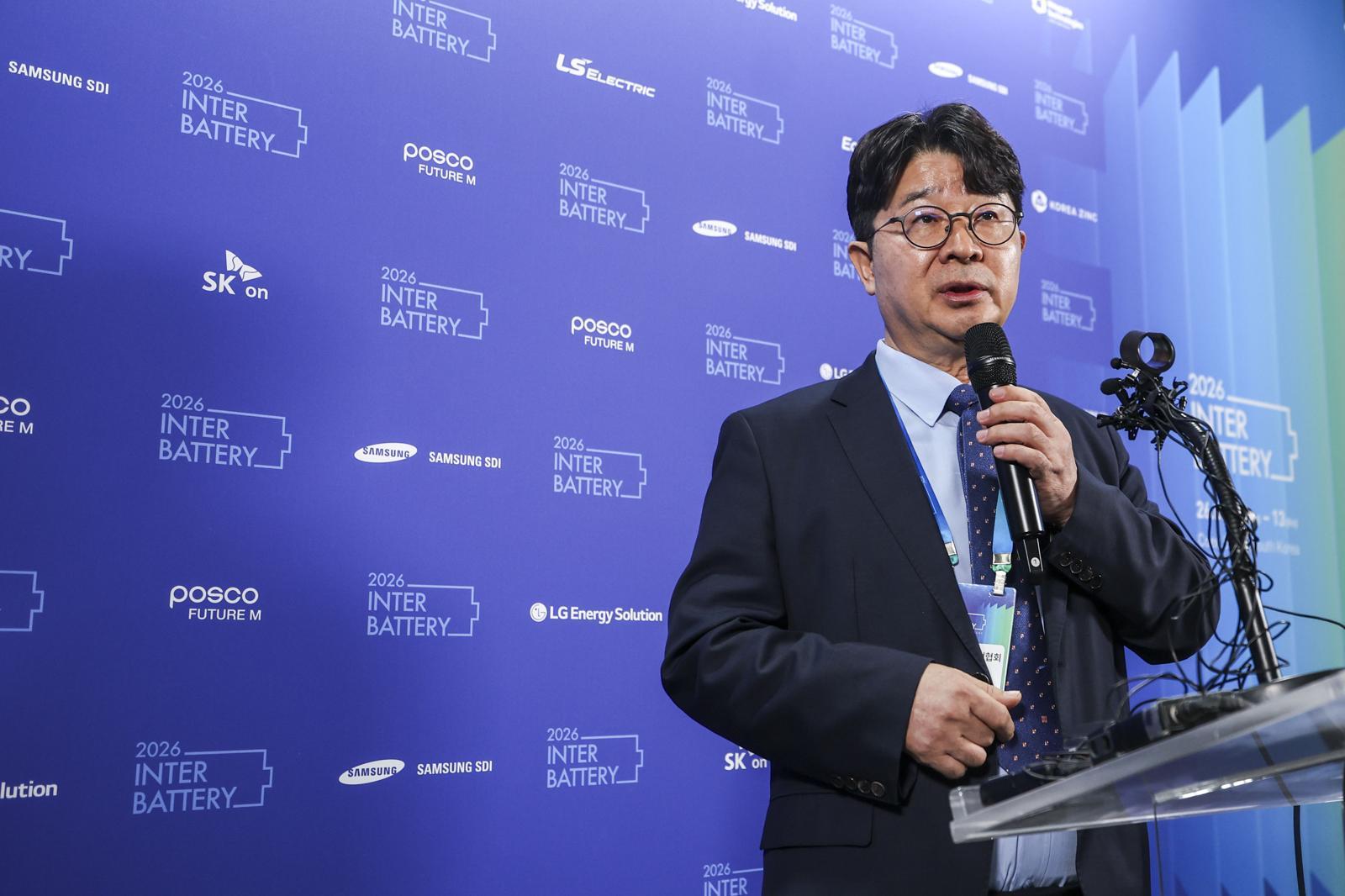
POSCO Future M CEO Eom Gi-cheon speaks to the press (doorstepping) at InterBattery 2026 held at COEX in Gangnam-gu, Seoul, on the 11th. 2026.03.11. Newsis
POSCO Future M has secured silicon anode material technology and will begin mass production in 2028. Silicon anode materials, which have higher energy density and faster charging speed than conventional graphite anode materials, are drawing attention in the next-generation battery market.
On the 20th, POSCO Future M announced that it had developed a silicon anode material capable of storing more than four times the energy of graphite-based anode materials. Anode materials are core materials that serve as storage sites to receive lithium ions inside lithium-ion batteries during charging. Due to silicon’s swelling characteristics and relatively low electrical conductivity, it is difficult to use silicon anode material on its own. It is generally used in batteries mixed with graphite anode material.
POSCO Future M has succeeded in increasing the mixing ratio of silicon anode material to over 20%. A POSCO Future M official said, “This significantly surpasses the previous mixing ratio, which remained in the single digits,” adding, “Durability has also been verified, with tests showing that more than 80% of the initial capacity is maintained after 1,000 charge-discharge cycles.” The company has also resolved the characteristic volume expansion issue during charging and discharging, which has long been cited as a barrier to the commercialization of silicon anode materials. A POSCO Future M official explained, “We have significantly mitigated the expansion issue by applying silicon nano-sizing technology and carbon compositing technology.”
POSCO Future M has set 2028 as the target for mass production of silicon anode materials. The company expects demand to grow rapidly, particularly in the premium electric vehicle market, which requires long driving ranges with short charging times. Hong Young-joon, head of POSCO Future M’s Technology Research Center, said, “Silicon anode materials are a next-generation key material that will determine battery performance,” adding, “Based on our accumulated materials technology and mass-production experience, we will provide the best solutions to our customers.”
Choi Won-young
AI-translated with ChatGPT. Provided as is; original Korean text prevails.
ⓒ dongA.com. All rights reserved. Reproduction, redistribution, or use for AI training prohibited.