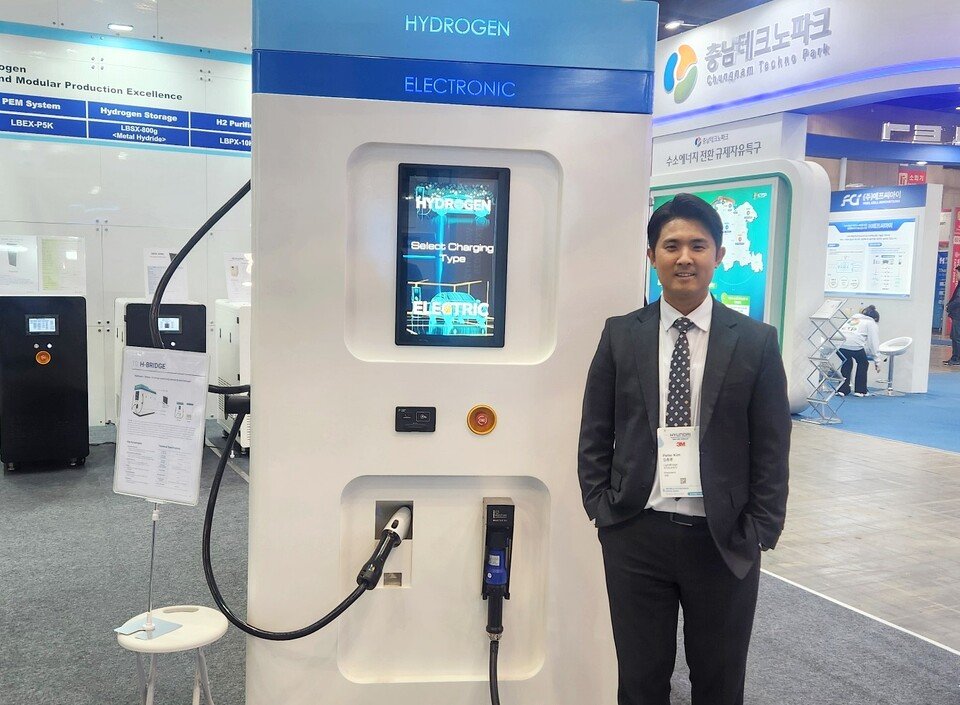
‘H-Bridge’ and Kim Jong-hoon, CEO of Lightbridge. Provided by Lightbridge
The construction model for green hydrogen infrastructure is shifting from large-scale plants to modular structures, and Lightbridge is accelerating the commercialization of related technologies.
Lightbridge announced on the 15th that it has developed “H-Bridge,” an on-site system that integrates hydrogen production, storage, and charging based on modular water electrolysis technology, and is expanding its infrastructure business. By applying a modular structure, the company explained, operational risk can be reduced and phased expansion is possible because only the affected module needs to be replaced if a problem occurs in part of the facility.
The company recently completed a Series A funding round worth KRW 4 billion and is currently pursuing the attraction of Series B investment. It is reviewing renewable energy operators and data centers as key demand sources and is also discussing expanded application to the industrial equipment sector.
In the hydrogen industry, expanding the scope of use from a focus on mobility to the power generation and industrial sectors is regarded as a key task. Kim Jong-hoon, CEO of Lightbridge, said, “Relying on mobility alone makes it difficult to ensure the expansion of the hydrogen industry,” adding, “The ecosystem will be complete only when various application areas grow together.”
Lightbridge has also established a new information and communications technology (ICT) division and is working to build an integrated platform that manages every step from hydrogen production to distribution and utilization. The company plans to enhance the efficiency of green hydrogen distribution by developing a blockchain-based management system in parallel with an electrochemical hydrogen compressor.
The company has signed a contract to supply four “H-Bridge” units to Gwangyang City and is scheduled to deliver them by the end of this year. It plans to lay the groundwork for expansion into the private market through cost reductions and product advancement going forward.
Kim said, “Realistic pricing is essential for private-sector expansion,” and added, “We will focus on cost reduction and enhancing product competitiveness until our planned listing between 2027 and 2028.”
Ji Hee-su
AI-translated with ChatGPT. Provided as is; original Korean text prevails.
ⓒ dongA.com. All rights reserved. Reproduction, redistribution, or use for AI training prohibited.