Equipped with proprietary ‘AI Planner’… vehicles autonomously determine routes
Urban autonomous driving powered by seven years of city driving data
Rule-based logic combined with AI enables flexible response to unexpected situations
Launching with two vehicles, “to be expanded in stages”
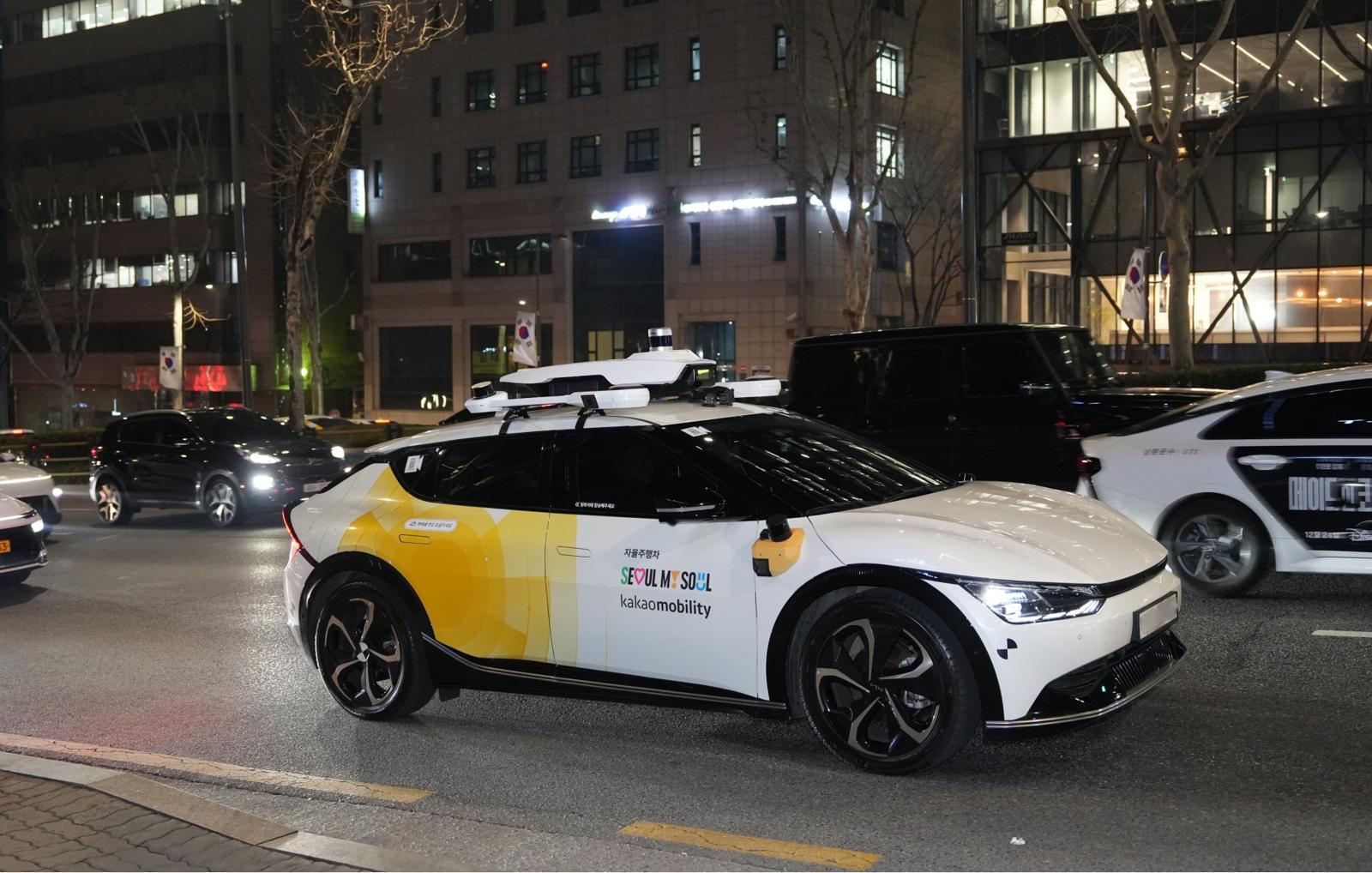
“Seoul Autonomous Car,” equipped with Kakao Mobility’s proprietary autonomous driving technology, is driving through the Gangnam city center. Provided by Kakao Mobility.
Kakao Mobility’s autonomous vehicle, developed with its own technology, is running in the Gangnam city center, one of the most complex road environments in Seoul. This marks the opening of a full-scale stage where the company’s autonomous driving technology and platform operation capabilities will be verified simultaneously in a high-difficulty section crowded with pedestrians and vehicles.
Kakao Mobility announced on the 15th that it has been selected as an autonomous vehicle passenger transportation service operator by the Seoul Metropolitan Government and will begin operating the “Gangnam Late-night Seoul Autonomous Car,” based on its proprietary autonomous driving technology, from the 16th.
The Gangnam Late-night Seoul Autonomous Car will operate on weekdays late at night (10 p.m. to 5 a.m. the following day) within the autonomous driving pilot zone in Gangnam-gu. It is currently available free of charge and is scheduled to become a paid service next month. Vehicles can be easily hailed through the “Seoul Autonomous Car” icon or the regular taxi-hailing menu in the “Kakao T” app.
●?
Autonomous driving powered by the vehicle’s “brain,” the AI Planner
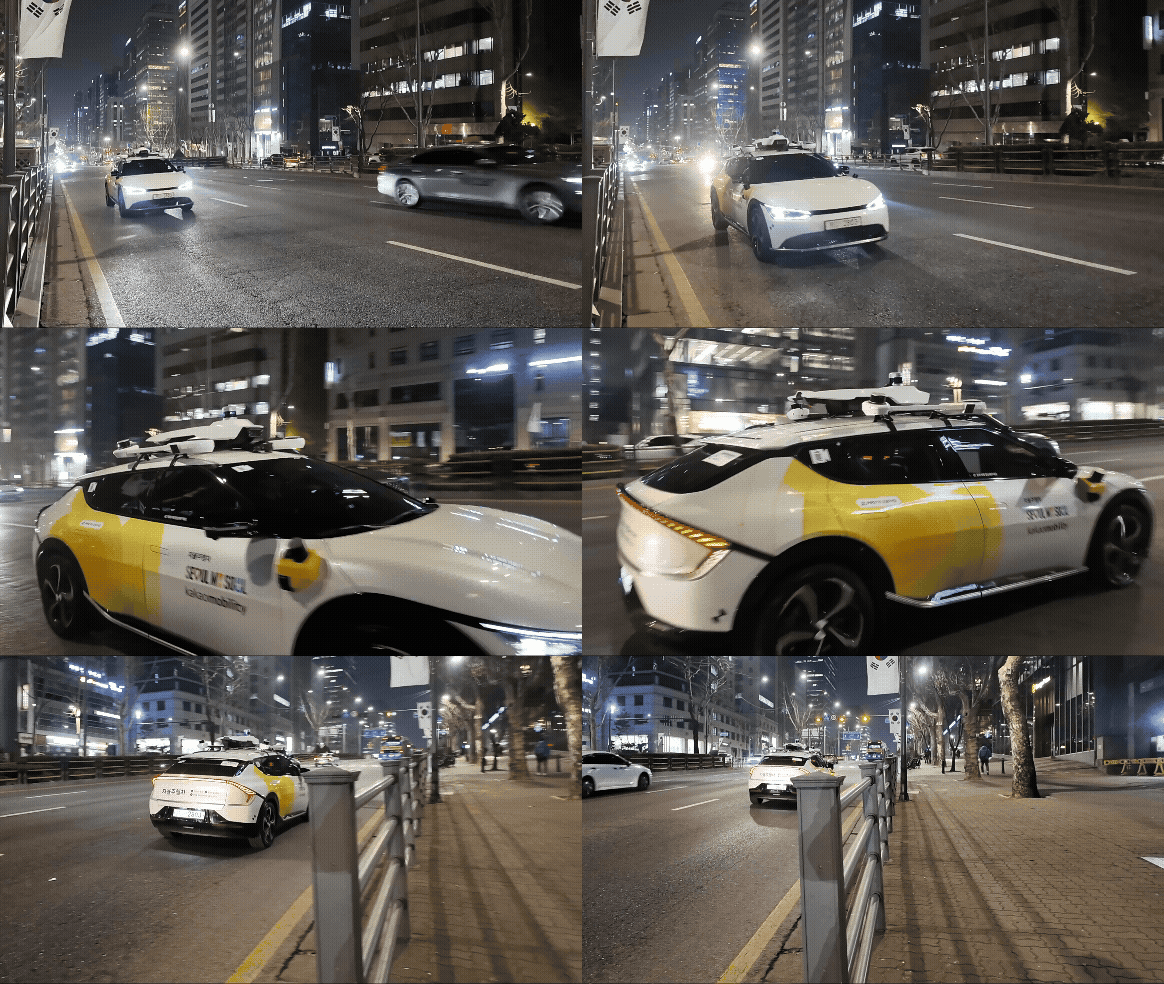
“AI Planner,” Kakao Mobility’s independently developed autonomous driving software, comprehensively analyzes HD map information and sensor data to determine the safest and most efficient route in real time. Provided by Kakao Mobility.
The autonomous vehicles deployed this time are equipped with Kakao Mobility’s independently developed autonomous driving software, “AI Planner.” AI Planner is the core module that serves as the vehicle’s “brain,” responsible for comprehensively analyzing HD map information and sensor data to determine and guide the safest and most efficient route in real time.
Since 2018, Kakao Mobility has been steadily collecting large-scale driving data in complex urban areas such as Pangyo and Gangnam by using “AV-Kit,” a modular autonomous driving sensor rig. The collected data is automatically labeled and processed by AI, then immediately fed into autonomous driving model training via the company’s proprietary “AI data pipeline.” Through this feedback loop, Kakao Mobility has continuously enhanced the performance of AI Planner. The Gangnam operation is the first full-scale case of implementing these technological achievements in an actual service environment.
●
Combining rule-based and AI, “hybrid autonomous driving” The autonomous driving industry currently employs two main technical approaches. One is the rule-based method, which moves strictly according to predefined rules such as “must come to a complete stop at this speed.” The other is the end-to-end (E2E) method, in which AI autonomously learns and handles the entire process of perception, decision-making, and control.
Kakao Mobility has adopted a hybrid strategy that combines the two. A deep learning-based “urban-specialized perception core model” thoroughly identifies surrounding objects such as traffic lights and pedestrians, while in predictable situations a proven rule-based method controls the vehicle. For unexpected variables such as sudden cut-ins or illegally parked vehicles, AI Planner responds flexibly in a human-like manner.
A Kakao Mobility official stated, “We have layered AI Planner on top of a proven rule-based method so that the two complement each other,” adding, “It is an approach optimized for urban environments like Gangnam, where there are many variables.”
●
? Starting with 2 vehicles, expanding in the first half of the year
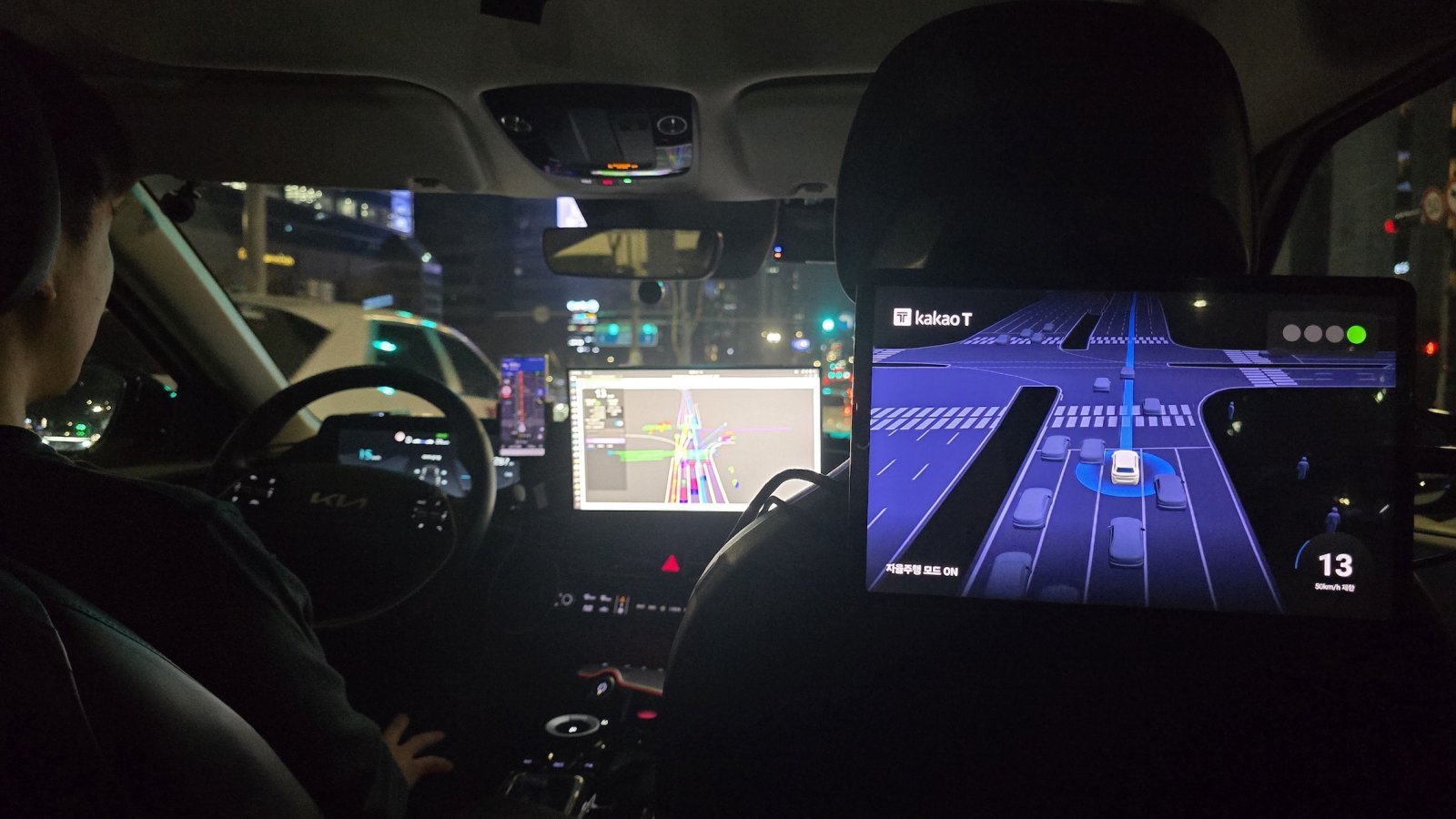
AVV (Autonomous Vehicle Visualization device) installed inside Kakao Mobility’s autonomous vehicles. It displays surrounding obstacles and route planning on the screen in real time, allowing passengers to directly check the vehicle’s driving status. Provided by Kakao Mobility.
The Seoul city-operated Gangnam late-night autonomous taxis will number a total of seven, of which two Kakao Mobility vehicles will be deployed in this phase. The company plans to gradually increase the number of operating vehicles in line with the license issuance schedule during the first half of the year (January to June).
During operation, the “Intelligent Integrated Safety Management Platform for Autonomous Driving” will also be activated to analyze vehicle data in real time and respond immediately to unexpected situations. Inside the vehicles, AVV (Autonomous Vehicle Visualization device), which visually displays surrounding obstacles and route planning, has been installed. As passengers can directly see the vehicle’s decision-making process, the system is expected to reduce anxiety about autonomous driving and enhance trust.
Ryu Geung-seon, CEO of Kakao Mobility, said, “At a time when securing independent technological competitiveness is more important than ever in the domestic mobility market, which global big tech has yet to fully dominate,” adding, “the company will grow into a physical AI-based technology enterprise, in which AI controls not only the digital but also the physical world.”
ⓒ dongA.com. All rights reserved. Reproduction, redistribution, or use for AI training prohibited.
Popular News