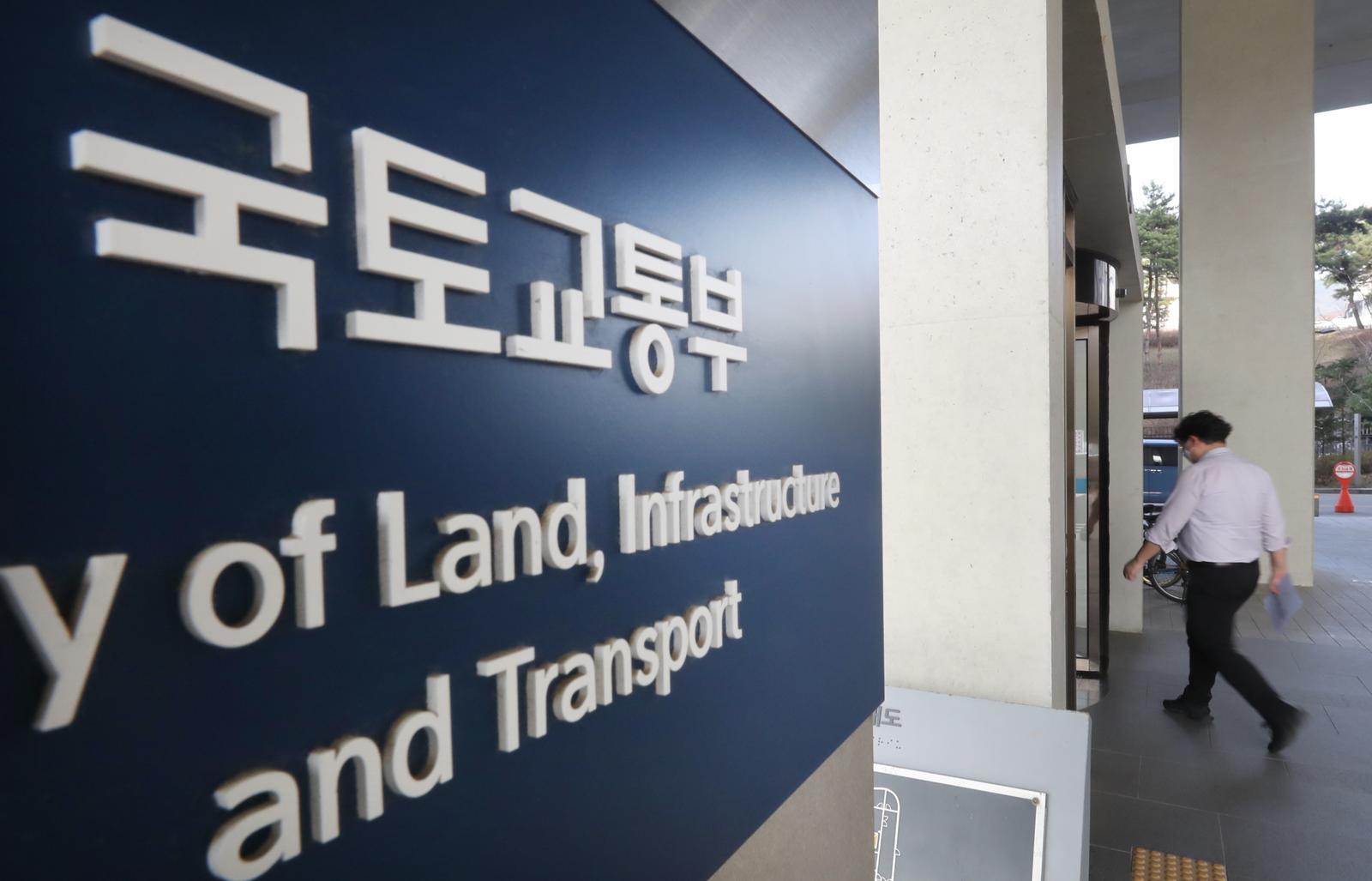
Employees enter the Ministry of Land, Infrastructure and Transport entrance at the Government Sejong Complex. News1
Gwangju as a whole is being transformed into a space for autonomous vehicle demonstration. Within Gwangju, regulations related to autonomous driving will be significantly eased, and dedicated vehicles and artificial intelligence (AI) data training infrastructure will be provided.
The Ministry of Land, Infrastructure and Transport announced on the 21st that it will promote an autonomous driving demonstration city and designate Gwangju as such a demonstration city. This is the first time in Korea that an entire city is being created as a demonstration city. As a follow-up measure to the new government’s economic growth strategy and plan to enhance competitiveness in the autonomous vehicle industry, a budget of KRW 61.0 billion will be invested. The Korea Transportation Safety Authority’s Automobile Safety Research Institute will be exclusively responsible for the operation and management of the demonstration city.
The entire Gwangju area will be designated a special regulatory zone for autonomous driving and will be operated as an autonomous driving sandbox starting in April. Regulations related to autonomous driving, such as the obligation for manual driving in child protection zones (school zones) and the requirement to de-identify personal information in video data, will be relaxed. Autonomous vehicles will operate on actual roads, including ordinary roads, residential areas, city centers, and at night, beginning with manned autonomous driving and gradually shifting to unmanned autonomous driving based on annual evaluations.
The demonstration project will also provide 200 dedicated vehicles operated 24 hours a day for technology development. Through a public call in April, three companies will be selected to participate in the demonstration project, and these vehicles will be allocated to them differentially according to their technological capabilities. Full-scale demonstrations will be conducted in the second half of the year (July–December). Previously, the main approach was to mount autonomous driving systems on finished vehicles. The dedicated vehicles used in this project are designed as software-centric vehicles to enhance system stability and control precision.
Data collected during the demonstration process will be standardized to ensure compatibility among participating companies. To share and train on the standardized data, dedicated graphics processing units (GPUs) at the Gwangju National AI Data Center will be provided. A simulator will also be operated to verify driving scenarios in a virtual environment. In addition, insurance products will be developed to reduce companies’ compensation burden in the event of autonomous vehicle accidents, and a regional co-prosperity council will be operated to support the project’s integration into the local community and explore win-win measures with the transport industry.
Im Yu-na 기자
AI-translated with ChatGPT. Provided as is; original Korean text prevails.
ⓒ dongA.com. All rights reserved. Reproduction, redistribution, or use for AI training prohibited.