[Sharing Happiness] ‘Greenbook,’ a platform supporting eco-friendly construction
Eco-friendly materials re-certified every two years
130,000 types of documentation consolidated in one place
Check certification status with a single click
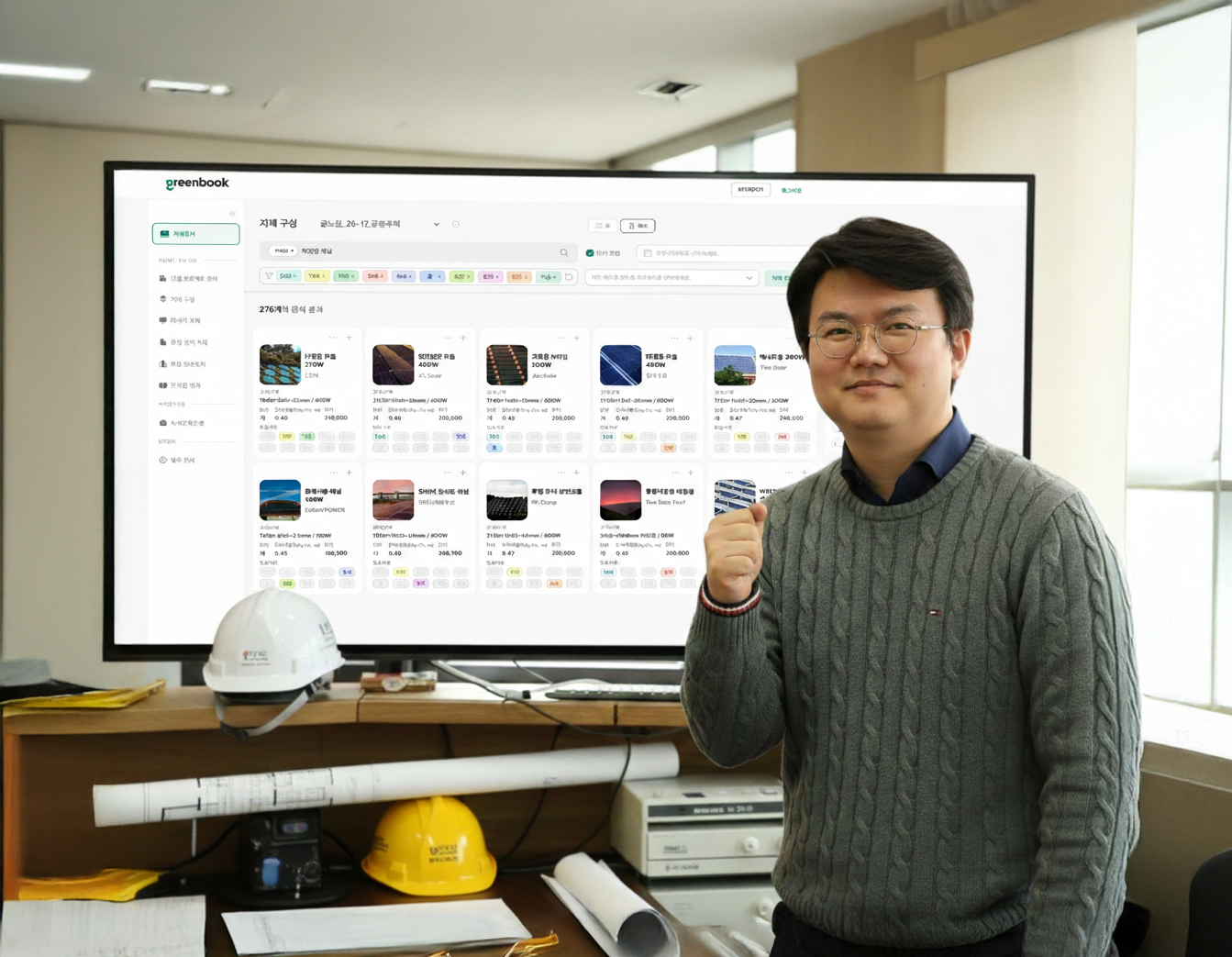
In November last year, Jeong Ho-gun, CEO of “Zest,” which was designated as a preliminary social enterprise, raised his right fist in anticipation of overseas expansion. Zest operates “Greenbook,” a platform that supports eco-friendly construction. Provided by Zest
Interest in eco-friendly construction has recently been rising, but in practice, sites face difficulties in obtaining information related to eco-friendly building materials, certification standards, and other issues. There is no website that aggregates information on eco-friendly architecture in one place, and since eco-friendly building materials must be re-certified every two years, it also takes considerable time to verify whether a material is certified.
Small and medium-sized construction companies and architectural design firms, which lack sufficient personnel, often give up on eco-friendly construction itself due to a shortage of information. Eco-friendly construction refers to a method of building structures that minimizes negative environmental impacts during construction, operation, and demolition.
“Zest,” which was designated as a preliminary social enterprise in November last year, operates the platform “Greenbook” to reduce the time and cost required for eco-friendly construction. CEO Jeong Ho-gun (43) of Zest, who majored in architecture as an undergraduate and completed a PhD program in urban engineering, experienced firsthand the difficulties small and medium-sized construction companies face in pursuing eco-friendly construction while visiting numerous construction sites. Jeong said, “Smaller companies do not have many staff members, so it is not easy for them to verify eco-friendly building material certifications one by one,” adding, “I decided to start a business to come up with solutions for such companies.”
In the domestic market alone, there are as many as 130,000 items classified as eco-friendly building materials, and about 1,000 new ones are registered every month. Jeong first organized the data on eco-friendly materials. He categorized the 130,000 building material items and created the “Greenbook” platform so that, by clicking on a material, users can download manuals, eco-friendly certification documents, quality documents, and Material Safety Data Sheets. Based on this information, he built a system that allows customers to order the materials they currently need and be connected to new suppliers.
Greenbook is operated based on artificial intelligence (AI). When a construction company uploads a project statement, the AI analyzes costs, production volumes, logistics expenses, and other factors and facilitates connections with eco-friendly building material suppliers. It enables price comparisons by product and, by incorporating information on carbon emissions, allows environmental impact assessments at the building level.
Since its founding in April 2024, Zest has participated in 84 construction projects through last year and has grown to secure 338 client companies. Jeong said, “Our goal is to build a material supply chain management platform so that more ‘circular materials’—those that recycle waste generated at construction sites—can be used,” adding, “After earning proper recognition in the domestic market, we hope to enter overseas markets such as the United States and Indonesia.”
ⓒ dongA.com. All rights reserved. Reproduction, redistribution, or use for AI training prohibited.
Popular News