The '2025 Korea Tech Festival', hosted by the Ministry of Trade, Industry and Energy and organized by the Korea Institute of Industrial Technology Evaluation and Planning (KEIT), Korea Institute for Advancement of Technology (KIAT), Korea Trade-Investment Promotion Agency (KOTRA), and Korea Testing Laboratory (KTL), concluded on December 5. The 2025 Korea Tech Festival was themed 'The Power of Technology, the Value of Commercialization, and the Future of Industry', integrating the 'Industrial Technology R&D Comprehensive Exhibition' and the Korea Technology Commercialization Exhibition to share industrial technology and R&D achievements.
The primary goal of the 2025 Korea Tech Festival was to announce the outcomes and plans of government R&D support for advanced industries and to showcase innovative technologies and research achievements from public research institutions, universities, large corporations, and startups. It attracted significant attention from the industry as it allowed for the verification of R&D full-cycle support achievements from startup to product launch.
Exhibition by Leading Domestic Companies Including Samsung Electronics and Hyundai Motor
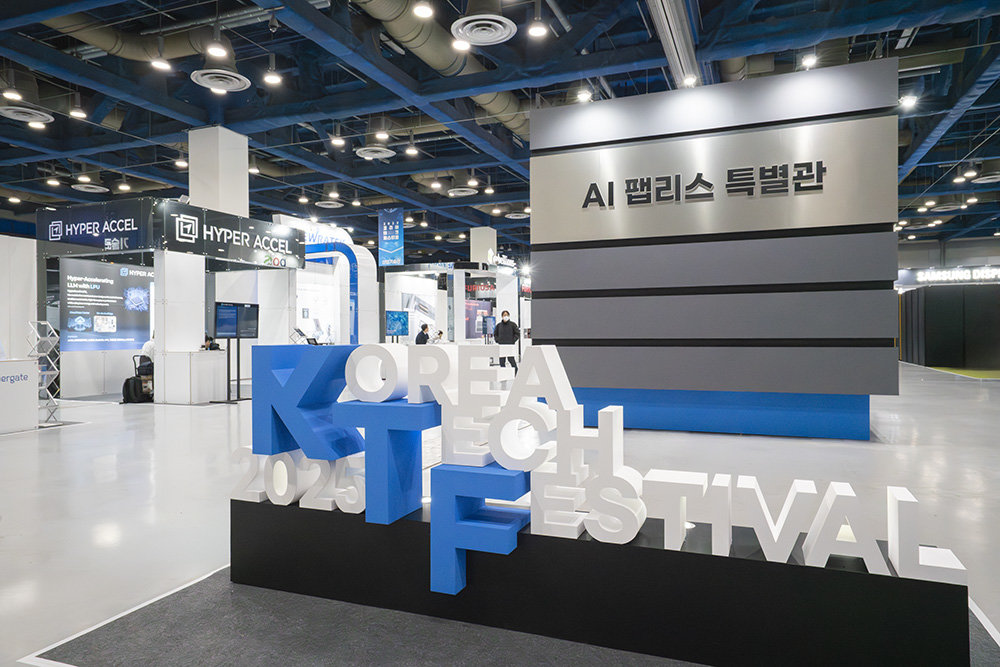
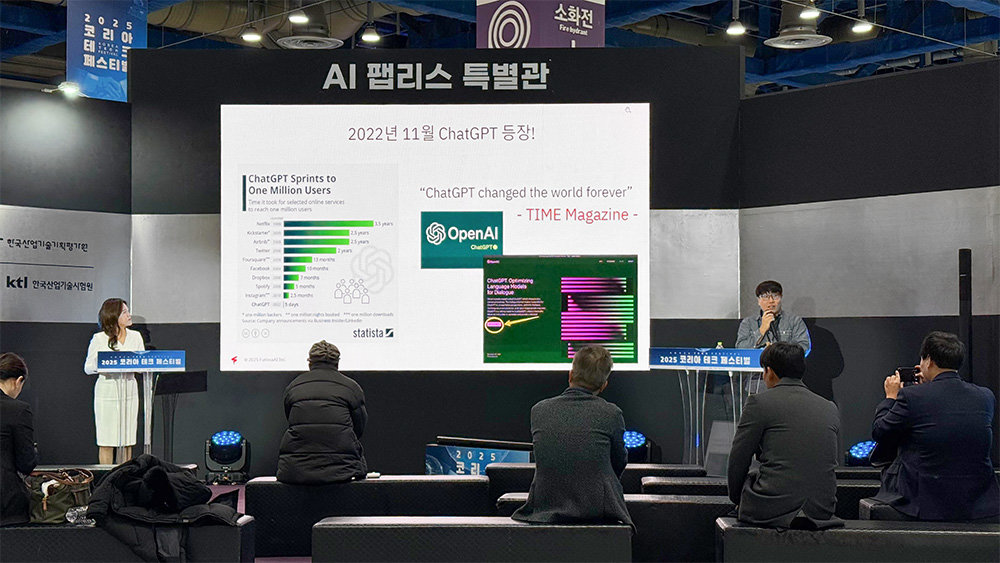
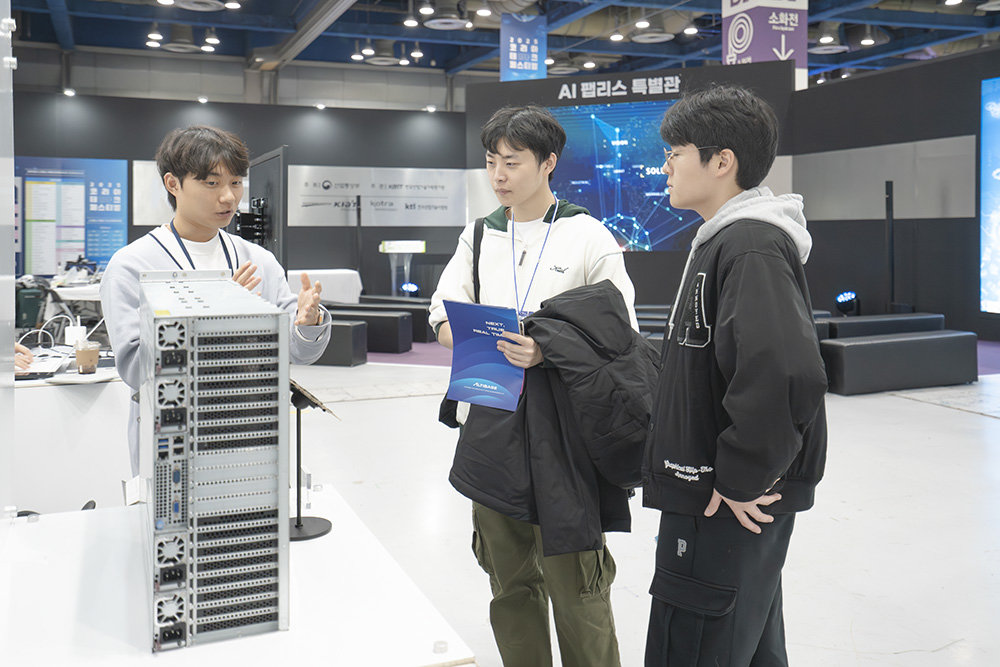
Visited the 'AI Fabless Special Hall' at the 2025 Korea Tech Festival / Source=IT Donga
The opening ceremony keynote speeches were delivered by former Go player Lee Sedol, a special professor at UNIST, Nakamura Shuji, a UC Santa Barbara professor who won the Nobel Prize in Physics for developing the world's first blue LED, and Todd Stavish, Vice President of SRI Ventures, discussing AI in future society, future technologies Korea should challenge, and trends in U.S. technology commercialization.
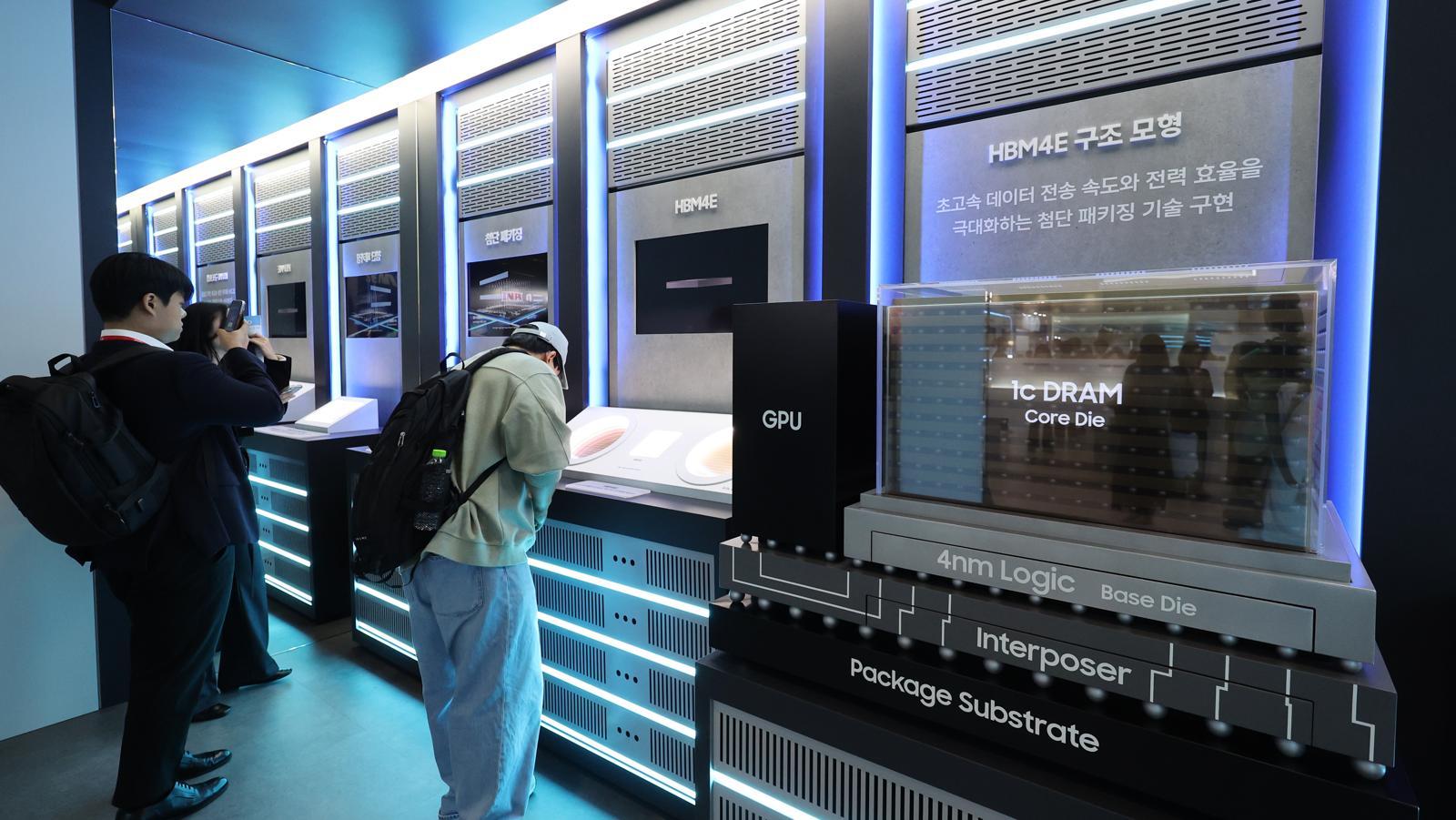
The exhibition hall featured 180 booths, including 78 companies representing the Korean economy such as Samsung Electronics, SK Hynix, LG Electronics, Samsung Display, Samsung Heavy Industries, Hyundai Motor, and Ecopro BM. It hosted the 'Top 10 R&D Representatives' representing the Ministry of Industry, the 'AI Semiconductor Special Hall' featuring domestic AI semiconductor technology companies, and 'Tech2biz Day' where public research institutions and domestic companies collaborated. Additionally, the four organizing institutions, KEIT, KIAT, KOTRA, and KTL, participated to explain the full-cycle support system for R&D planning, evaluation, commercialization support, overseas market entry, and testing and certification.
Major Domestic AI Deep Tech Companies Gathered··· The Key is 'Open Innovation'
During the three-day event, KOTRA's 'Global Open Innovation Meet-Up Program' and 'Global Telecom·AI Platform Open Innovation Meet-Up' attracted more interest than expected. Both programs allowed participants to meet key figures from Japanese deep tech, global venture capital, telecom and AI platforms, and Japanese government and local governments, and directly introduce solutions. Companies such as FuriosaAI, Ucast, Remo, Wonderful Platform, Modizense Vision, Cubic, Darysoft, and HarborMax participated in the program to propose collaboration possibilities.
Jung Young-beom, Executive Director of FuriosaAI, introducing FuriosaAI to overseas company and institution representatives / Source=IT Donga
Overseas telecom companies participating included NTT Docomo and Softbank, the top two telecom operators in Japan, as well as network equipment company NEC Networks & SI, Deutsche Telekom from Germany, Telkomsel from Indonesia, and Telekom Srbija from Serbia. Additionally, 'GreenNode', a subsidiary of Vietnam's tech giant VNG and a provider of AI cloud and high-performance computing infrastructure, and Kuwait's IT and telecom service company Wajda Group also attended.
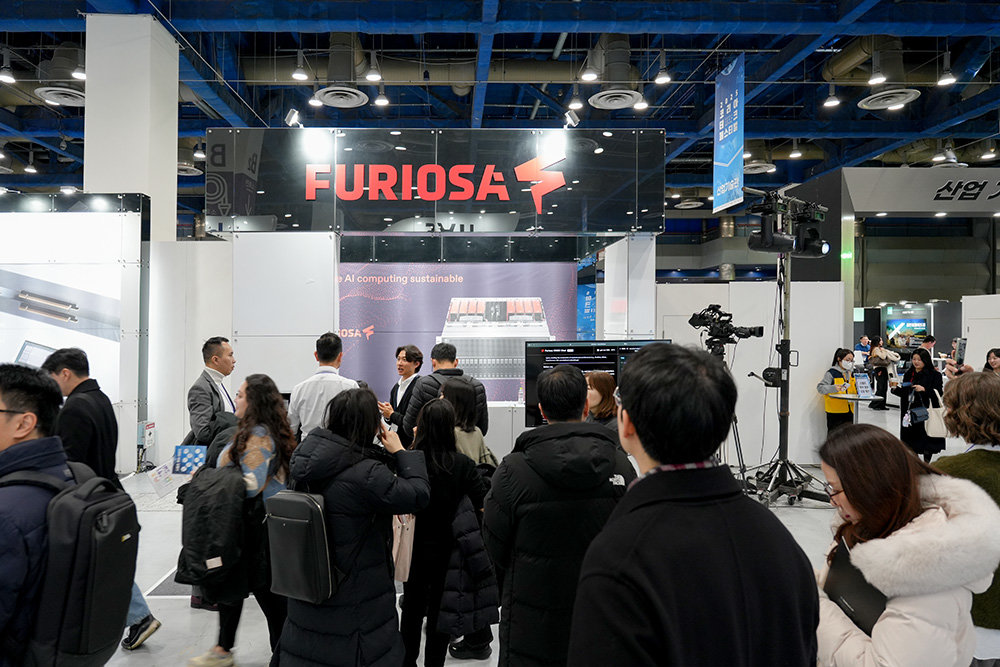
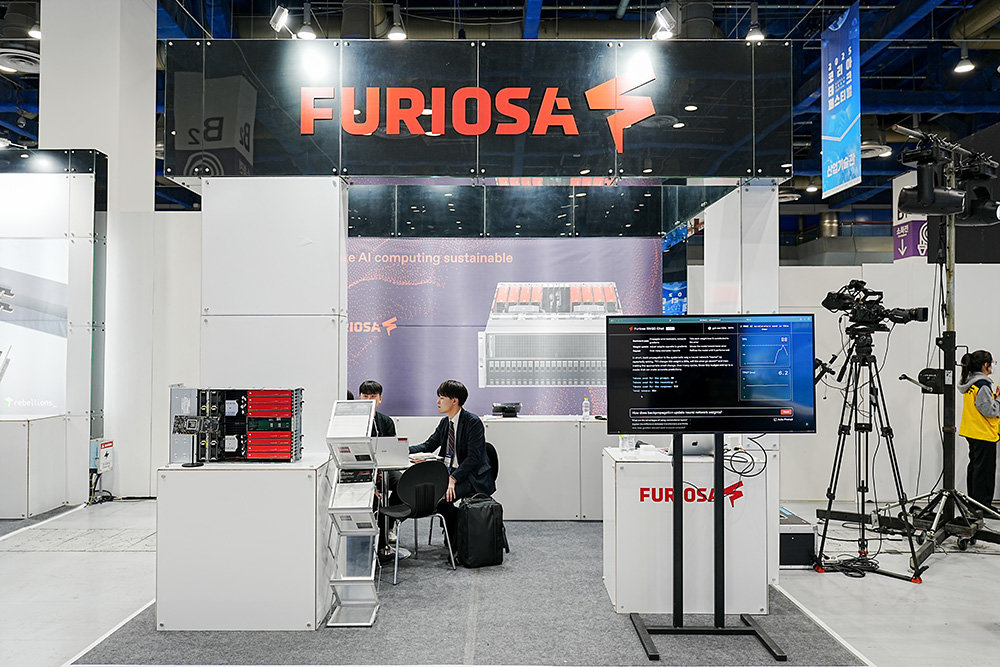
Overseas institution representatives visiting the FuriosaAI booth to inquire about the RNGD server / Source=IT Donga
Among the companies that participated in the presentations, FuriosaAI received the most attention. FuriosaAI is a leading AI semiconductor design company in Korea, showcasing RNGD (Renegade), a semiconductor optimized for AI inference operations used in various fields such as data centers, autonomous driving, and robotics. Currently, AI semiconductors are divided into those used for model training and those for model inference. While NVIDIA's graphics processing units (GPUs) can be used for both training and inference, they have limitations due to high costs and power consumption. Therefore, there is a movement to use neural processing units (NPUs) like FuriosaAI's RNGD specifically for inference purposes.
NPUs have designs optimized for AI processing, offering a higher performance-to-power consumption ratio compared to GPUs, and are relatively advantageous in terms of cost and supply issues. As a result, operators of data centers, telecom, and cloud services seeking to support AI operations are looking for NPUs. FuriosaAI is already sampling with major partners, and from early next year, the second-generation semiconductors will begin mass production to expand market supply. Consequently, overseas companies interested in NPU supply visited the site to explore the utilization and business potential of FuriosaAI semiconductors.
Three-Day On-Site Exhibition, Interest from Overseas Institutions and Cloud Companies Confirmed
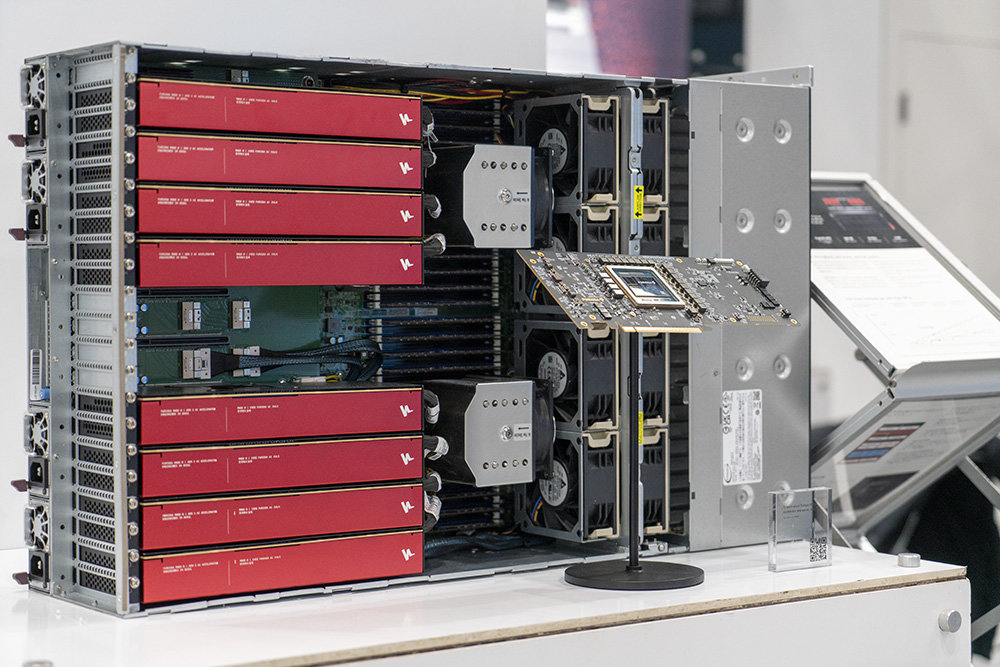
RNGD server equipped with 8 RNGD cards / Source=IT Donga
FuriosaAI discussed collaborative relationships through open innovation and exhibited an RNGD server and RNGD semiconductors composed of 8 RNGD cards at the 'AI Semiconductor Special Hall'. Alongside FuriosaAI, nine companies, including Rebellion, Neural Tech, DeepX, Hyper Excel, Supergate, UX Factory, Boss Semiconductor, and Analog AI, participated in the exhibition.
The RNGD server is a complete data center server product composed of 8 RNGD cards and 2 AMD EPYC 9354 processors. It supports a total of 384GB of memory with 48GB of HBM3 per card, offering performance of 4096 TFLOPS at FP8 and 4096 TOPS at INT8. The system memory supports 1TB DDR5, and it is equipped with two 25GB dual-port NIC cards. The software supports a simplified LLM stack, including a compiler, runtime, and Furiosa LLM, which Furiosa is directly building.
FuriosaAI representative guiding customers visiting the booth on technical specifications / Source=IT Donga
With the ability to hear explanations from NPU server and on-site personnel, many company and institution representatives considering NPU adoption attended. A FuriosaAI representative stated, "This year, six major Japanese local governments, including Shibuya, Nagoya, and Kobe, visited the event to find solutions for AI transition, and our booth was visited by government officials and government-related businesses not only from Japan but also from Thailand."
Domestic company representatives and university students interested in AI fabless visited the site / Source=IT Donga
He continued, "Both countries prefer on-premise conditions for running AI in a closed environment rather than in the cloud. The performance and budget required by the government are clear, but it is difficult to achieve this solely with NVIDIA GPUs, so they consulted on whether FuriosaAI NPUs could achieve this. They also gathered opinions on whether NPUs could be introduced in various government projects."
Domestic AI Semiconductor Companies Continuously Striving to Secure Demand Sources
All domestic AI semiconductor companies are in need of clear demand sources both domestically and internationally, and to achieve this, initial adoption cases and securing an industrial ecosystem must be realized together. Today, NVIDIA could become a mainstay in the AI semiconductor market because CEO Jensen Huang has been building industrial utility and software ecosystems with GPGPU since 2005. While the GPU infrastructure market is very robust, there are certainly areas that NPUs can achieve, and domestic AI semiconductor companies are steadily working to secure adoption cases.
In the case of FuriosaAI, it is proposing the potential of its semiconductors for LLM inference to domestic and foreign companies based on the supply of LLM inference semiconductors to the LG AI Research Institute. Rebellion is working to secure NPU adoption cases through strategic collaborations with companies like KT Cloud and SK Telecom. They also support customized software and joint development to ensure that companies adopting NPUs can use them smoothly.
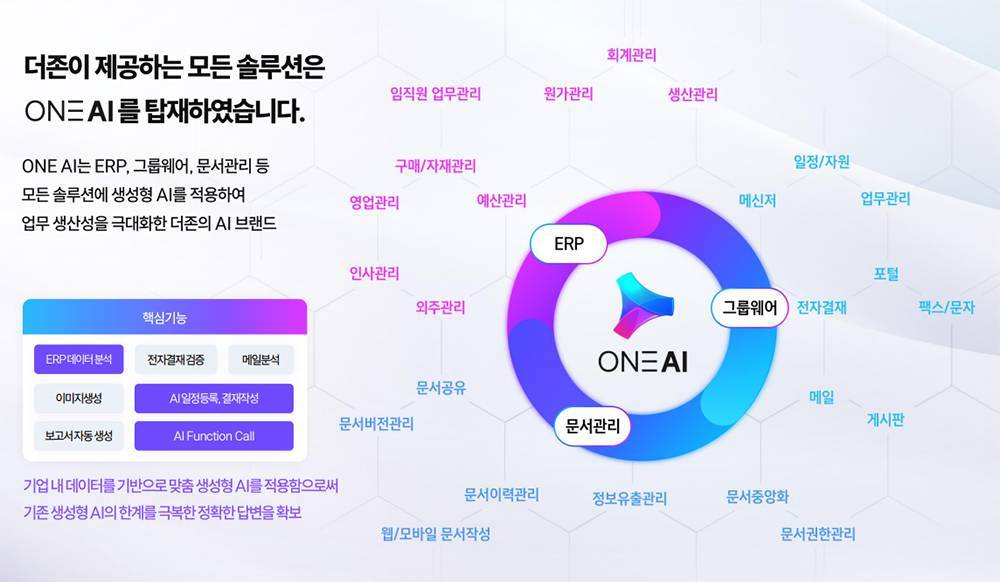
FuriosaAI is providing 'ONE AI' services to Japanese companies in collaboration with Douzone Bizon / Source=Douzone Bizon
Recently, FuriosaAI, based on the 2025 AI-Semiconductor Overseas Demonstration Support Project, has begun introducing services targeting Japanese SMEs in collaboration with Douzone Bizon. When demand companies adopt Douzone Bizon's 'ONE AI', a customized AI service for enterprises consisting of enterprise resource management, data analysis, electronic payment verification, and mail analysis, the necessary computations are run by FuriosaAI's RNGD. By 2026, FuriosaAI's RNGD will be mass-produced and introduced to the market. It is hoped that as many adoption cases as possible will be secured to demonstrate the potential of domestic AI semiconductor companies.
IT Donga Reporter Nam Si-hyun (sh@itdonga.com)
ⓒ dongA.com. All rights reserved. Reproduction, redistribution, or use for AI training prohibited.
Popular News