Journalists from the Dong-A Ilbo IT Science Team introduce noteworthy technologies, trends, and companies in IT, science, space, and bio fields. "What is this company?" The behind-the-scenes stories of tech companies changing the world with technology! From ideas that amazed the world to the current concerns of founders, they delve into everything you were curious about.
U.S. President Donald Trump signed an executive order on the 24th of last month (local time) to launch the 'Genesis Mission,' a large-scale national project to secure leadership in the artificial intelligence (AI) hegemony competition. This involves mobilizing scientific and technological capabilities within the U.S. to build an AI platform, with movements to integrate AI into areas of scientific discovery such as protein generation and nuclear fusion becoming more pronounced.
In Korea, AI startup Trillion Labs is leading the development of a medical science foundation model through a consortium with medical AI company 'Lunit,' preparing for the era of 'AI Co-Scientist.'
Shin Jae-min, CEO of Trillion Labs, a former 'Naver' employee, stated in an interview with the Dong-A Ilbo, "AI being good at language is now (the competition is) over, and the next is mathematics, science, and coding. Domains are being conquered in the order of data abundance."
He said, "The recent focus is on creating a foundation model that handles the entire cycle from the molecular stage to clinical and new drug development, and creating a 'Co-Scientist' that outputs this in human language," adding, "The discussion with Lunit was that we should expand to 'AI for Science' such as chemistry and life sciences, not just 'medical'." He further added, "Watching Demis Hassabis, CEO of Google DeepMind, win the Nobel Prize in Chemistry with the protein structure prediction AI 'AlphaFold,' I was convinced that the 'next' is Co-Scientist."
CEO Shin founded Trillion Labs in 2024 based on his experience participating in the development of 'HyperCLOVA X' at Naver. Along with the startup, he attracted an investment of about KRW 9 billion, and within a year of its establishment, he unveiled a large-scale proprietary AI model, drawing attention from the industry. The following is a Q&A with CEO Shin.
Shin Jae-min, CEO of Trillion Labs. Provided by Trillion Labs
Trillion Labs recently released the large-scale language model (LLM) 'Tri-70B (70 billion parameters)' as open source. It is the largest language model developed from scratch in Korea to date. Notably, it also announced 'intermediate checkpoints' that disclose each step of the entire AI creation process. It is said to be the first in the world to disclose intermediate checkpoints at the 70B scale.
"The 70B model, the largest model developed from scratch in Korea, is a full-size LLM with 70 billion parameters, similar to Meta's Llama or Alibaba's Qwen. It is a model aimed at enhancing the performance of small models (SLM) and requires advanced large models for the execution of high-difficulty agents, under the strategy of elevating the completeness of technology.
Through the disclosure of intermediate checkpoints, researchers or developers can review how the model has been improved. Trillion Labs aimed to maximize technical transparency through this disclosure and clearly demonstrate its independent technical capabilities to develop large models independently to the industry. Especially for startups, this open-source strategy is considered the most powerful way to dispel external doubts about technical capabilities and transparently prove quality and independence."
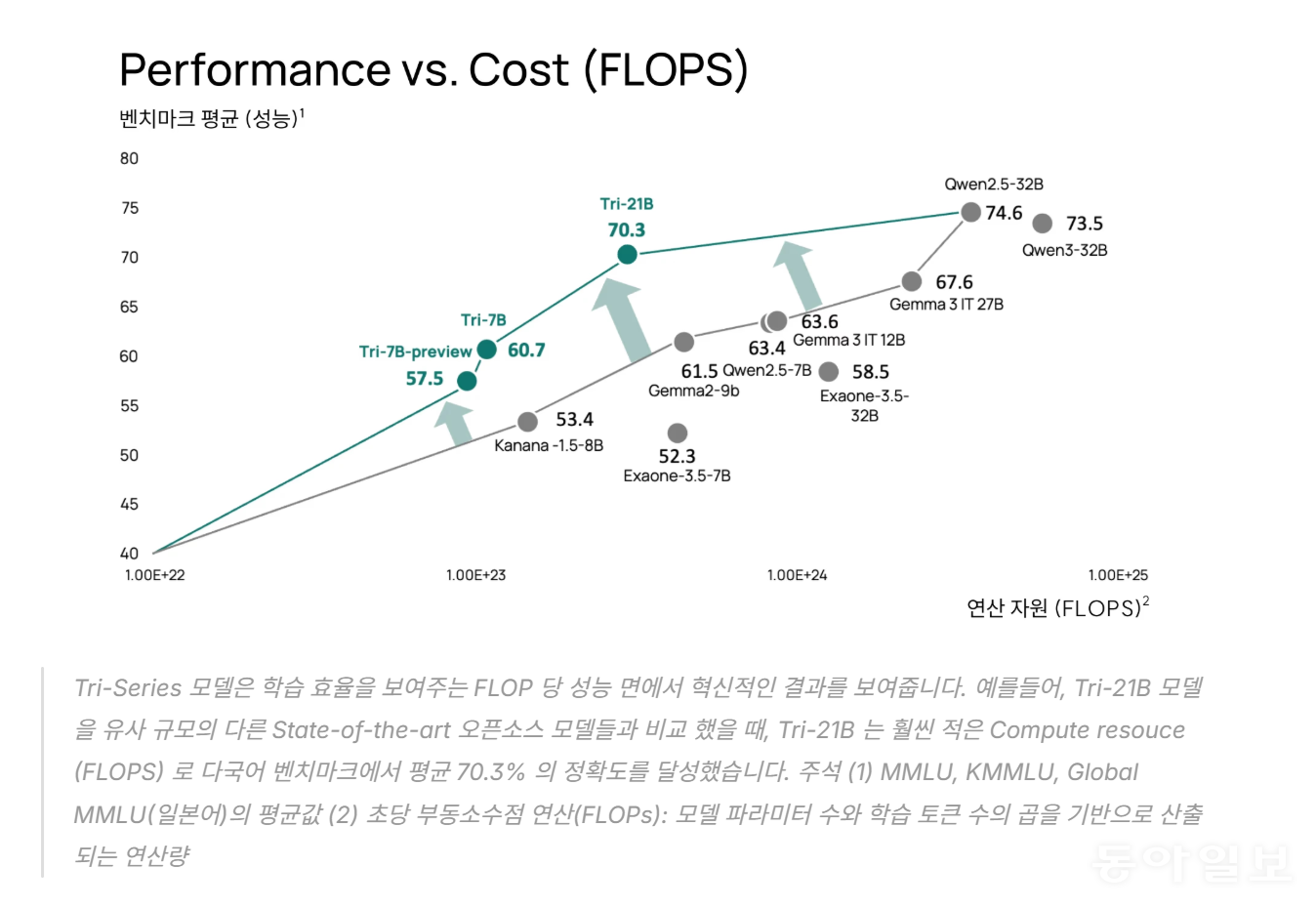
Through XLDA (Cross-Lingual Document Attention) technology, it achieved high Korean performance while reducing the proportion of Korean in the training data. Could you explain the principle and cost efficiency of this technology in detail?
"XLDA (Cross-Lingual Document Attention) technology maximizes the efficiency of the algorithm itself, instead of directly generating a massive amount of Korean-English 'synthetic data,' allowing AI to learn as if there is sufficient data. The core principle of this technology is to efficiently transfer vast English knowledge to be learned in Korean. Thanks to this technological innovation, AI can become intelligent as if it has acquired vast English knowledge with only a small amount of Korean data. This achieved an innovative cost efficiency, reducing learning costs to 1/12 of the previous level."
Trillion Labs previously disclosed that it spent about KRW 243 million to train the 7B model with 2 trillion tokens. How did you achieve such cost efficiency compared to the hundreds of billions of KRW investments by large corporations?
"This low cost was possible due to the aforementioned proprietary XLDA technology. A small elite development culture also had a significant impact. In LLM development, since GPUs handle most of the calculations, the concentration of core personnel is more important than the number of people, and a structure where a small team can make quick decisions and focus leads to high development with limited resources."
You are participating in the government's 'AI Specialized Foundation Model Development Project' by forming a consortium with the leading medical AI company 'Lunit.' What synergy do you expect from collaboration with a medical AI company?
"The goal of the specialized foundation model consortium is not to catch up with global big tech but to pioneer new areas in Korea. The medical science model we will create through this government project is not merely to cite existing knowledge but to expand AI that understands 'science such as medicine and life phenomena' by combining inference capabilities with understanding human language. This model integrates and learns unstructured biological data such as genomes, proteins, and chemicals, implementing BMCS (Bio-Medical Co-Scientists) functions that directly support scientific hypotheses and experiments, such as new drug development, target discovery, drug repurposing, and clinical hypothesis generation.
Collaboration with Lunit creates significant synergy both technically and industrially. Lunit has global clinical experience and deep insights into the medical field. This provides direction so that the model developed by Trillion Labs can be immediately utilized in actual hospital environments. If we create the 'brain,' Lunit completes it as a 'clinical tool.'"
How is the mobile AI agent, scheduled to be released in the first half of 2026, different from existing chatbots? What is the biggest technical challenge in implementing functions that manipulate actual apps, like 'order something from the internet'?
"The mobile AI agent, scheduled to be released in the first half of 2026, is a service that provides a new user experience by directly controlling the phone, unlike existing chatbots. It is being developed to handle various tasks such as reservations, searches, and even grocery shopping by manipulating actual apps according to user commands. This is entirely different from existing web browser-based technology, and without proprietary LLM source technology, there may be significant limitations in implementing such entirely new technology."
You have stated that the ultimate goal is to solve humanity's challenges such as diseases and climate issues through the development of 'superintelligent AI' that surpasses human intelligence. What is Trillion Labs' vision for 2030?
"The models we are currently developing are laying the foundation for the ultimate goal of superintelligent AI (ASI). Trillion Labs is drawing a roadmap to gradually reach AGI (Artificial General Intelligence), and for this, we have developed and advanced the full-stack LLM, which is the source technology.
Based on models that understand and utilize various languages such as Korean, English, and Japanese, and have reasoning capabilities, we are also building a medical science foundation model that learns specialized data in the fields of science and medicine. Furthermore, we will lead the AI era where autonomous virtual AI agents capable of cognition, reasoning, and action across the web and mobile can make decisions and solve problems in real environments."
ⓒ dongA.com. All rights reserved. Reproduction, redistribution, or use for AI training prohibited.
Popular News