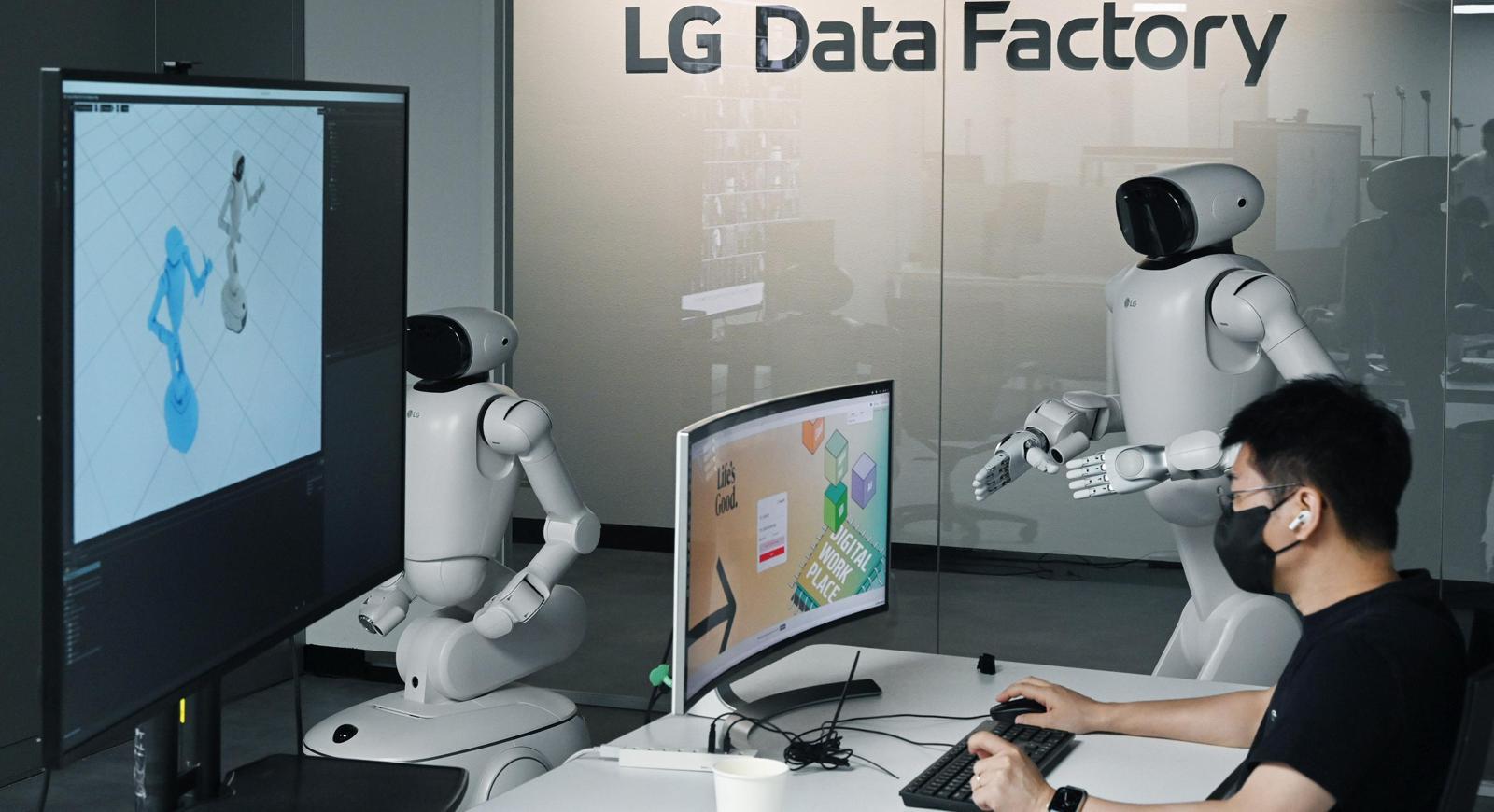
An LG Electronics researcher is building and verifying training data for LG CLOiD by using data augmentation and synthesis solutions at the Data Factory. Provided by LG Electronics
LG Electronics has deployed its humanoid robot “LG CLOiD” to production lines at its factories in Tennessee, United States, and Changwon, South Gyeongsang Province. The company aims to use its own plants as real-world training grounds for the robot to collect on-site data. Starting with CLOiD, LG plans to increase the number of deployed robots, including the mobile manipulator “MoMa,” and hand over dozens of processes at the two plants to robots by the end of next year.
As data collection from production sites gains momentum, synergies are expected to grow with “LG Data Factory,” the robot training hub that began partial operation in August this year. Based on high-quality data, LG Electronics is working to build a “data flywheel” (a virtuous data cycle) to secure leadership in the physical artificial intelligence (AI) race.
● On-site data collection at Tennessee and Changwon plants Last month, LG Electronics deployed CLOiD to its washing machine plant in Tennessee and to its actuator production line in Changwon, and began a proof of concept (PoC). At the Tennessee plant, the robot is responsible for transporting washing machine top panels and aligning and loading drain pumps. At the Changwon plant, it is being tested in actuator assembly and packaging processes to verify its performance in precise, repetitive work environments.
The core of this PoC is securing data that can only be obtained in actual production settings. Variables such as changes in production speed, deviations in workpiece positions, interference between facilities and process-specific exceptions are difficult to replicate through simulations alone. Robots experience these variables on the factory floor and record the resulting data. Data accumulated in manufacturing environments is regarded as a key asset for improving robots’ stability and adaptability to real-world sites.
Both plants have been selected as “Lighthouse Factories” by the World Economic Forum (WEF), meaning they are leading sites that apply advanced digital technologies such as AI and big data to manufacturing. This is why expectations are rising that these facilities will become optimized training grounds for robots.
An LG Electronics official said, “Through on-site PoC we plan to reduce potential risks in the commercialization phase in advance and accelerate the pace of business deployment.”
● Building a ‘data flywheel’ around the Data Factory LG Electronics is also concentrating on building a “data flywheel.” The company believes that a structure in which physical behavior data obtained from robots operating in the real world is synthesized and amplified in a virtual environment, then repeatedly fed back into robot training, will be the core competitive edge in physical AI.
The key hub for realizing this virtuous cycle is LG Data Factory, which is being established in Yangjae-dong, Seoul. Spanning four floors from one basement level to three above ground with a total area of 10,000㎡, the site includes various spaces modelled on factory production lines and homes. CLOiD learns the motions needed for tasks such as parts assembly, transport and housework in each process. It also plays the role of converting tacit knowledge—such as the know-how of skilled workers accumulated by LG Electronics over decades in manufacturing—into data, and of amplifying and expanding data generated from home appliances installed worldwide.
Data obtained in this process is processed and synthesized in virtual space by linking it with NVIDIA’s robotics solutions, and the amplified data is then used again to train robots. At the same time, field data continues to be accumulated on the production lines at the Tennessee and Changwon plants. Data acquired in the real and virtual worlds interact to advance the sophistication of robot learning. The volume of high-quality measured and synthetic training data to be secured at the Data Factory within this year is expected to reach 100,000 hours.
● Betting on a hybrid strategy LG Electronics’ hybrid strategy, which integrates real-world and virtual data, is intended to compensate for the shortcomings of each approach. Learning methods for physical AI largely fall into two categories: acquiring data physically in real environments and generating and training on data in virtual environments. Approaches in which humans remotely control robots or make them work in real spaces can capture complex real-world variables and unexpected situations, but require considerable time and cost. Methods in the latter category, such as simulations or world models (AI that virtually reproduces reality), can generate and train on large volumes of diverse scenarios. While they require less time and cost, they can create a “sim-to-real gap,” where behaviors learned in virtual space do not transfer directly to the real world.
Chinese robotics companies have shown strengths in rapidly securing real-world data by deploying large numbers of actual robots and using remote control and similar methods. In the United States, technology development aimed at enhancing robot generality through virtual data generated by world models and simulations is active.
Leveraging its manufacturing strengths, LG Electronics has chosen to combine the two approaches. With both real-world spaces—factories and homes—and a virtual platform in place, the company aims to reduce time and cost constraints while improving data quality. Robotics firms without factories must borrow customer plants or newly prepare sites where data can be collected, but LG Electronics can quickly spin its data flywheel by using its existing manufacturing assets for robot training. Through this, the company plans to build a Robot Foundation Model (RFM) optimized for manufacturing and home environments and differentiate its robotics business.
The key question is whether on-site verification results can be translated into actual process automation. Whether data synthesized in virtual environments will function properly in the real world, and whether PoC results will lead to the expansion to dozens of processes by the end of next year, are expected to be the first major tests.
An industry official said, “As securing high-quality data that determines software performance is becoming more important than robot hardware, LG Electronics’ hybrid strategy, which combines on-site motion data with world models, will become a differentiated competitive strength in the global physical AI race.”
ⓒ dongA.com. All rights reserved. Reproduction, redistribution, or use for AI training prohibited.
Popular News