Injecting KRW 200 trillion in fiscal funds and KRW 790 trillion in climate finance
Accelerating decarbonization in five key sectors including steel and petrochemicals; supporting 10 major green industries such as EVs and SMRs
Private companies also announce investments totaling KRW 220 trillion
Chey Tae-won: “AI transition and green transition must go hand in hand”
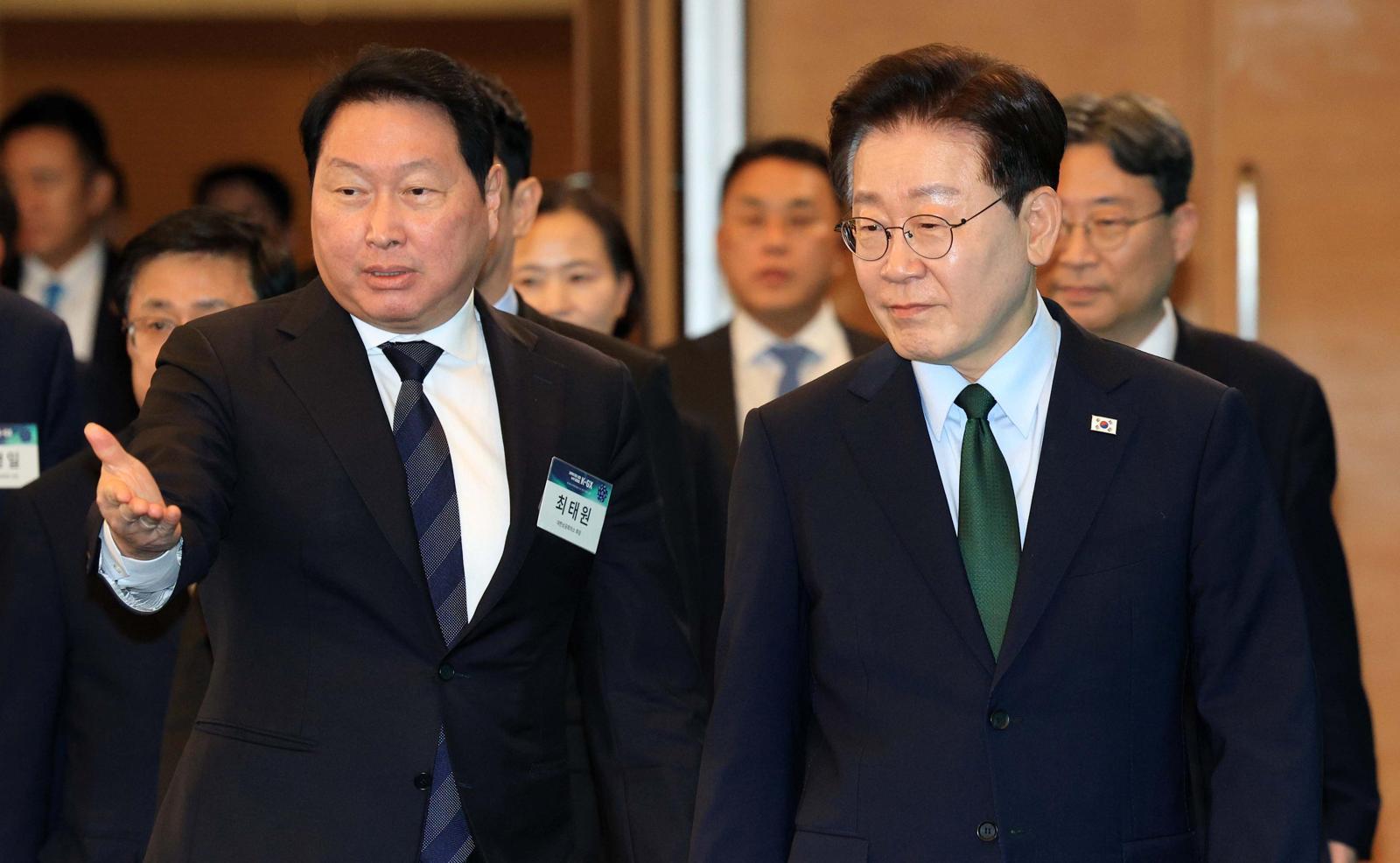
President Lee Jae-myung and Chey Tae-won, chairman of the Korea Chamber of Commerce and Industry, enter the “Korean Green Transformation (K-GX) Strategy National Briefing” held at the Korea Chamber of Commerce and Industry in Jung-gu, Seoul, on the 7th. On this day, the government unveiled a strategy to foster green industries such as renewable energy as national new growth engine projects by investing KRW 1,000 trillion in fiscal resources and climate finance over the next 10 years. Cheong Wa Dae Press Corps
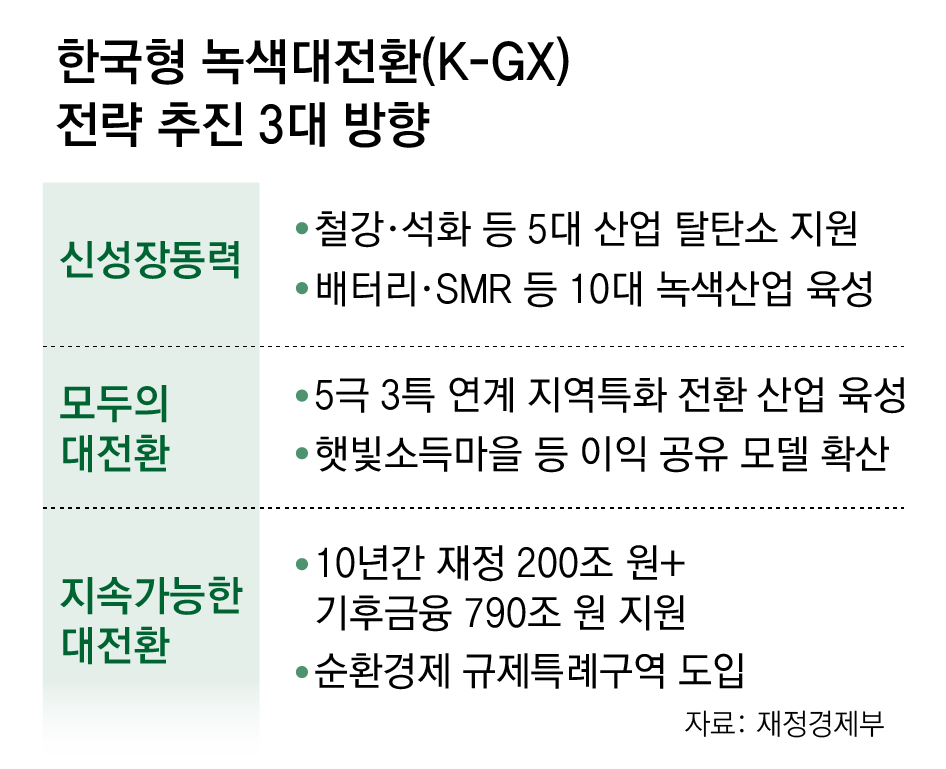
The government will promote the “Korean Green Transformation (K-GX) Strategy” to achieve carbon neutrality and economic growth simultaneously by investing KRW 1,000 trillion by 2035. The plan is to support decarbonization of five key industries including steel, petrochemicals, and refining, and to nurture 10 green industries such as batteries, solar power, and small modular reactors (SMRs) as new growth engines.
President Lee Jae-myung stated on the 7th that “Green transformation is a definitive future strategy that secures international competitiveness while protecting people’s lives and livelihoods from the climate crisis,” stressing that “Korea must become a leader in the green market.” Private companies also announced investment plans of about KRW 220 trillion, signaling their intention to take the lead in green transformation.
● Fostering green industries as drivers of economic growth
The government held the K-GX Strategy National Briefing at the Korea Chamber of Commerce and Industry in Jung-gu, Seoul, on this day, presided over by President Lee. The strategy was drawn up based on discussions by the public-private K-GX Promotion Task Force, which included the government, business associations, and industry. It consists of three implementation directions: “New Growth Engine K-GX,” which enhances industrial competitiveness through decarbonization-driven technological innovation; “K-GX for All,” which cultivates regionally specialized industries; and “Sustainable K-GX,” which underpins the private-sector ecosystem through fiscal and financial support from the government.
The government will convert production processes in five high carbon-emitting sectors—steel, petrochemicals, refining, cement, and semiconductors/displays—to decarbonized methods. In steel, it will pursue demonstration of hydrogen-reduced ironmaking, a greenhouse gas reduction technology, targeting commercialization by 2037. In petrochemicals and refining, it will support technology development to expand eco-friendly fuels. To achieve 100 GW of renewable energy by 2030, it will expand solar and wind power generation. By 2035, it will increase the share of zero-emission vehicles such as electric and hydrogen cars to at least 70% of new vehicle sales, and it will also expand electrification of two-wheelers, construction machinery, and ships.
Ten core green industries will be fostered as flagship national industries. These include electric vehicles, batteries, solar power, wind power, SMRs, power equipment, power semiconductors, heat pumps, hydrogen, and carbon capture, utilization and storage (CCUS). The intention is to strengthen domestic production capacity by supporting technology development and commercialization. The government will support the world’s first commercialization of next-generation solar cells and introduce domestic production tax credits for key components and equipment in solar, wind, and secondary batteries. SMRs will be designated as a national strategic technology and receive tax benefits and other support.
Over four years, the government will select 200 promising climate-tech companies and provide package support worth up to about KRW 10 billion per company, including for commercialization of their technologies, to nurture them into unicorns with corporate values of more than KRW 1 trillion. It will develop region-specific GX models such as Naju, an energy-specialized city in Gwangju, South Jeolla Province, and designate “just transition special zones” within the year to help workers make a soft landing in industrial transitions.
● Private companies respond with KRW 220 trillion in investment
The government plans to support the green transformation with at least KRW 200 trillion in fiscal resources and more than KRW 790 trillion in climate finance over the 10 years to 2035. Climate finance will be raised by five policy financial institutions, including the Korea Development Bank, the Export-Import Bank of Korea, and the Korea Credit Guarantee Fund. The Climate Response Fund will be expanded from KRW 2.6 trillion this year to KRW 7.6 trillion next year, and green bonds will be issued in the first half of next year (January–June). Related regulations will also be eased, including the introduction of special regulatory zones for the circular economy.
Companies such as Hanwha Qcells, POSCO, LG Electronics, and Samsung Electronics, which attended the event, also announced “K-GX Signature Projects” totaling about KRW 220 trillion. Hanwha Qcells will push for domestic production of tandem solar cells, which are more efficient than conventional silicon solar cells. POSCO Holdings presented plans to establish a decarbonized steel ecosystem, while LG Electronics and Samsung Electronics introduced green transformation projects for residential spaces.
Chey Tae-won, chairman of the Korea Chamber of Commerce and Industry (and chairman of SK Group), said, “The AI transformation and green transformation are twin national strategies that must be designed and pursued together,” adding, “In response to government support, we must strive to implement the KRW 220 trillion investment without a hitch and demonstrate results on the ground.”
At the event, one participant asked the government to consider direct subsidies in addition to domestic production tax credits. This is because tax credits, which provide benefits only when large amounts of tax are paid, cannot benefit early-stage companies that are still in the red. In response, President Lee instructed Deputy Prime Minister and Minister of Economy and Finance Lee Hyeong-il to review a “hybrid” support measure that combines tax credits and subsidies, saying, “Isn’t there a way to provide part of the support as subsidies first and then deduct it later from the tax credits?”
ⓒ dongA.com. All rights reserved. Reproduction, redistribution, or use for AI training prohibited.
Popular News