[5th Nuri Launch] First on-time liftoff in five launches
First successful orbital insertion of five cluster satellites
Cargo bay redesigned to carry multiple payloads
1 of 10 CubeSats fails to deploy… per-launch cost of KRW 120 billion remains a challenge
At 12:25 p.m. on the 7th, when the Korean launch vehicle Nuri lifted off from the launch pad, vibrations were transmitted all the way through the ground of the Naro Space Center in Goheung, South Jeolla Province. The assembled spectators simultaneously let out exclamations.
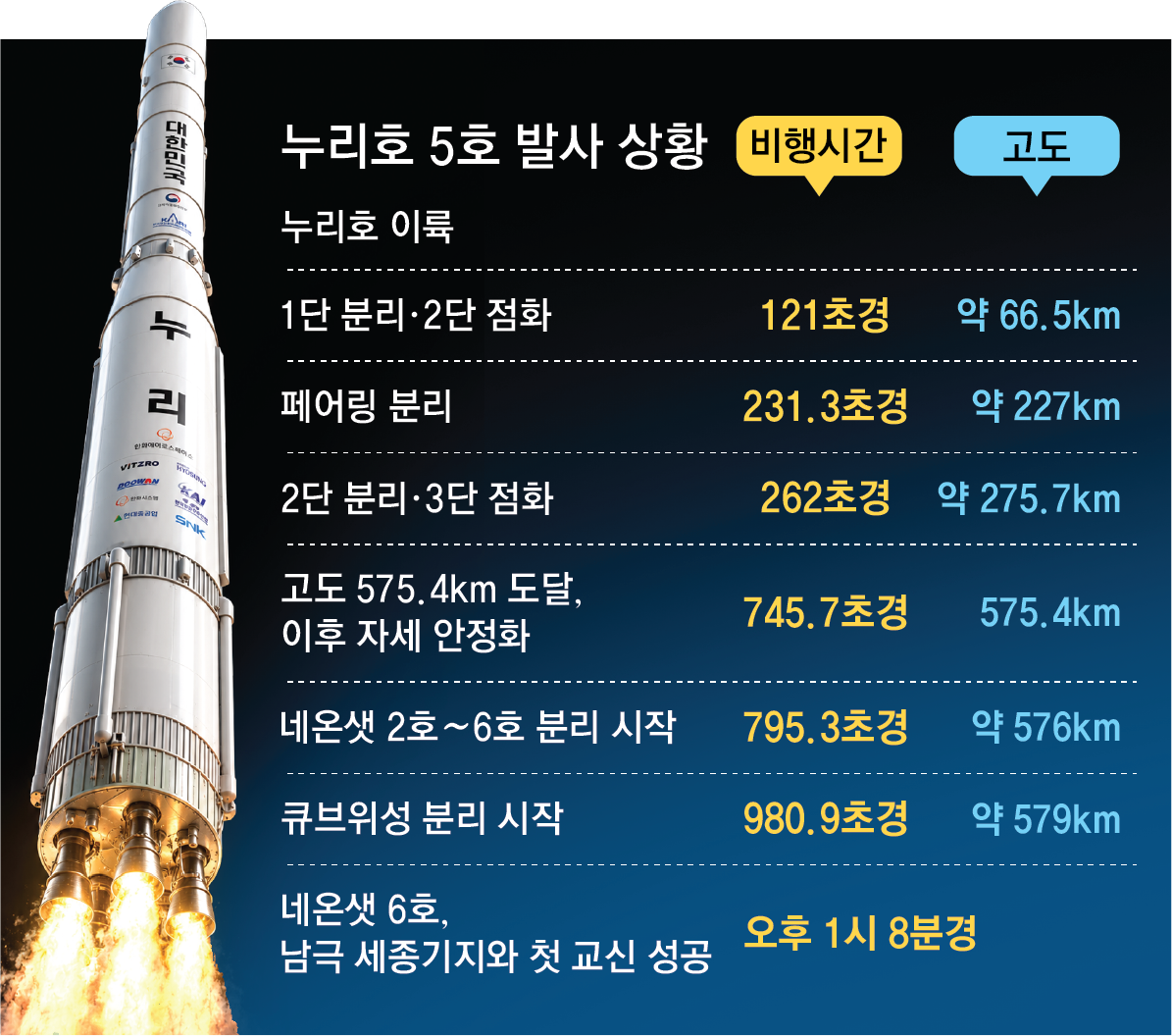
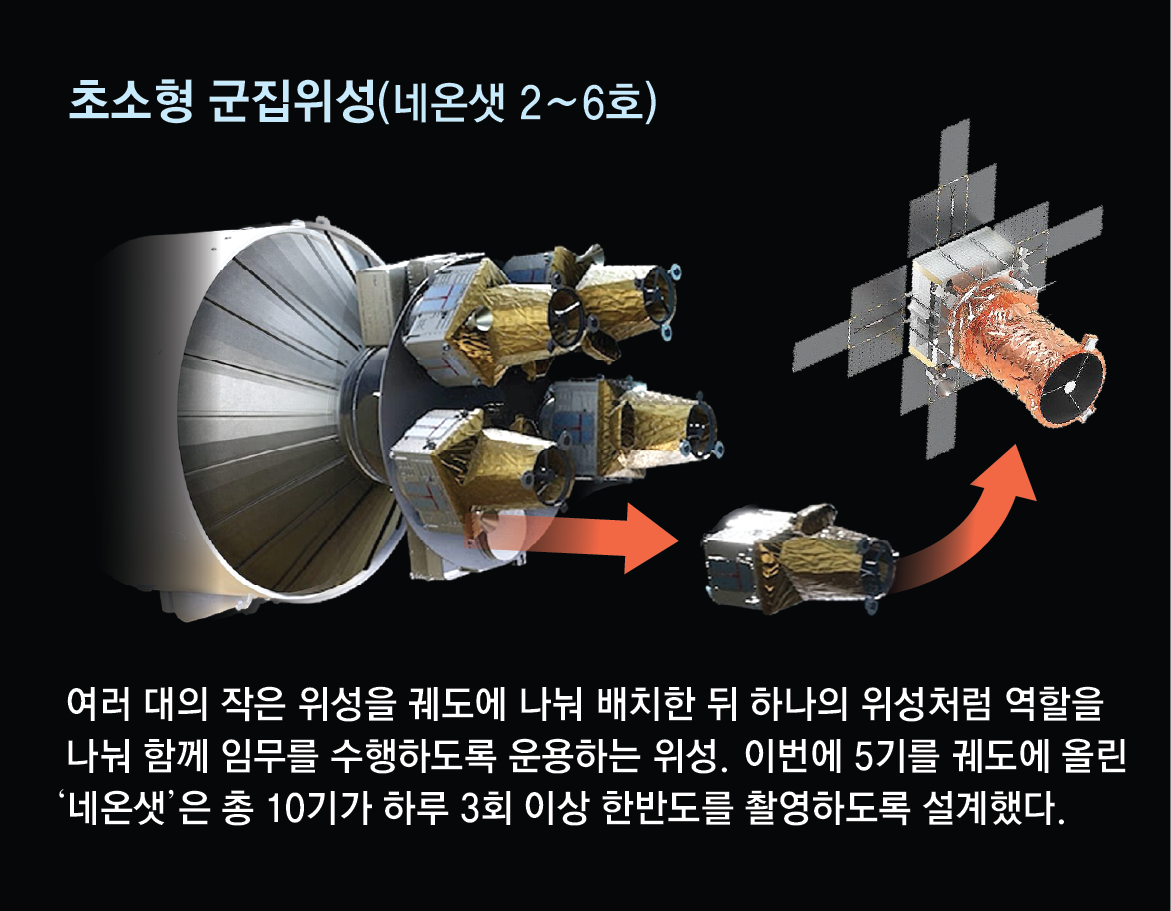
After sequentially separating its first and second-stage rockets, Nuri established its attitude 745.7 seconds after liftoff at an altitude of 575.4 km. It then rotated its upper stage in 35–40 second intervals and deployed the primary payload—a cluster of ultra-small satellites, Neonsat-2 through Neonsat-6—one by one, a total of five satellites. By 5:52 p.m. that day, all five cluster satellites had successfully communicated with ground stations including King Sejong Station in Antarctica and the Svalbard station in Norway. This marked the first time a satellite cluster developed by Korea began a space mission.
● First on-time liftoff carrying five primary payloads
Nuri failed on its first launch in 2021, but after four consecutive successes, its launch success rate has risen to 80%. This time, it placed South Korea’s first satellite cluster (Neonsat-2 through Neonsat-6) into orbit. It was also the first time Nuri was launched at the scheduled time with no deviation. Oh Tae-seok, Administrator of the Korea AeroSpace Administration (KASA), said, “This mission went beyond simply delivering satellites to their target orbit, successfully performing the task of precisely deploying multiple satellites into orbit with a single launch.”
Nuri’s satellite payload section at the top was rebuilt to place multiple Neonsats into orbit at once. A multi-satellite adapter was installed to hold each of the five Neonsats in place and then separate them one by one, and a new low-shock separation device was developed to reduce the impact on the satellites at the moment of separation. As a result, the total weight of the satellite section, including the satellites and the separation/ejection devices, increased from about 960 kg at last year’s launch to about 1,071 kg this time.
This was the first time Nuri lifted off exactly at the scheduled time. The second launch (2022) was delayed about a week due to strong winds and sensor anomalies, and the third launch (2023) was postponed by a day because of communication issues between computers. Last year’s fourth launch also lifted off 18 minutes late because of abnormal sensor signals.
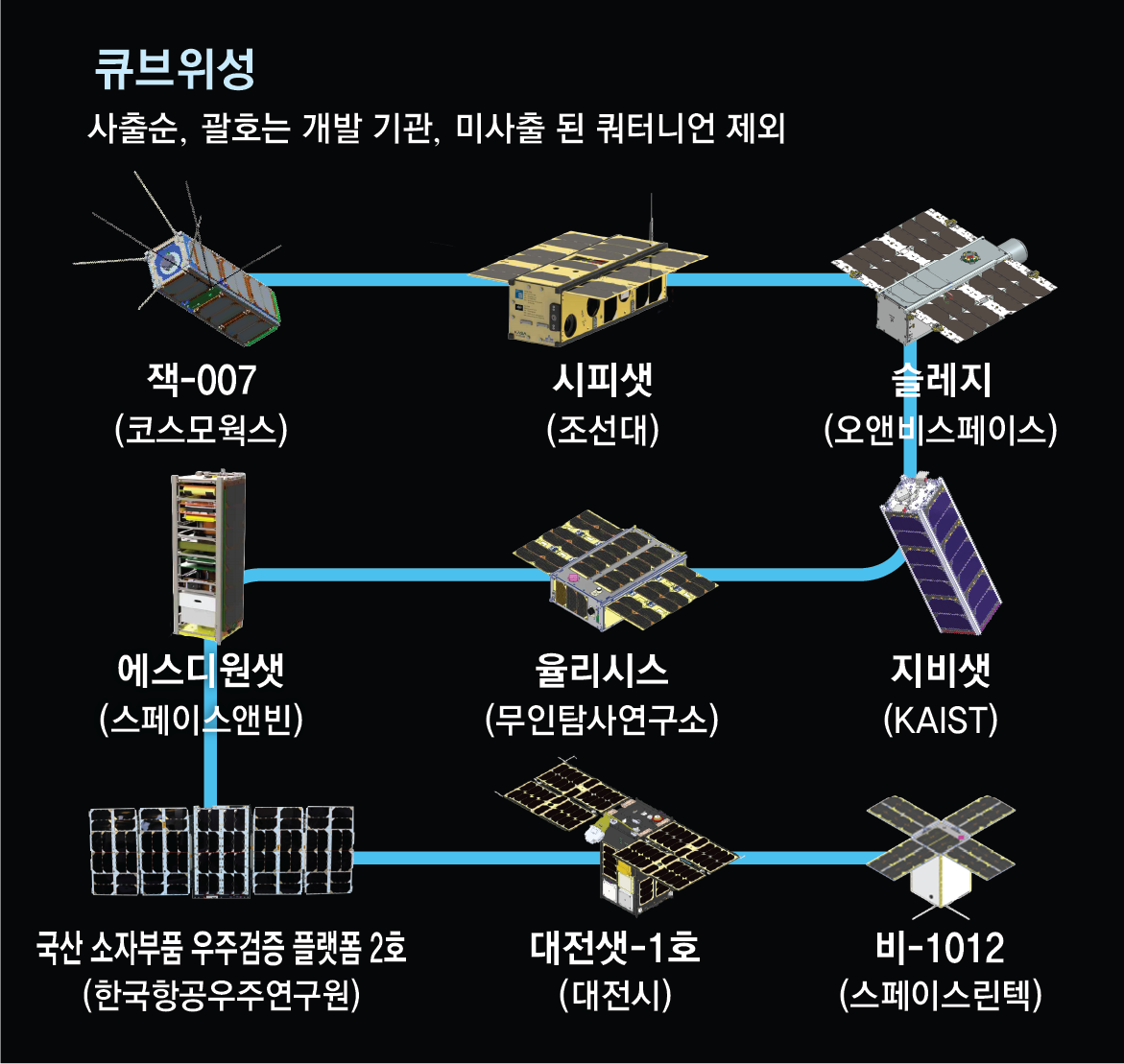
This time, however, it lifted off exactly at 12:25 p.m., the time confirmed that morning. To deploy the Neonsats into their designated orbit at the designated time, the launch time itself had to be strictly observed. However, among the 10 cube satellites carried along with the Neonsats, one satellite—“PURSAT-02” from Quaternion—failed to deploy. Park Jongchan, Director of the Korea Space Launch Vehicle Advancement Program at the Korea Aerospace Research Institute (KARI), explained, “We sent the ejection signal, but the cover on the ejection tube did not open,” adding, “The exact cause is under investigation.”
Immediately after the success of Nuri’s fifth launch, President Lee Jae-myung wrote on X (formerly Twitter), “I pay tribute to the researchers and officials from related industries who have spent countless sleepless nights and shed sweat to make today’s success possible.”
● Private companies move to the center of space launch vehicles
In this launch, private companies took the lead in launch operations. Before liftoff, KASA Deputy Administrator Kwon Hyun-joon said, “If in the past (private companies) were in the supporting role, this time they are in the leading role.” For the first time, personnel from Hanwha Aerospace participated in operating the launch control center consoles (control equipment), a task that had been handled by KARI researchers up to last year’s fourth launch. Kim Seon, Vice President of Hanwha Aerospace, said, “The success of the fifth launch is not a goal but part of a process. The upcoming sixth and seventh launches will also be part of that process.”
For the sixth launch, scheduled for the second half of next year (July–December), the role of the private sector will expand further, with Hanwha assembling each stage of Nuri at its own plant built in Suncheon, South Jeolla Province. Some point out that for Nuri to enter the commercial launch market in the future, there remains the challenge of reducing the launch cost, currently about KRW 120 billion per launch, through expanded private participation.
Astrophysicist Kang Sung-joo (former senior researcher at the Korea Astronomy and Space Science Institute) said, “The ‘New Space’ transition—where the private sector leads the space industry—occurs when private companies take over government-developed technologies, manufacture directly, operate them, and then launch again,” adding, “This launch showed that such a shift is underway at the launch site.”
ⓒ dongA.com. All rights reserved. Reproduction, redistribution, or use for AI training prohibited.
Popular News