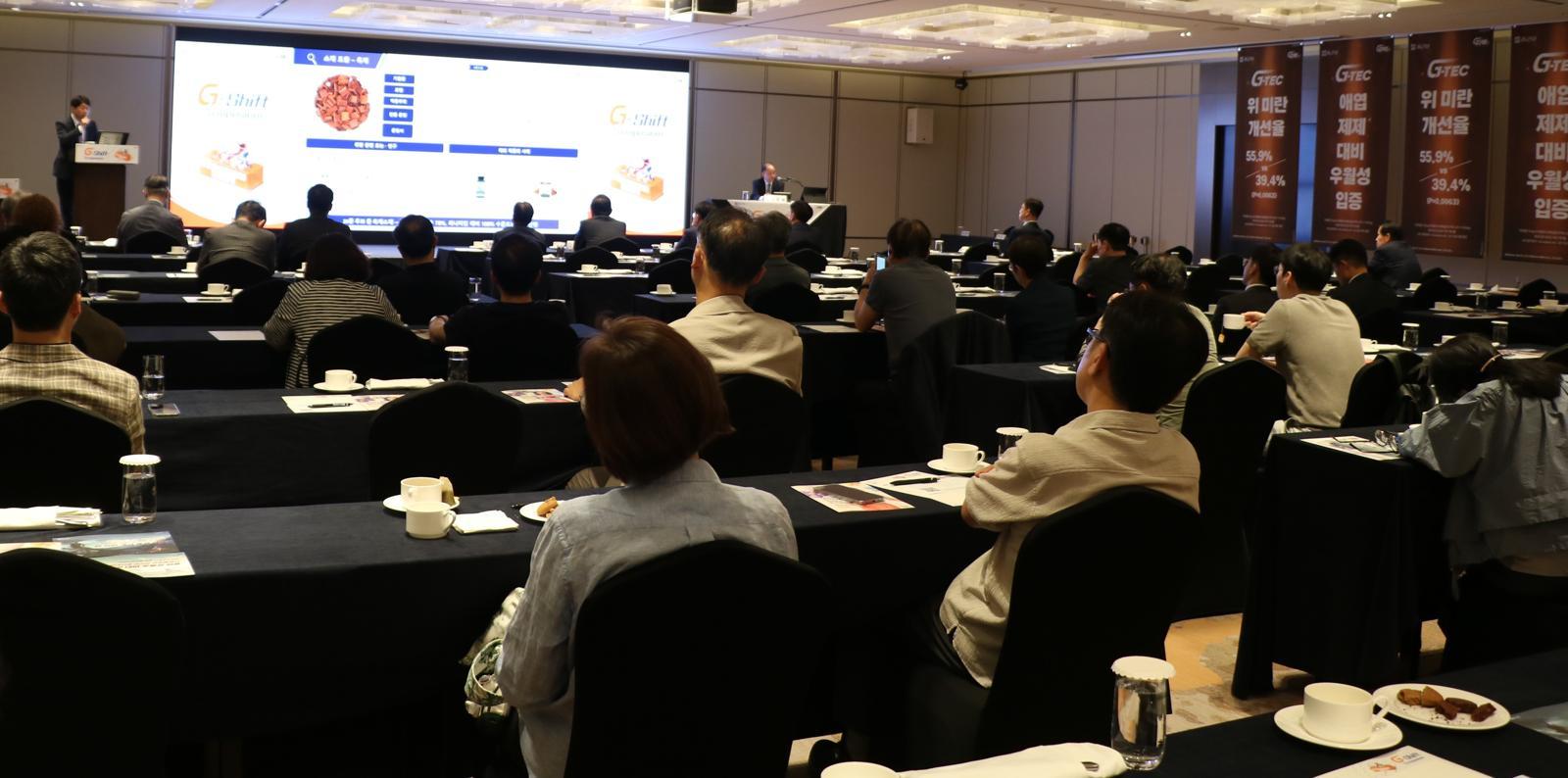
Participants listen to presentations at the launch symposium for Chong Kun Dang’s natural product gastritis treatment “G-TEC,” held at the Parnas Hotel in Gangnam-gu, Seoul, on the 30th of last month. Provided by Chong Kun Dang.
Chong Kun Dang has launched “G-TEC,” a natural product-based gastritis treatment developed with its own technology, and is moving to target the domestic gastritis treatment market.
Chong Kun Dang announced on the 1st that it held a launch symposium on the 30th of last month at the Parnas Hotel in Gangnam-gu, Seoul, to commemorate the release of the natural product-based gastritis treatment “G-TEC” (ingredient name: Cinnamomi Cortex siccus extract).
About 100 domestic gastroenterologists and healthcare professionals attended the symposium. Chong Kun Dang introduced the development process and clinical trial results of G-TEC and shared its therapeutic effects compared with existing gastritis treatments.
G-TEC is a new natural product drug developed using “Cinnamomi Cortex,” a medicinal material made from the dried bark of the stems of cinnamon trees in the laurel family. A key feature is that Chong Kun Dang applied a proprietary extraction method to enhance the therapeutic effect in gastritis treatment.
According to Chong Kun Dang, the company has been exploring materials and extraction methods that could be used for gastritis treatment from various herbal medicines since 2013. In this process, it confirmed the potential of Cinnamomi Cortex in treating gastritis, and through non-clinical trials, it verified its anti-inflammatory effects and actions that enhance gastric mucosal defense factors, such as promoting gastric mucus secretion.
The company also stated that it applied its own technology to address the major challenges in developing natural product medicines, namely homogeneity of raw materials and impurity control. It established a proprietary extraction process that enables consistent securing of active ingredients from the raw material stage and management of potential harmful substances such as benzo(a)pyrene, and it carried out the entire process—from material selection and raw material control to extraction and finished product development—using its own technology.
In clinical trials, G-TEC demonstrated improvement in gastric mucosal erosion compared with existing gastritis treatments.
In a Phase 2 clinical trial, G-TEC showed a statistically significant improvement in endoscopic efficacy rates compared with the placebo group as well as with the groups treated with rebamipide and 95% ethanol soft extract of Artemisia asiatica.
Based on these results, Chong Kun Dang did not stop at confirming non-inferiority to existing treatments, but proceeded to a Phase 3 trial to determine whether the therapeutic effect of G-TEC was superior to that of the comparator drug.
The Phase 3 clinical trial was conducted in 242 domestic patients with acute or chronic gastritis in whom gastric mucosal erosion was confirmed by endoscopy. Using a randomized, double-blind, parallel-group, multicenter design, the study compared the efficacy and safety of G-TEC with those of an active comparator drug.
The study found that the G-TEC treatment group demonstrated a statistically significantly higher improvement in the primary efficacy endpoint—endoscopic efficacy rate—than the active comparator group treated with 60 mg of 95% ethanol soft extract of Artemisia asiatica.
In particular, the odds ratio (OR) for erosion improvement in the G-TEC treatment group compared with the control group was 2.25. The 95% confidence interval was 1.26–4.03, and the p-value was 0.0063. The odds ratio is an index comparing the likelihood of a specific treatment outcome between two groups; a value greater than 1 indicates that the outcome is more likely to occur in the treatment group than in the comparison group.
Improvement effects were also confirmed in secondary efficacy endpoints. In terms of erosion cure rate, key endoscopic findings such as edema, erythema, and bleeding, and gastrointestinal symptom assessments, the G-TEC treatment group generally showed higher improvement than the control group.
In the safety evaluation, no significant differences were observed between the two treatment groups, and no serious adverse events or drug-related adverse reactions were reported.
Professor Lee Oh-Young of Hanyang University Hospital, who attended the symposium, said, “In clinical trials, G-TEC demonstrated erosion improvement and therapeutic effects compared with existing major active ingredients used in gastritis treatments,” adding, “Given its clinical evidence verifying both the characteristics of a natural product-derived medicine and its superiority over the comparator drug, it is expected to become a new treatment option for patients with gastritis.”
A Chong Kun Dang official said, “G-TEC is a new natural product drug developed entirely with in-house technology, from material selection and extraction process to the finished product,” and added, “Starting with the Seoul launch symposium, the company plans to expand academic marketing activities to promote the clinical value and therapeutic effects of G-TEC to healthcare professionals.”
ⓒ dongA.com. All rights reserved. Reproduction, redistribution, or use for AI training prohibited.
Popular News