Roundtable on “The Future of Korean-Style Sovereign AI”
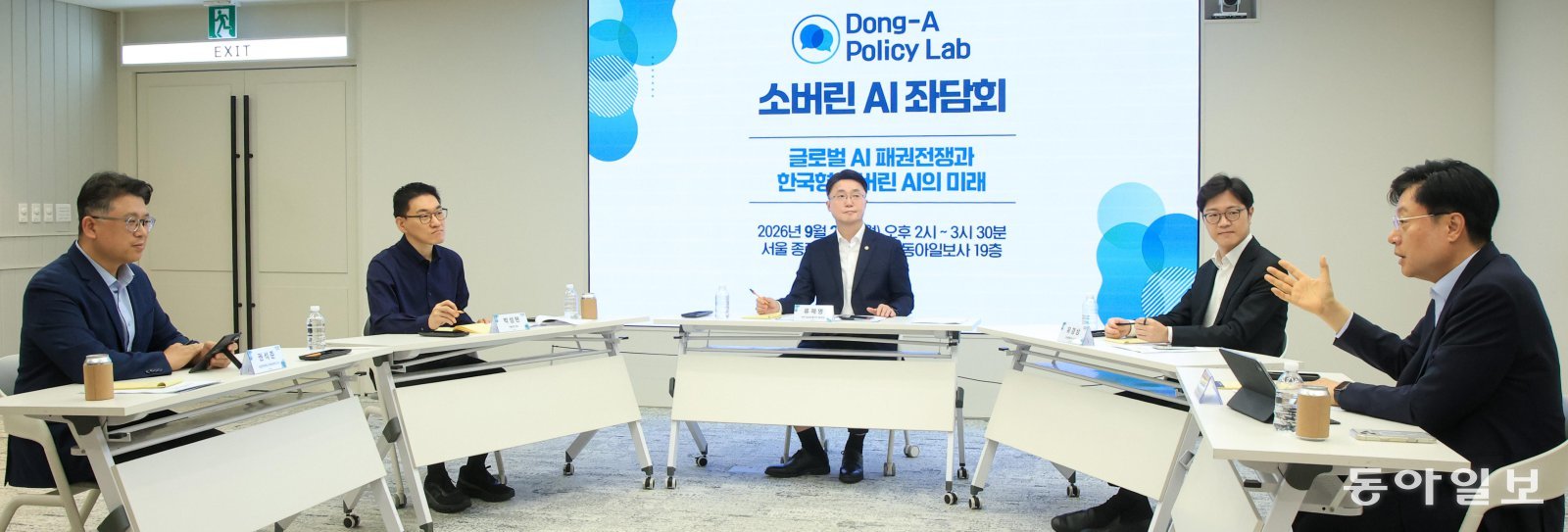
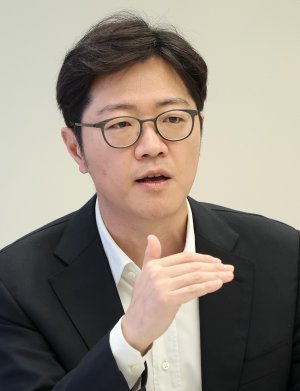
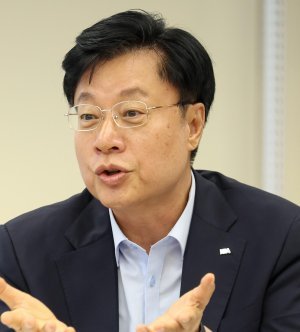
On the 21st, a “Donga Policy Lab” roundtable to discuss the future of Korea’s sovereign AI was held at the Dong-A Ilbo Gwanghwamun headquarters in Jongno-gu, Seoul. Participants engaged in wide-ranging discussions on the need for a Korean-style sovereign AI and ways to build an independent ecosystem. From left: Prof. Kwon Seok-jun of Sungkyunkwan University, Park Sung-hyun, CEO of Rebellions, Ryu Je-myung, Second Vice Minister of Science and ICT, Yoo Kyung-sang, Head of SK Telecom’s AI CIC, and Kim Hyung-chul, President of the National Information Society Agency (NIA). Reporter Song Eun-seok silverstone@donga.com
“Sovereign AI (Sovereign AI, or data sovereignty) is not a question of whether it can be done or not. It is a matter of survival if it is not done, so the goal is to make it succeed one way or another.”
Second Vice Minister of Science and ICT Ryu Je-myung stressed this point at the “Donga Policy Lab: Global AI Power Competition and the Future of Korean-Style Sovereign AI” roundtable held at the Dong-A Ilbo in Jongno-gu, Seoul, on the 21st. He underscored that amid U.S. restrictions on access to advanced AI and the spread of low-cost Chinese models, Korea must establish its own AI ecosystem that does not depend on external technologies.
The roundtable was chaired by Prof. Kwon Seok-jun of the Department of Chemical Engineering at Sungkyunkwan University and attended by Vice Minister Ryu, Rebellions CEO Park Sung-hyun, SK Telecom AI CIC Head Yoo Kyung-sang, and NIA President Kim Hyung-chul. Participants included representatives from government, public institutions, and academia, as well as corporate figures directly driving Korean-style sovereign AI in models and infrastructure.
Participants agreed that it is crucial for Korea to hold the initiative in the sovereign AI initiative the government is pursuing. They emphasized that the core issue is whether Korea can secure “choice” — the ability to immediately switch to other models and semiconductors if the supply or use conditions of overseas technologies are cut off or changed.
● “Plug pulled without warning”… Why sovereign AI is being pursued
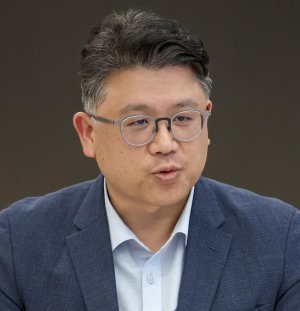
Prof. Kwon Seok-jun, Sungkyunkwan University
“Countries dependent on intelligence vs. exporters… now at a crossroads”
The first topic was why Korea needs to pursue sovereign AI. Prof. Kwon said, “For any country, it is difficult to achieve 100% self-sufficiency in AI,” and asked how Korea should respond when the supply or usage conditions for overseas models or semiconductors suddenly change. Vice Minister Ryu cited the U.S. government’s measure in July this year restricting foreign access to high-performance AI models of its company Anthropic, pointing out that “There was no prior notification through government channels at that time. There was no consultation that would have been expected between allies.”
He went on to say, “It is as if the plug was pulled without warning while companies or the government were using AI models,” adding, “We must answer how to build the capabilities and ecosystem to protect the nation and companies without external help.”
As the goal for an independent AI model to be developed by Korea, a “phased approach” was proposed: first reaching the level of China’s open models and then challenging advanced models from the U.S. and China. Yoo, Head of the AI CIC, said, “With national support and the private sector joining forces, we must at least catch up to Chinese models. After that, we should challenge the most advanced models.” He also stressed that it is important not to be satisfied with achieving global No. 1 in one round of performance evaluation, but to maintain competitiveness on an ongoing basis.
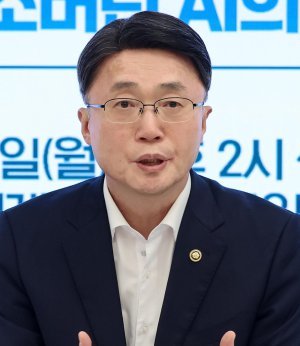
Ryu Je-myung, Second Vice Minister of Science and ICT
“U.S. Anthropic access restriction was like pulling the plug without notice”
Vice Minister Ryu also assessed that “(Korea’s sovereign AI) must at least be on par with China’s open models.” Referring to plans to expand next year’s development resources to about 10 times the level of existing projects, he said, “Even that is not enough,” emphasizing the need to attract private investment.
The discussion also touched on growing Korea’s AI ecosystem so that it can withstand external shocks. President Kim cited responses to Japan’s export restrictions on materials, components, and equipment as an example, saying, “The goal is to aim for 100 points, but at the very least we need to build a robust ecosystem that can satisfy 80 points.” He added, “Not only independent models but also semiconductors, talent, data centers, and software must grow together so that when one link is threatened, it can be restored.”
CEO Park said, “While actively using excellent overseas models and graphics processing units (GPUs), services must be able to continue operating and switch to other technologies if supply conditions change.” The idea is to apply domestic AI models and domestically produced neural processing units (NPUs) to actual services to broaden the range of choices.
● “No exclusion of Korean companies”… Government should be first sovereign AI customer
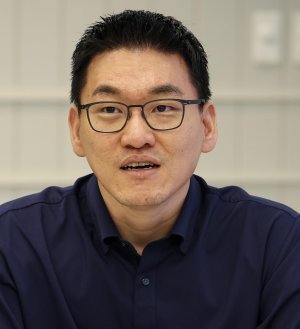
Park Sung-hyun, CEO of Rebellions
“AI chips are about scale… public tenders must be more open”
Regarding the role of public investment in sovereign AI, participants proposed that the government should become the “first major customer.” Rebellions CEO Park, whose company produces domestic NPUs, stressed that sovereign AI companies must have opportunities to participate in the government’s public procurement. He said, “If the AI semiconductor conditions for participation in public projects are specified as ‘GPUs’ (from U.S. company Nvidia), companies focusing on NPUs cannot even bid,” and proposed that “in order for domestic semiconductors to participate in tenders, participation requirements in (government) tenders should be changed to neutral expressions such as ‘AI accelerators’ or ‘AI semiconductors.’”
In particular, Park emphasized a different path to AI semiconductor self-reliance from AI model development. “Semiconductors inevitably become a battle of ‘who swallows whom’ because of economies of scale,” he said, adding, “We need driving force that goes beyond a single ministry.” For AI semiconductors, which are core to AI infrastructure, there must be sufficient demand to justify investment in product development and mass production for the sector to be sustainable.
Yoo Kyung-sang, Head of SK Telecom AI CIC
“Independent models through phased approach… catch up with China, then move to the cutting edge”
The government’s key role was identified as “stimulating demand.” Yoo said, “If you ask whether (government support) should be subsidies or demand, it is overwhelmingly demand.” He explained, “If you receive KRW 1 trillion worth of equipment support, you gain only KRW 1 trillion, but an AI company that generates KRW 1 trillion in revenue can gain recognition worth several tens of trillions of won,” emphasizing, “Once demand emerges, capital from around the world will flow in and drive up corporate value.”
However, participants also agreed that performance competition must be maintained so that companies do not become complacent with government purchases. President Kim said, “Evaluations must go beyond just reviewing proposals to verifying actual performance and pilot application results.” He added, “If a three-year contract is signed for a specific company’s product, only that company will stay in the market for three years, which weakens competition,” stressing the need for a procurement structure that allows for new challengers.
Vice Minister Ryu noted that “the initial purchaser bears significant risk,” and pointed out the reality that if problems arise after adopting a startup’s product, responsibility is concentrated on the person in charge. Highlighting the importance of indemnity mechanisms and innovative procurement to mitigate this, he announced plans to increase the budget for demonstration projects that apply domestic NPUs to real services for validation from KRW 150 billion this year to KRW 430 billion next year.
● “AI development in Korea must match the scale of AI use” The final issue of the day was how to secure the competitiveness of a Korean-style “full-stack AI” that spans models, semiconductors, data centers, and services. Participants emphasized that the most important factor is a structure in which individual technologies operate together and improve in tandem. Vice Minister Ryu said, “The U.S.-China competition ultimately comes down to a contest over who will dominate the global AI ecosystem through a full AI stack,” and argued that Korea must look holistically from land, power, and water for data centers to semiconductors, cloud, and models.
Yoo cited the call summary function of SK Telecom’s “A.” phone service as an example of such integration. “Initially, we used overseas models, but we switched to our own model, improving performance and reducing operating costs,” he said. “We are applying servers based on Rebellions’ NPUs to some aspects of the call summary service.” He also underscored the importance of feeding user experiences back into AI model improvement. “We must be able to answer whether Korean AI is getting better in proportion to how much AI is used in Korea,” he said, adding, “The ‘red-pen data’ that shows whether customers like or dislike services and how they want them changed is invaluable.”
There were also calls to lower barriers in both the public and private sectors so that AI can utilize data and perform real-world tasks. Yoo said, “One of the aspects of the U.S. AI ecosystem that inspires envy is API connections,” explaining, “AI needs to be able to book restaurants or hospitals, but in Korea companies are blocking services. SK Telecom will reflect on this and try to open up as much as possible.” An API is an interface that connects external programs so they can use a service’s functions.
Kim Hyung-chul, NIA President
“A robust ecosystem including data centers and software is also vital”
Data-sharing standards were also identified as a future task for building sovereign AI. President Kim cited personal information and copyright as obstacles to the use of public data, stating, “Even identifying copyright holders for existing data is a task in itself.” He suggested expanding the use of pseudonymization and synthetic data, and securing permissions for AI training from the contract stage.
Participants agreed that Korea must leverage its unique manufacturing base as a competitive strength to expand overseas. Vice Minister Ryu said, “Korea has manufacturing sites and experience that other countries do not. As overseas stakeholders evaluate Korea as a ‘trusted partner with alternative technologies’ and express a desire to build sovereign AI together, if we pursue a full-stack strategy from a global perspective, Korea can become an irreplaceable country,” he emphasized.
ⓒ dongA.com. All rights reserved. Reproduction, redistribution, or use for AI training prohibited.
Popular News