Texas gas-fired power plant as “First U.S. Investment”
Early launch seen likely and profitability viewed as high, factoring in rising AI power demand from U.S. Big Tech
Alaska LNG development also emerges as another candidate
Future focus on contract terms and additional construction costs
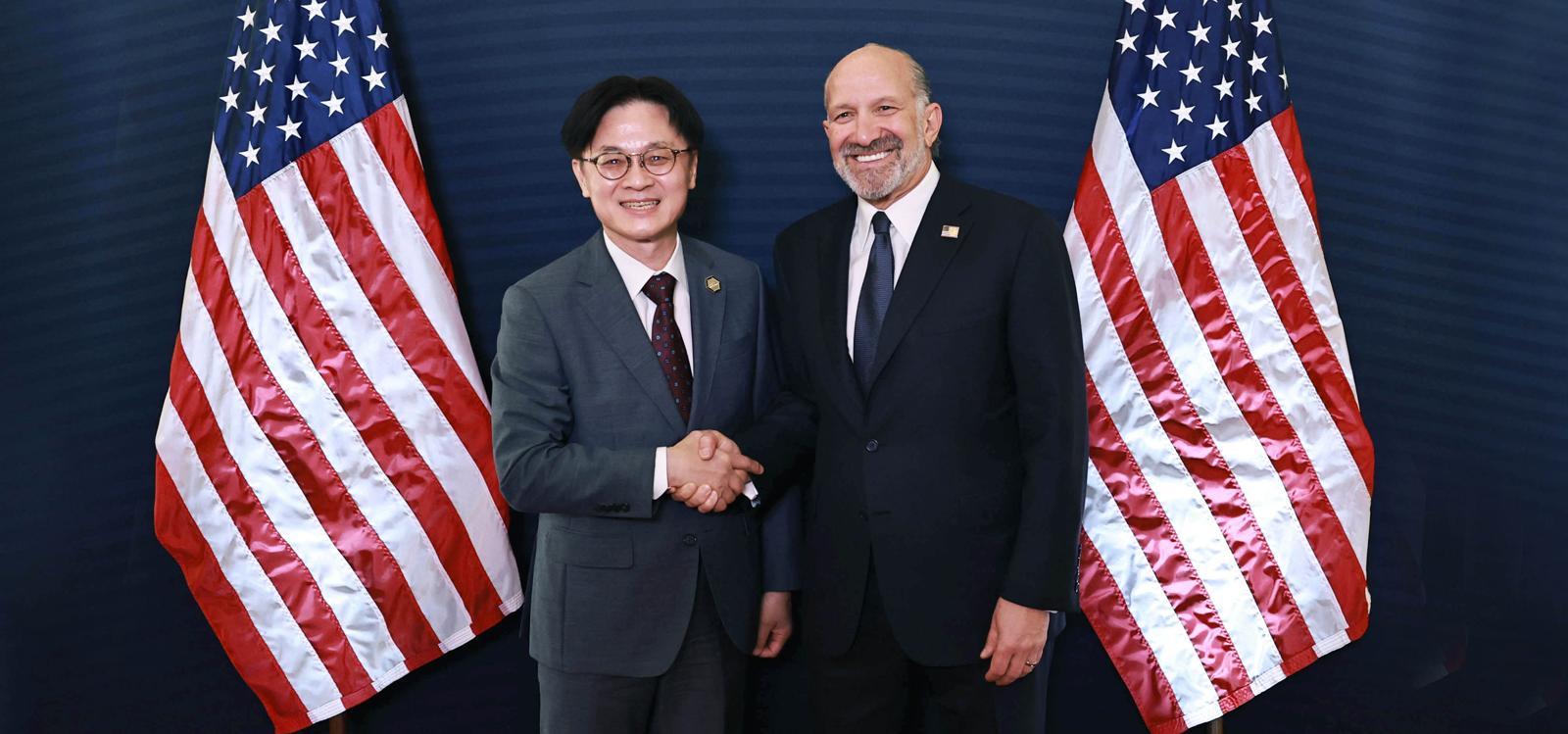
On the 2nd (local time), Minister of Trade, Industry and Energy Kim Jeong-kwan (left) attends the G20 Innovation Ministers Meeting held in Chapel Hill, North Carolina, USA, and poses for a commemorative photo with U.S. Secretary of Commerce Howard Lutnick. Provided by the Ministry of Trade, Industry and Energy
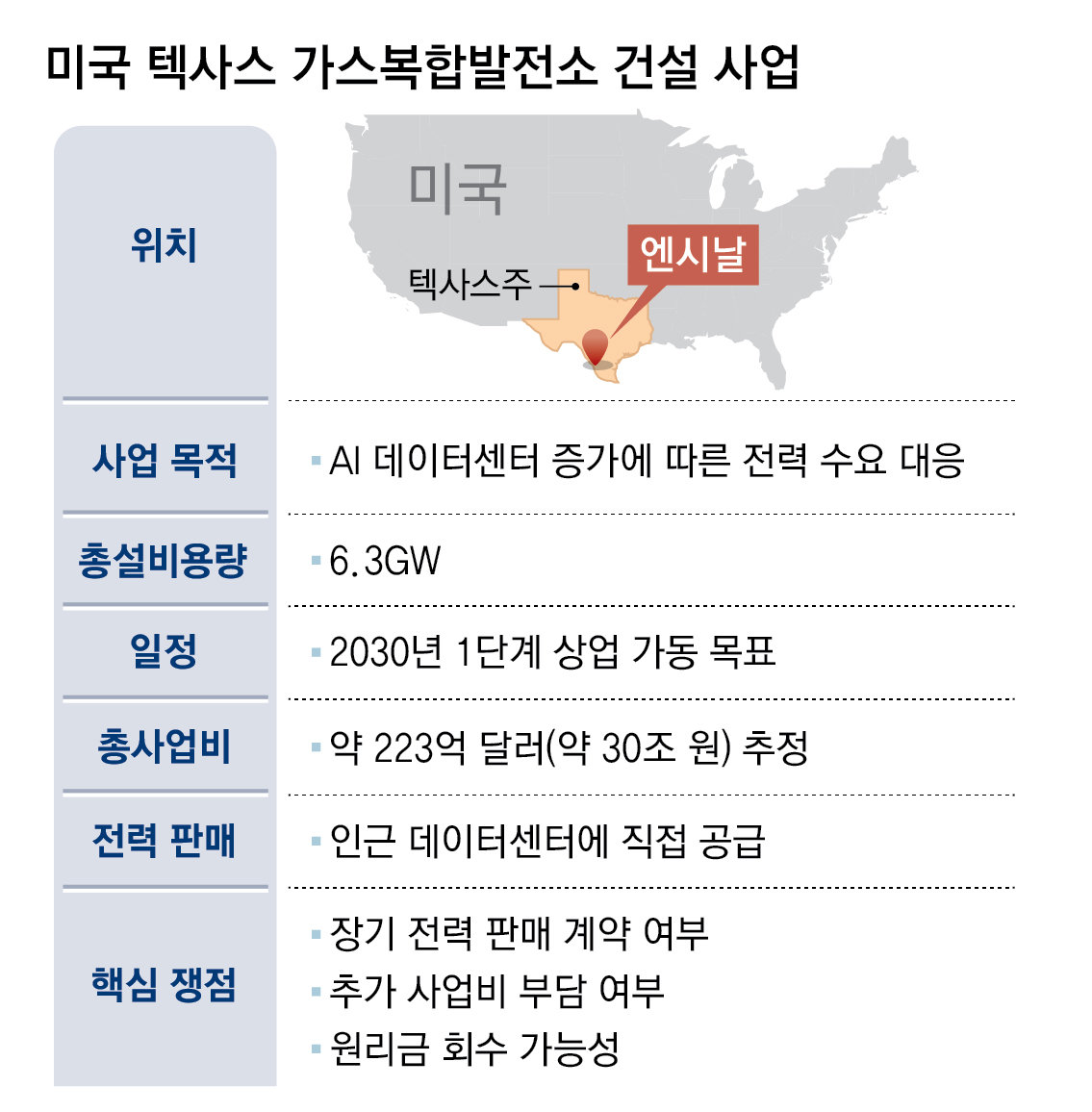
The government’s decision to select the gas-fired combined-cycle power plant construction project in Encinal, Texas as the first project under its investment initiative in the United States is seen as reflecting the assessment that a nearby artificial intelligence (AI) data center will provide a stable outlet for electricity sales. By signing a long-term power purchase agreement (PPA) with the data center, the plant can secure a buyer even before operations begin, increasing the likelihood of recouping the investment. The fact that the plant site and natural gas supply conditions as fuel are already in place, enabling faster project execution than nuclear power plants or liquefied natural gas (LNG) export terminals, is also understood to have been taken into account. However, actual profitability is expected to depend on the contract terms with the data center and on how any additional construction costs are shared.
● Targeting AIDC power demand… Aiming for operation in 2030
Within and outside the government, multiple projects such as the Louisiana LNG export terminal and nuclear power plant construction in the United States had been reviewed as candidates for the first investment. However, with electricity demand rising rapidly due to construction of AI data centers (AIDC), and with relatively favorable conditions for power plant siting and natural gas supply, the Encinal project is assessed to have scored highly in terms of early implementation potential and profitability.
The Encinal project will first build gas turbine power generation facilities to verify power demand and business viability, and then gradually expand high-efficiency combined-cycle facilities. Instead of constructing all facilities at once, it is structured to decide follow-up investments based on the performance of the initial phase, thereby reducing the risk of large-scale upfront investment. If permitting and power supply contracts proceed as planned, commencing Phase 1 commercial operation around 2030 is under consideration. Since LNG export terminals must simultaneously establish liquefaction, storage, and shipping facilities, it appears that the faster timeline for gas-fired power generation to demonstrate investment outcomes was also a consideration.
On the Korean side, funds will be contributed and invested into investment vehicles designated by the U.S. government through the fund established under the Korea-U.S. Strategic Investment Corporation. Options are also being reviewed for domestic power generation, construction, and equipment companies to form a consortium and participate in engineering, procurement and construction (EPC) and the supply of power generation equipment. To maximize the industrial impact of the investment in the United States, it is considered essential not only to provide capital to U.S. projects, but also to secure orders for Korean companies and their entry into the U.S. power generation market.
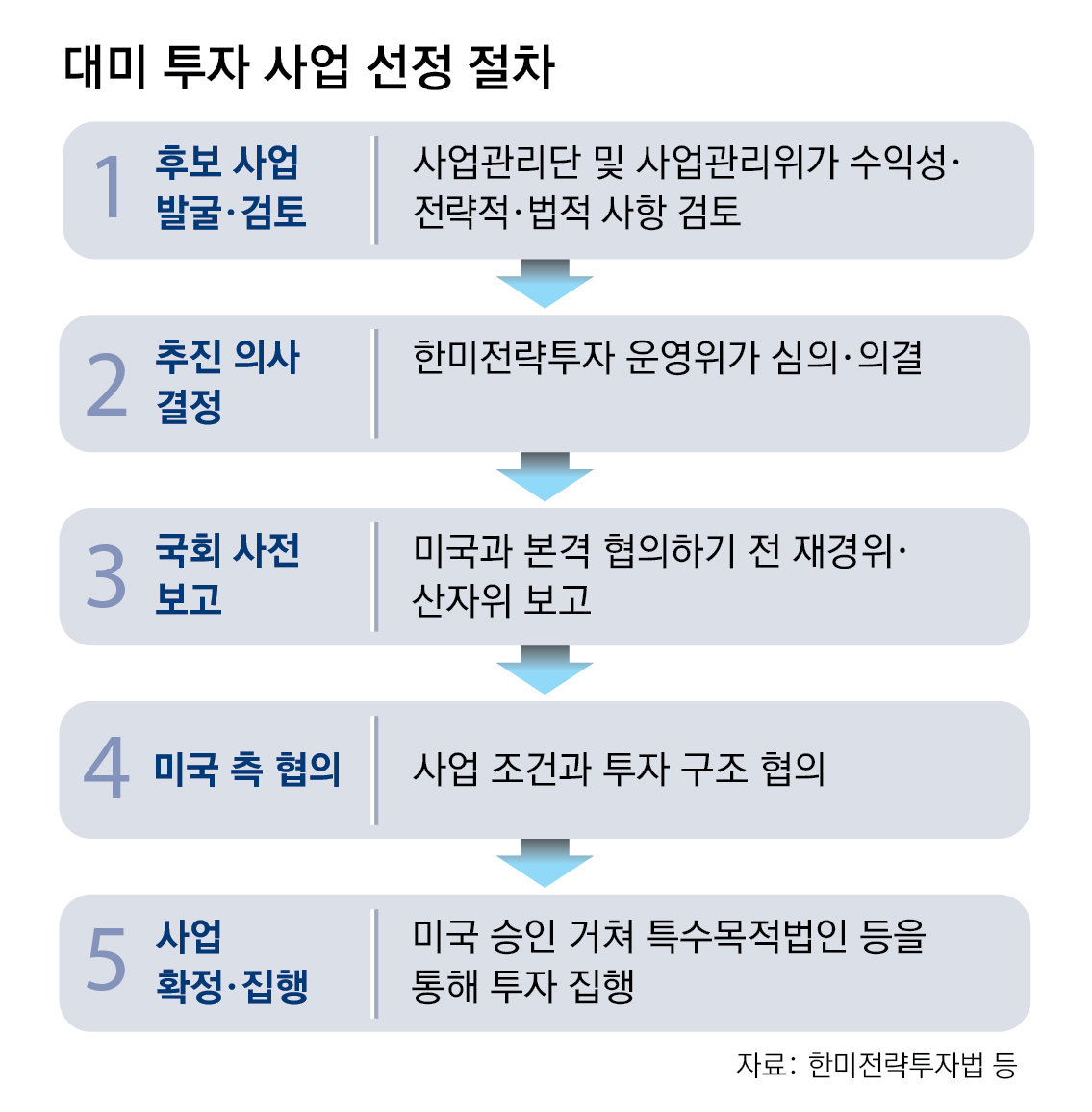
Under the Korea-U.S. Strategic Investment Act, once the Project Management Committee of the Ministry of Trade, Industry and Energy reviews candidate projects in terms of commercial rationality, strategic and legal aspects, U.S. government support conditions, and the potential for participation by domestic companies, the Steering Committee, chaired by the Deputy Prime Minister and Minister of Economy and Finance, deliberates and decides on the government’s intention to proceed with the project as well as the scale and timing of the investment. After the Steering Committee’s resolution and before beginning official consultations with the United States, the government must report relevant details to the National Assembly’s Strategy and Finance Committee and the Trade, Industry, Energy, SMEs and Startups Committee. If a project lacking secured profitability is pursued on grounds such as national security or supply chain stability, the consent of both standing committees must be obtained.
The success or failure of the Encinal project hinges on whether it can secure a stable cash flow by concluding a long-term power purchase agreement with a data center. Once such a contract is in place, the project can reduce risks stemming from fluctuations in market power prices and demand shortfalls, and secure predictable long-term revenues. Conversely, if contract negotiations are delayed or concluded at lower-than-expected prices, the likelihood of recovering the investment will diminish. Profitability is also expected to depend on which party bears any additional construction costs that may arise from building ancillary facilities such as transmission networks and gas supply pipelines, as well as from increases in raw material and labor costs.
● Nuclear power likely as the second project… Two of eight units to be “Korean-designed”
According to industry sources, among the follow-up candidates for investment in the United States, the construction of eight nuclear power units, a project estimated at USD 120 billion (about KRW 161 trillion), appears to be the most advanced. Initially, the two sides diverged over the choice of reactor model: the United States favored the AP1000 developed by Westinghouse, while Korea preferred the Korean-designed APR1400, which would increase participation and order opportunities for domestic nuclear power companies. However, it is reported that negotiations have led to a provisional agreement to build two of the eight nuclear units using the APR1400.
However, the government is said to have no plans, at this stage, to specify details such as the exact locations for the nuclear plants, overall project size, or participating companies. It is expected first to present nuclear power as a strong candidate sector for follow-up investment, and then to flesh out individual projects after reviewing their profitability and the conditions of U.S. government support.
The Alaska LNG development project is also cited as another investment candidate. Options under review include participation by Korean companies through equity investment in the project company, long-term LNG purchasing, and the supply of steel products for pipelines. However, the massive costs of pipeline construction and the economics of long-distance transportation are expected to be key variables in project selection.
It is also reported that, of the USD 200 billion in strategic industry investment excluding the USD 150 billion for Korea-U.S. shipbuilding cooperation, a plan to execute USD 20 billion on a priority basis has been placed on the negotiation table between the two countries. This stems from the U.S. side’s request for early execution of part of the funds in order to make investment outcomes visible within the Trump administration’s term of office.
ⓒ dongA.com. All rights reserved. Reproduction, redistribution, or use for AI training prohibited.
Popular News