Collaboration across the entire process from R&D to market research and business model design
Establishing ‘science-based communication standards’ to prevent market misperceptions
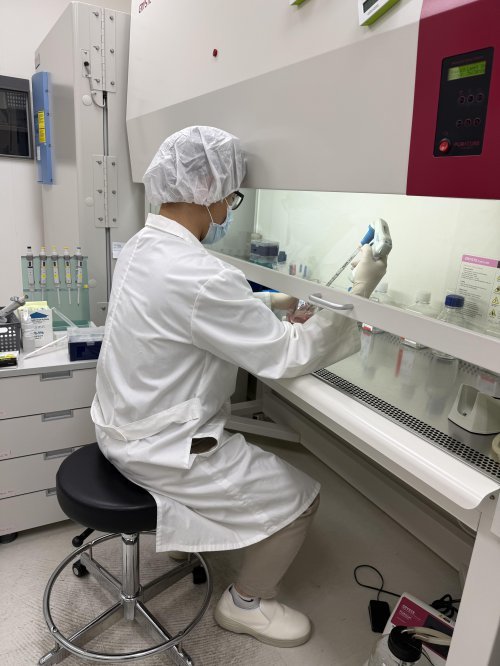
A researcher at Design Cell Co., Ltd. is conducting R&D on extracellular vesicle (EV) isolation and purification while wearing sanitary garments such as a lab coat and mask. Photo provided by Design Cell
Design Cell Co., Ltd. is accelerating basic research in regenerative medicine and drug delivery carriers using stem cells and extracellular vesicles (EVs) derived from animal tissues.
Design Cell announced that it has signed a memorandum of understanding (MOU) with METACOM Co., Ltd. for “research on extracellular vesicle-based technologies and cooperation for business commercialization.” Through this agreement, the two companies will review the commercialization potential of their R&D outcomes and jointly promote market communication.
Extracellular vesicles are microscopic particles with a lipid bilayer structure secreted by cells to the outside, and they interact with other cells by carrying biomaterials. Recently, in the bio industry, they have attracted attention as a key research material in fields such as regenerative medicine, biomarkers, and drug delivery technologies.
Based on its EV technologies derived from stem cells and animal tissues, Design Cell plans to search for functional candidate substances while sequentially carrying out initial R&D stages such as isolation and purification, characterization, and production process review. For plant-derived EVs, which are subject to relatively lower regulatory hurdles, the company will first explore potential applications in non-medical areas such as cosmetic ingredients.
METACOM will support market research on technologies and candidate substances, business model design, partner identification, and external public relations consulting. The two companies also plan to establish communication standards based on scientific evidence so that accurate information can be delivered to investors and consumers.
However, for technologies related to extracellular vesicles such as exosomes to be developed into actual pharmaceuticals, it is essential to conduct quality characterization, non-clinical and clinical trials, establish a GMP (Good Manufacturing Practice) system, and obtain approval from relevant authorities such as the Ministry of Food and Drug Safety.
A Design Cell representative stated, “This agreement does not mean that therapeutic efficacy for specific diseases has been confirmed or that formal medical products are being launched,” adding, “It is a preemptive step to establish a framework for cooperation for efficient R&D on candidate technologies and their future commercialization.”
ⓒ dongA.com. All rights reserved. Reproduction, redistribution, or use for AI training prohibited.
Popular News