Toward overcoming dementia… Breakthroughs by Korean researchers continue Institute for Basic Science publishes study in Nature “Beyond animal testing, raising hopes for new treatments”
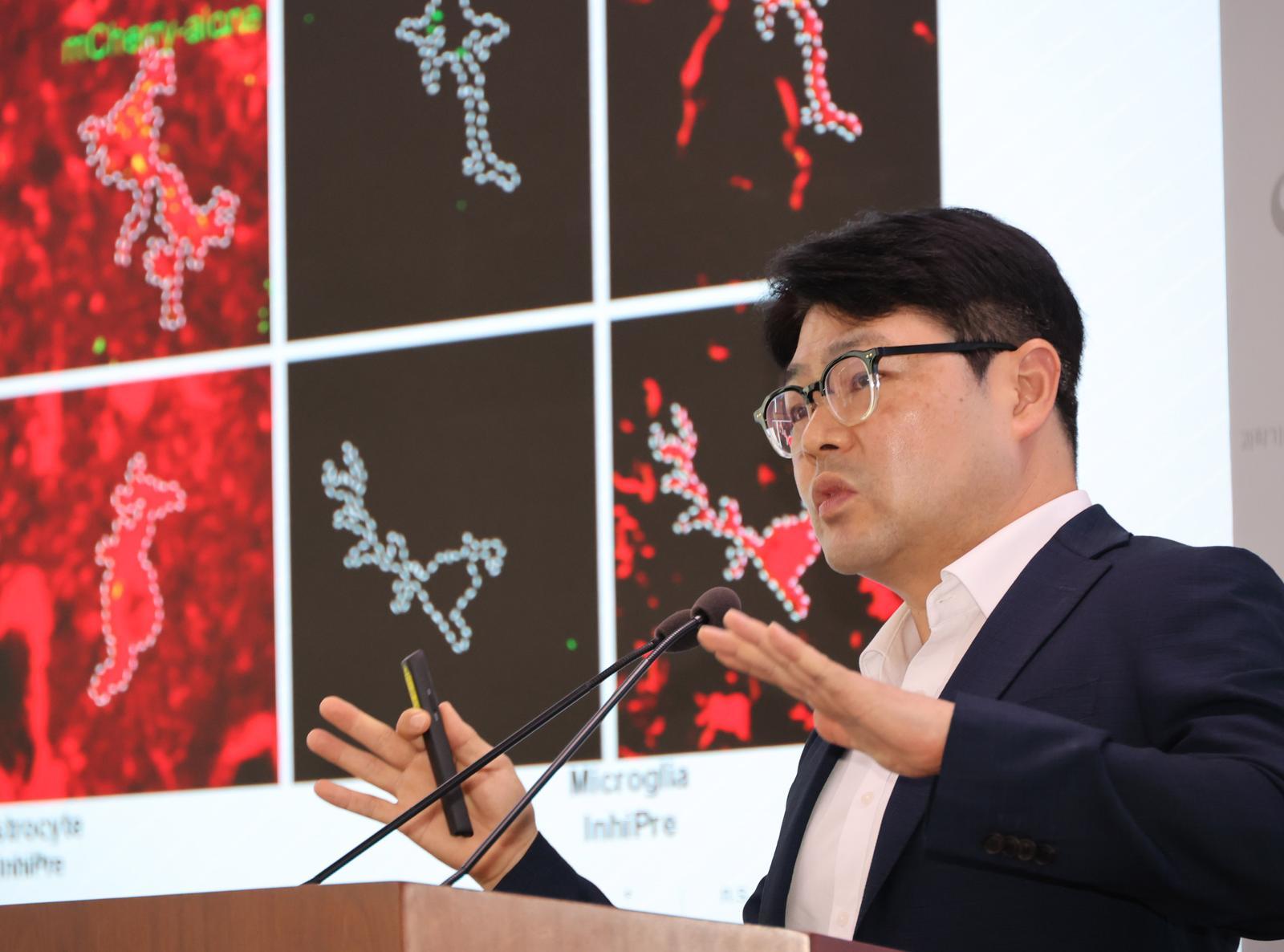
Jeong Won-seok, deputy director of the Center for Vascular Research at the Institute for Basic Science (IBS), gives a briefing on the identification of a key regulatory factor that worsens Alzheimer’s disease at the Sejong Government Complex in Sejong on the morning of the 26th. 2026.08.27. Sejong=Newsis
A Korean research team has discovered a “master switch” that simultaneously regulates multiple brain abnormalities that exacerbate Alzheimer’s disease. Until now, research has focused on eliminating amyloid beta, the causative substance of Alzheimer’s that accumulates in the brain. The latest study has identified a new target that can simultaneously reduce neuronal damage and inflammation that emerge as Alzheimer’s progresses.
According to the Ministry of Science and ICT on the 26th, a research team led by Deputy Group Leader Jeong Won-seok of the IBS Center for Vascular Research has identified ERBB4 as a key protein that aggravates Alzheimer’s. Alzheimer’s disease is the most common degenerative brain disorder that causes dementia. The study found that, in the early stages of Alzheimer’s, this protein abnormally increases in certain neurons and promotes abnormalities such as neuronal damage and inflammation. The findings were published on the 27th in the international journal Nature.
In the brains of patients with Alzheimer’s, not only does amyloid beta accumulate, but neurons become excessively excited, synapses—the junctions between neurons—disappear, and inflammation occurs, resulting in multiple problems appearing simultaneously. The challenge is that even if amyloid beta is removed, the pathological changes that have already begun do not completely disappear.
The research team removed only ERBB4 from excitatory neurons in mice with Alzheimer’s disease. As a result, excessive neuronal excitation, inflammation, and synaptic damage were reduced together, and amyloid beta accumulation decreased by more than 50%. In maze and other behavioral tests, impaired memory and cognitive function also recovered. Conversely, when ERBB4 levels were increased in normal mice, brain abnormalities similar to those seen in Alzheimer’s appeared.
The study is still at the animal experiment stage. The research team is working on a therapy that selectively inhibits ERBB4 expressed in excitatory neurons of patients with Alzheimer’s disease. Deputy Group Leader Jeong said, “It is still at an early stage, but if we can control it well, it may be possible to develop it into a therapeutic agent.”
Jeon Hye-jin
AI-translated with ChatGPT. Provided as is; original Korean text prevails.
ⓒ dongA.com. All rights reserved. Reproduction, redistribution, or use for AI training prohibited.