‘Bleeding competition’ forces Chinese firms to raise prices
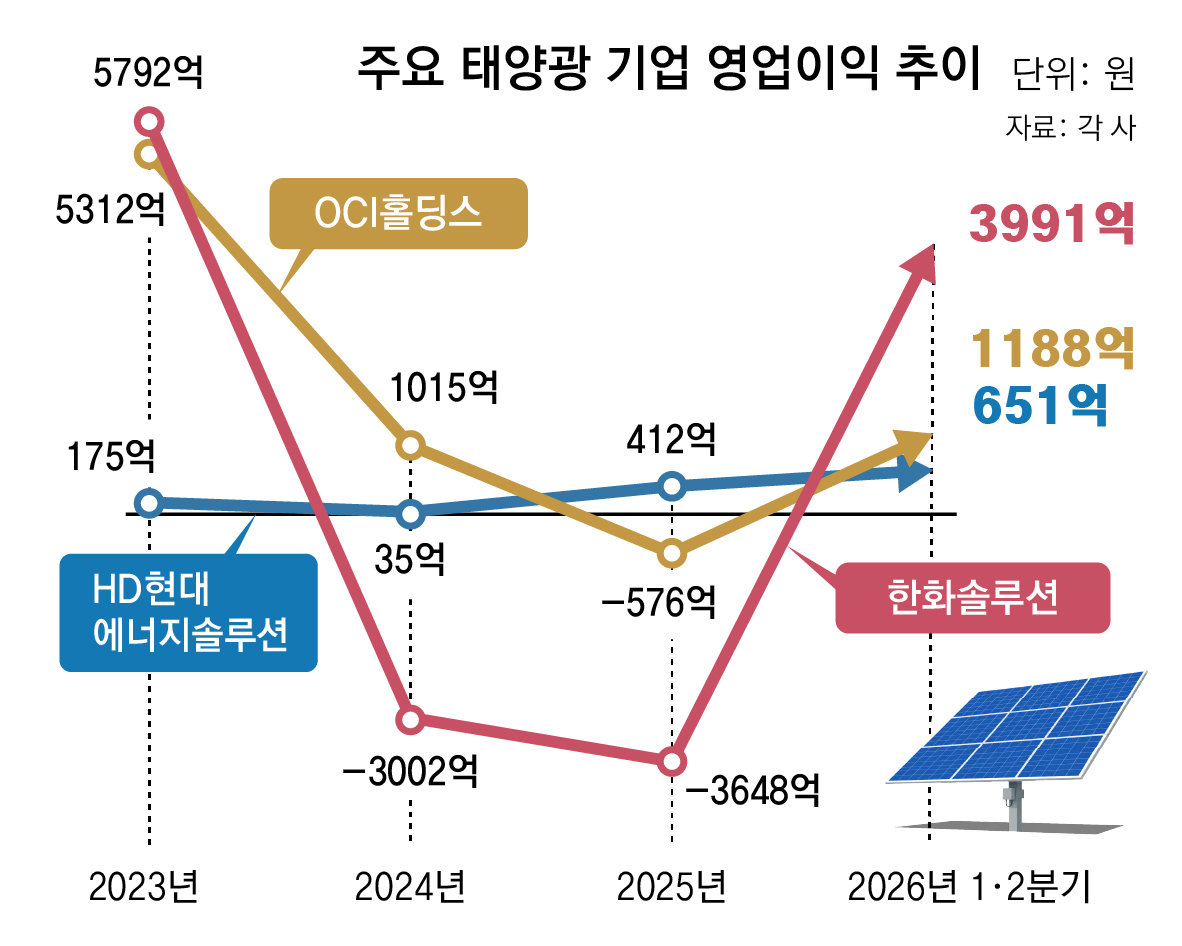
Korea’s three major solar companies all report improved results
Rising exports to the U.S. spur production capacity expansion
“Korea’s presence grows in non-Chinese solar supply chains”
The performance of major domestic solar power companies is improving. As U.S. sanctions against China intensify and China itself has begun to curb below-cost dumping, the wave of low-priced Chinese products in the solar market has eased. As a result, global solar product prices have recently risen across the board and Korean solar companies’ exports to the U.S. are also increasing.
● Clear performance improvements at three solar power companies
According to industry sources on the 12th, sales of major domestic solar power companies rose simultaneously in the second quarter of this year (April–June). Hanwha Solutions announced that second-quarter sales of its renewable energy division (Hanwha Qcells), which operates the solar business, came to KRW 2,482.3 billion, with an operating profit of KRW 164.4 billion, marking a surplus for two consecutive quarters following the first quarter of this year (January–March).
OCI Holdings likewise posted second-quarter sales of KRW 1,023.0 billion and operating profit of KRW 108.0 billion this year, with operating profit increasing by about tenfold from the previous quarter. In particular, after recently signing a long-term supply agreement (LTA) with a new U.S. customer and effectively selling out existing production volume, the company decided to expand its polysilicon and wafer production facilities through 2029. HD Hyundai Energy Solutions also recorded quarterly record results in the second quarter, with sales of KRW 1,065.0 billion and operating profit of KRW 36.1 billion.
The simultaneous improvement in performance at the three domestic solar power companies this year is largely due to the effective end of China’s “low-price offensive.” Around 2023–2024, as the Chinese government strongly pushed renewable energy policies, solar companies undertook large-scale expansions of production facilities. The sudden expansion of facilities led to a surge in supply of solar-use polysilicon and wafers, and prices plunged by about 80% from their 2022 peak. As the prices of Chinese products fell, the price gap with non-Chinese products widened to as much as threefold.
This cutthroat competition continued through 2025, steadily worsening the financial condition of Chinese companies. According to China Specialist Forum (CSF) recently, in the first half of this year (January–June), total losses at China’s three major solar companies—LONGi Green Energy, Tongwei, and TCL Zhonghuan—reached CNY 10 billion (about KRW 2.1 trillion).
● “Korea’s presence to grow in non-Chinese supply chains”
As these losses deepened and the Chinese government fully abolished export value-added tax refunds on solar products from April this year, Chinese companies also gradually began to raise product prices. This is analyzed as having contributed to the simultaneous rise in operating profits at domestic companies.
Hanwha Solutions and HD Hyundai Energy Solutions, which sell solar modules, attributed their improved quarterly results to “the impact of higher module selling prices.” According to these companies, there had previously been strong pressure to cut prices because negotiations in the international market were based on the lowest-priced Chinese products. However, following U.S. sanctions against China, this low-price pressure has eased significantly.
In addition, the recent imposition of tariffs and introduction of minimum import prices on polysilicon derivative products by the U.S. is expected to benefit Korean companies. As U.S. sanctions on China expand, demand is increasing for supply chains that exclude China.
Yoon Jae-sung, an analyst at Hana Securities, stated in a recent report, “Given that production capacity for polysilicon, wafers, and cells within the U.S. is absolutely insufficient, it is expected that the U.S. will take relatively favorable measures toward non-Chinese products.” This suggests that Korean solar power companies could gain a greater presence than before.
ⓒ dongA.com. All rights reserved. Reproduction, redistribution, or use for AI training prohibited.
Popular News