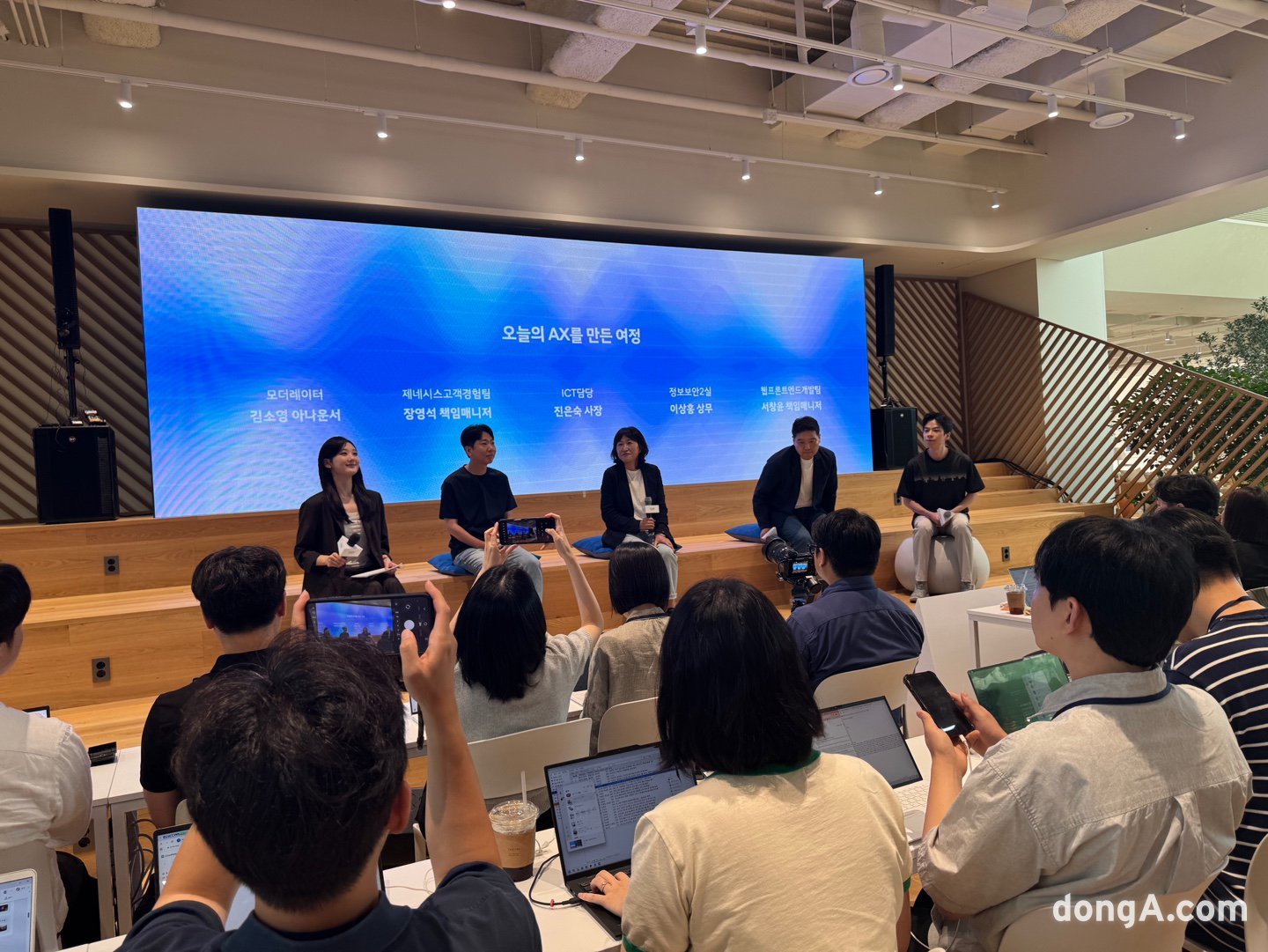
Hyundai Motor Group holds the “AX Performance Presentation” at its headquarters in Yangjae-dong, Seocho-gu, Seoul, on the 12th. Photo by Reporter Jung Jin-su
Hyundai Motor Group has trimmed “excess fat” from its operations using AI. After achieving annual cost savings of KRW 5.24 billion in manufacturing alone, the Group is now improving efficiency across all areas, including research and development, maintenance, and customer service, making visible the成果 of its AI Transformation (AX). Market observers say the introduction of AI is translating into tangible management outcomes in the form of productivity gains and cost efficiencies.
On the 12th, Hyundai Motor Group held the “AX Performance Presentation” at its headquarters in Yangjae-dong, Seocho-gu, Seoul, where it disclosed the key成果 and future direction of its ongoing Digital Transformation (DX) and AI Transformation (AX).
Since last year, Hyundai Motor Group has opened its in-house generative AI platform “H Chat Pro” to general employees. H Chat Pro is a platform that allows users to select and utilize external generative AI models such as ChatGPT, Google Gemini, and Anthropic Claude for work tasks. It currently has about 30,000 users, covering approximately 80% of Hyundai Motor and Kia’s general and research staff.
By extending AI use beyond specific developers or IT organizations to general employees, AI is now being utilized in a wide range of tasks, including document drafting, data analysis, information search, and even coding.
Hyundai Motor Group is also operating AI training programs in which executives participate directly, as well as an in-house AI community. The aim is to spread a culture across the organization in which frontline employees themselves use AI and apply it to their daily work.
Jin Eun-soo, President in charge of ICT at Hyundai Motor Group, stated that “AI is a tool to be used, not an end in itself,” stressing that “what is important is to understand AI and apply it to real work in order to generate成果 for the organization.”
AI is generating concrete productivity improvements in actual work settings. In research and development, the Group introduced a “Crash Safety AI Assistant” at the Namyang R&D Center late last year. This AI-based R&D system integrates search across decades of accumulated vehicle crash test results, images, and analytical data, and supports comparison and analysis of similar past cases.
Previously, researchers had to spend considerable time manually searching for the necessary data and comparing it with past test results. Since the introduction of AI, the time required to search for cases and review analytical data has been cut by about 90%. In the R&D process, AI is effectively linking past experience and knowledge to decision-making on the ground.
In manufacturing, AI-driven automation is directly translating into cost reductions. The “AI Automation Recognition Service” is a system in which AI automatically reads the Vehicle Identification Number (VIN) and compares it in real time with actual vehicle information and data registered in the production system. By automating the process in which workers previously checked and input vehicle information manually, the system has reduced the likelihood of errors and improved efficiency in the production process. Currently deployed at around 70 Hyundai Motor and Kia production sites worldwide, this system generates annual cost savings of KRW 5.24 billion at Hyundai Motor Group plants. It is cited as a representative example of how the Group is using AI as a tool to directly improve manufacturing costs and production efficiency.
AI has also been applied to the parts supply process on production lines. The trolley alignment optimization technology analyzes the movement data of trolleys that transport parts along the production line, optimizes their complex routes, and automatically controls equipment. This has reduced unnecessary production downtime caused by trolley alignment issues by 86%. By using AI to identify and optimize small inefficiencies in the production process, the Group has translated these improvements into higher productivity.
Hyundai Motor Group is expanding AI from a technology used only by specialist developers to one that frontline employees can apply directly to their work. A representative example is “E-Forest: Polaris,” an AI agent ecosystem specialized for manufacturing. It enables engineers to directly create and deploy AI agents tailored to functions such as quality, production, facilities, and logistics. Instead of requiring frontline staff to submit separate requests to AI development teams for needed features, the system allows on-site employees to build AI solutions suited to their specific tasks themselves.
Through this approach, Hyundai Motor Group plans to rapidly convert a wide variety of tasks arising across manufacturing sites to AI-based processes and to build a structure in which ideas from the field lead directly to real work innovation.
The scope of AI use is expanding beyond manufacturing sites into service operations. At overseas maintenance sites, a large language model (LLM)-based “Maintenance Support AI Service” has been deployed. When a technician inputs a vehicle error code or symptom, the AI analyzes past maintenance records and related technical information to propose likely causes and response measures. By leveraging the experience of skilled technicians and historical service data through AI at the point of service, the time required for maintenance response has been reduced by 42%.
AI has also been adopted in customer-response operations. Hyundai Motor Group has built a “Customer Review Response Automation Solution” that automatically classifies global customer reviews and proposes appropriate responses. Previously, it took an average of 35 minutes to process a single customer review; with AI, this has been reduced to 5 minutes. Cutting processing time by 30 minutes per case translates into an approximately 85.7% reduction in handling time. Currently, more than 85% of all customer reviews are handled based on AI, and from next month the Group plans to pursue full automation of all customer review-response tasks. The system supports 17 languages, enabling automatic analysis of customer feedback received from global markets and generation of responses.
● Eight years of accumulated DX underpin AI成果The background enabling Hyundai Motor Group to deploy AI so rapidly in the workplace is the DX it has been driving for several years. Since 2018, the Group has been promoting digital transformation to change working methods and the data utilization environment. At that time, Chairman Chung Euisun of Hyundai Motor Group articulated the direction that the Group “must become more of an IT company than IT companies themselves.”
In line with this, the Group introduced SaaS-based work management and collaboration platforms such as Jira, Dooray, and Confluence, building an environment in which work can be managed systematically and knowledge and information can be shared within the organization.
In the past, work-related information often remained in personal email or messenger accounts and was limited to the knowledge of the individual in charge. Hyundai Motor Group has introduced co-authoring tools and work management systems to build a structure in which individual experience and knowledge are accumulated as organizational assets.
The Group has also established a global collaboration environment. In particular, it built a “Global One Data Pipeline” to standardize data scattered across different organizations and connect it into a single flow. Rather than merely securing data, the Group has focused on creating a foundation that organically links data generated across the entire value chain—from R&D, production, and sales to quality—so that required information can be used in a timely manner and support decision-making.
Hyundai Motor Group views AX transformation as a change in working methods and organizational culture. President Jin explained that “technology paradigms have continually evolved—from computers and the internet to mobile and cloud,” and that “generative AI is an important technology in that same continuum.” He added, “AI can greatly help increase the speed and accuracy of decision-making, but ultimately what matters is applying AI to real work to generate成果 for the organization.”
● Era of physical AI… expanding investment in data and AI infrastructureHyundai Motor Group expects that in the forthcoming era of “physical AI,” which will encompass vehicles, robotics, and manufacturing sites, the AX foundation it has built will become an important competitive edge. Physical AI refers to technology that enables AI to perceive, judge, and act in real physical environments such as vehicles, robots, and factories, beyond the digital space. To this end, the view is that a virtuous cycle is needed in which not only AI models but also high-quality data are continuously secured and trained, and new data are accumulated again in the field.
Hyundai Motor Group is pursuing a strategy of actively leveraging excellent external AI models and technologies while building internal AI models and training platforms in areas where security and data protection are critical.
The Group is also expanding investment in AI infrastructure. It has secured a site for a data center in Saemangeum with a capacity of about 500 MW and is preparing AI infrastructure with the goal of construction between 2029 and 2030. Based on this, Hyundai Motor Group plans to maximize AI utilization across diverse domains, including vehicle development and production, autonomous driving, and robotics.
President Jin stated, “Hyundai Motor Group is learning faster than anyone and translating that into tangible成果, making it the company that utilizes AI most effectively worldwide,” adding, “We will continue to learn and grow rapidly, not only in AI but also in new technologies that will emerge in the future.”
He continued, “Hyundai Motor Group’s AX transition is not a specific project, but a competitiveness embedded in the organization and a change in the way we work,” and added, “Going forward, we will also support the AX transition of small and medium-sized enterprises, broaden the base of AI utilization across the industrial ecosystem, and thereby contribute to enhancing the competitiveness of Korean industry.”
ⓒ dongA.com. All rights reserved. Reproduction, redistribution, or use for AI training prohibited.
Popular News