Led by the Ministry of Climate, Energy and Environment… Promoting commercialization of eco-friendly physical recycling by 2030
Resource circulation from clothing to automotive interior materials and building panels with participation from 11 industry-academia-research institutions
Contributing to global environmental regulation compliance and the establishment of a K-circular economy value chain
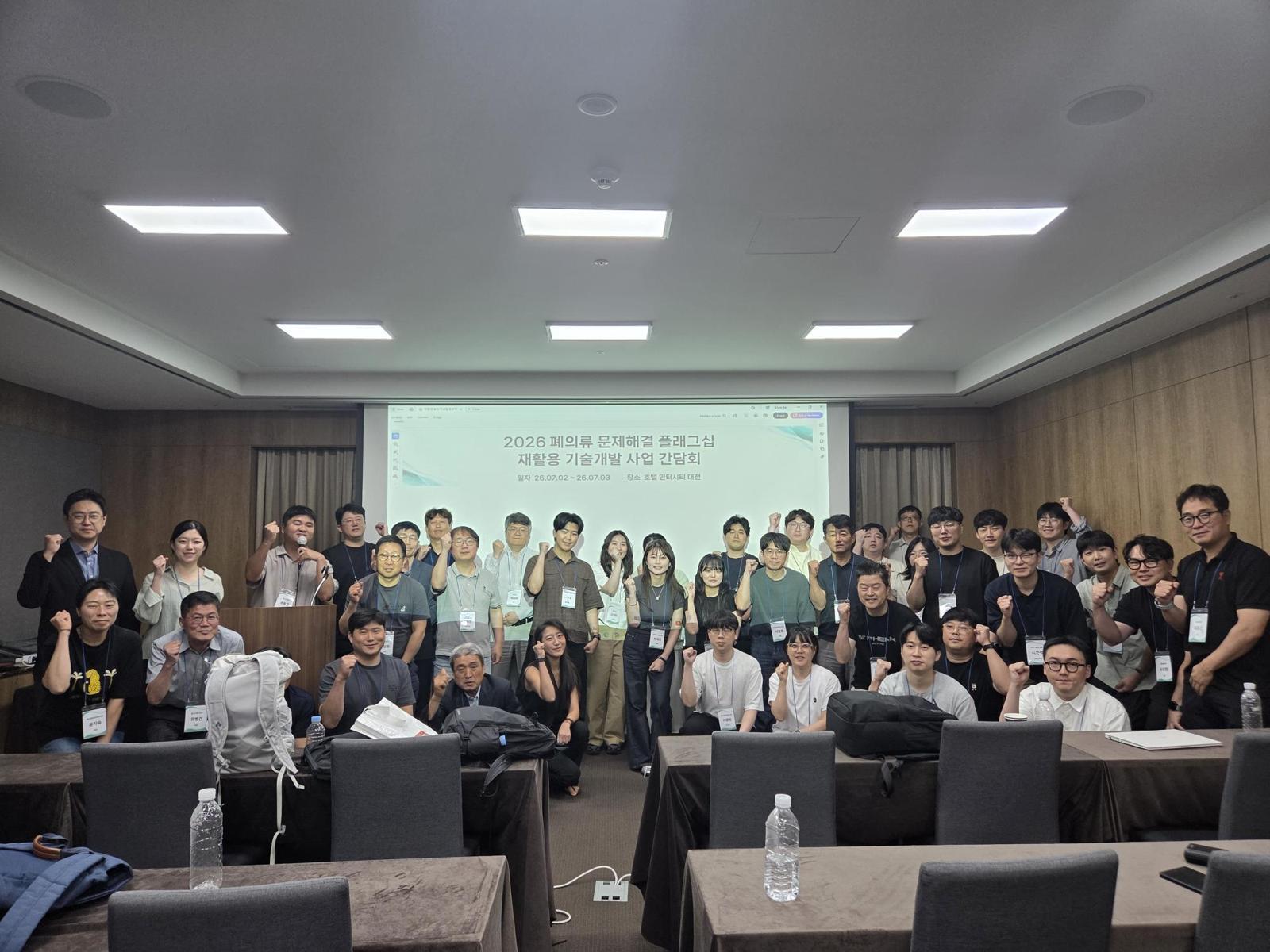
At the “2026 Waste Clothing Problem-Solving Flagship Recycling Technology Development Project Meeting” held in Daejeon on the 2nd, industry-academia-research participants, including Gong Dong-hwan, CEO of the lead institution Textile.ly Co., Ltd. (fifth from the left in the front row in the photo), pose for a commemorative photograph. Through this project, the consortium plans to localize physical recycling technologies that respond to carbon reduction and global environmental regulations. Photo provided by Textile.ly
Textile.ly Co., Ltd., a company specializing in resource circulation of waste blended fibers (CEO Gong Dong-hwan), announced that it has been selected as the lead institution for the “Waste Clothing Problem-Solving Flagship Recycling Technology Development Project,” overseen by the Ministry of Climate, Energy and Environment and supported by the Korea Environmental Industry & Technology Institute (KEITI).
The total project budget is approximately KRW 8.1 billion (KRW 5.6 billion in government funding and about KRW 2.5 billion in private-sector contributions), and the project will run for 57 months from April 2026 to December 2030. The goal is to develop basic processes by 2028 and complete mass-production demonstration and commercialization by 2030.
Large volumes of waste clothing generated each year have mostly been landfilled or incinerated, causing environmental burdens such as greenhouse gas emissions. In particular, given that the fashion and textile industry accounts for a share of global carbon emissions, resource recirculation of waste clothing is regarded as a key task for carbon reduction. With global environmental regulations such as the European Union’s Ecodesign for Sustainable Products Regulation (ESPR) entering full force, securing recycling technologies has emerged as a factor in strengthening the responsiveness of the domestic textile and fashion industry.
In response, the detailed task being pursued is “Technology Development for Recycling Waste Clothing into Raw Materials and for Productization into Recycled Fibers.” The core objective is to establish a circular system that converts waste clothing into raw materials using eco-friendly physical recycling technologies, and then productizes them into apparel and industrial textiles, automotive interior materials, and construction panels.
A total of 11 institutions from industry, academia, and research will participate in this project to conduct research and development by field.
In the preprocessing and raw material segment, Textile.ly will develop technologies for removing heterogeneous materials, manufacturing PET chips, and solid-state polymerization, while the Inha University Industry-Academic Cooperation Foundation will be responsible for PET property analysis. Muhansangsa Social Cooperative will handle collection and supply as well as the accessory removal system, and Woosung Fiber will be in charge of fiber length recarding technology.
In the yarn and fabric segment, the Korea Institute of Industrial Technology and Kolon Industries Inc. FnC Division will develop PET spinning technology; Shinhan Spinning Co., Ltd. will be responsible for spun yarn technology; and the ECO Convergence Textile Research Institute will advance knitting and dyeing technologies.
In the productization segment, Kolon FnC and The Green Generation Co., Ltd. will handle apparel, Daehan Solution Co., Ltd. will manage automotive interior materials, and Samwoo Architects & Engineers Carbonomy will be responsible for technologies to manufacture interior and exterior construction materials.
The Korea Institute of Industrial Technology will support measurement of carbon reduction volumes and acquisition of Global Recycled Standard (GRS) and Environmental Product Declaration certifications.
The consortium plans to link this initiative with the “AI-based Automated System for Sorting and Separating Waste Clothing” project, working to establish an integrated system that connects collection and sorting with raw material conversion and productization.
Gong Dong-hwan, CEO of Textile.ly, stated, “Recycling waste clothing is a task essential for resource circulation and responding to global environmental regulations,” adding, “By pooling the capabilities of industry, academia, and research, the consortium will promote the localization of physical recycling technologies and contribute to the transition of the domestic textile industry toward a circular economy.”
ⓒ dongA.com. All rights reserved. Reproduction, redistribution, or use for AI training prohibited.
Popular News