Resource reallocation accelerates amid memory shortfall
SK says it is “reviewing a range of options”
Large-scale financing push in U.S. and other markets
“The future of chipmakers hinges on securing firepower”
View of SK hynix headquarters in Icheon, Gyeonggi Province. 2026.07.29. Newsis
SK hynix is accelerating a company-wide “resource reallocation” initiative to respond to a global memory shortage stemming from surging demand for artificial intelligence (AI) semiconductors. The company has determined that expanding production capacity is essential to capture exploding demand in the memory semiconductor market, leveraging its competitiveness in high-bandwidth memory (HBM). To this end, it is simultaneously pursuing asset optimization and capital raising.
● SK hynix considers plant sale
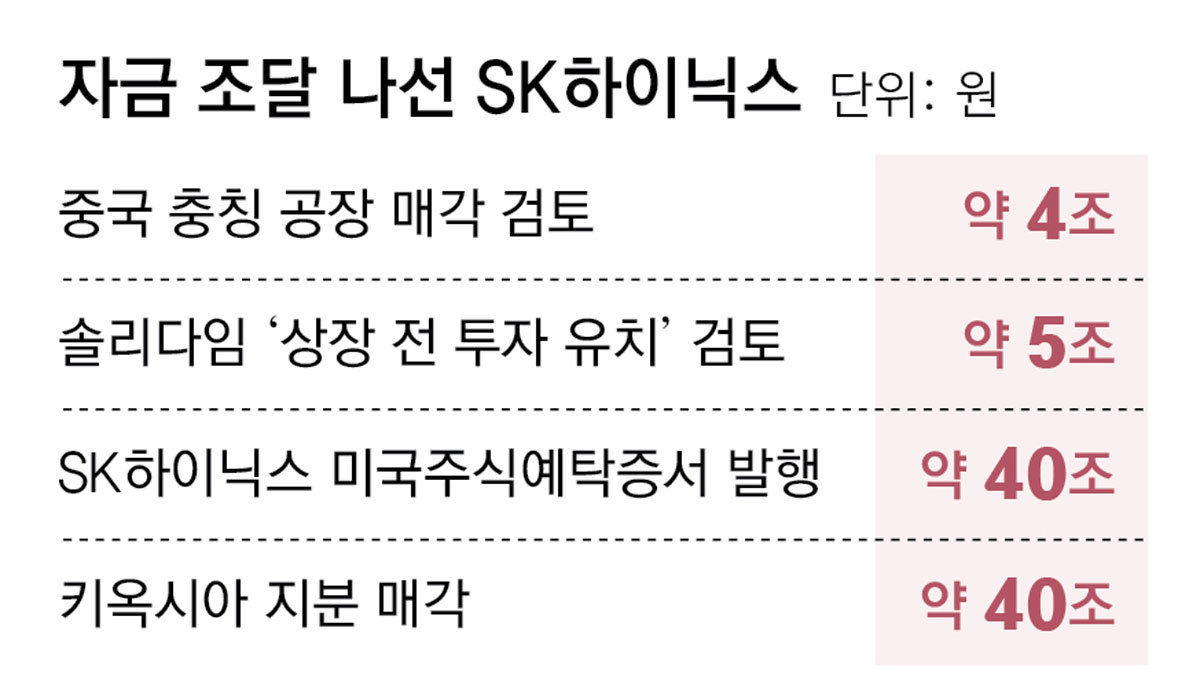
On the 8th (local time), Bloomberg reported that SK hynix is considering selling its NAND flash plant in Chongqing, China, which is estimated to be worth about USD 3 billion (approximately KRW 4 trillion).
The Chongqing plant is a base for back-end (packaging) processes for NAND flash. The industry interprets the review of this equity sale as part of a broader resource reallocation effort to increase production capacity for key semiconductors such as HBM. U.S. export controls on semiconductors to China, which have made it difficult to expand advanced facilities in the country, also appear to have influenced the review of a sale. SK hynix stated, “We are reviewing various possibilities, but nothing has been finalized.”
SK hynix is also simultaneously conducting large-scale capital raising to fund semiconductor infrastructure investments. Recently, it raised about USD 26.5 billion (approximately KRW 40 trillion) through a public offering of American Depositary Receipts (ADR) in the U.S. market. In addition, U.S. NAND subsidiary Solidigm has launched a pre-IPO (pre-listing fundraising) targeting KRW 5 trillion, with a corporate valuation goal of KRW 50 trillion, and the company is also known to have secured around KRW 40 trillion by recently partially disposing of its stake in Japan’s Kioxia, in which it invested in 2018.
The “war chest” secured in this way is to be deployed in building core production bases going forward. On the 7th, SK hynix’s board of directors approved a total investment of KRW 54.3 trillion in the semiconductor cluster in Yongin, Gyeonggi Province, and the fab in Cheongju, North Chungcheong Province. SK Group Chairman Chey Tae-won also indicated the possibility of additional overseas investments, saying in a recent U.S. media interview, “In addition to the advanced packaging facility in Indiana, very large investments will be made in the near future.”
● Global DRAM production race accelerates
SK hynix is betting heavily on resource acquisition and infrastructure investment because absolute production volume has become critical in the global DRAM market.
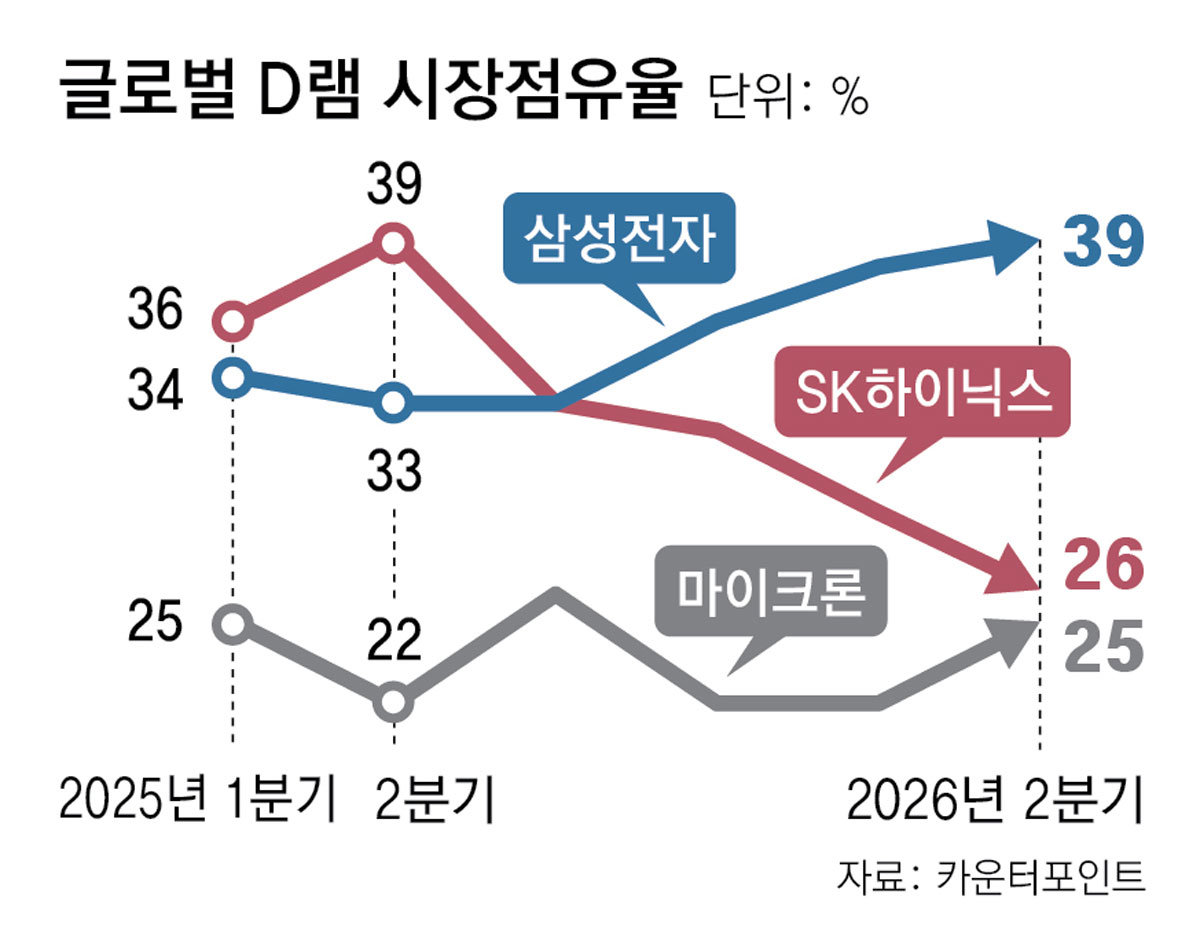
Buoyed by its HBM competitiveness, SK hynix captured the No. 1 position in global DRAM market share (36%) for the first time in its history in the first quarter (January–March) of last year. However, it ceded the top spot back to Samsung Electronics in the fourth quarter (October–December) of last year, which leveraged its massive production capacity, and in the second quarter (April–June) of this year its share fell to 26%, coming under pressure from third-ranked Micron (25%) with only a one-percentage-point gap.
The key factor behind these market-share shifts is the production capacity gap. According to market research firm Omdia, based on 300 mm wafers, Samsung Electronics’ annual DRAM output is about 8.175 million wafers, whereas SK hynix’s is 6.39 million wafers, equivalent to 78% of Samsung’s level. Although SK hynix initially led the HBM market, analysts say limitations in its total production capacity have contributed to its decline in the market rankings.
Competitors’ aggressive investment moves are also adding pressure on SK hynix. Samsung Electronics has announced a long-term domestic investment plan totaling KRW 2,106 trillion, while U.S. company Micron has unveiled plans to invest a total of USD 250 billion (approximately KRW 377 trillion) by 2035. China’s ChangXin Memory Technologies (CXMT) also plans to pour funds raised through its initial public offering (IPO) into expanding DRAM capacity.
Kim Dae-jong, a professor at Sejong University, said, “The expansion of production facilities to maintain market share and the ability to raise the capital needed for this will determine the future of semiconductor companies.”
ⓒ dongA.com. All rights reserved. Reproduction, redistribution, or use for AI training prohibited.
Popular News