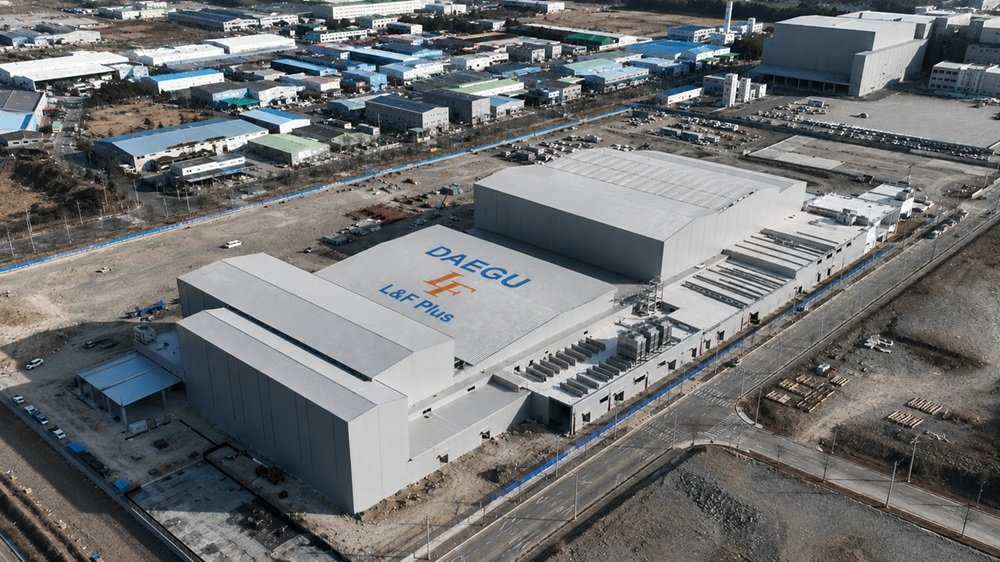
L&F LFP subsidiary L&F Plus Daegu plant overview. Provided by L&F
L&F announced on the 21st that it has signed a strategic investment agreement with CIS Chemical, a company specializing in battery recycling. The move is aimed at expanding its lithium iron phosphate (LFP) and nickel cobalt manganese (NCM) battery recycling business. The investment size and equity stake were not disclosed.
This investment is a follow-up to the LFP and NCM battery recycling cooperation memorandum of understanding signed by the two companies in May. L&F plans to utilize CIS Chemical’s post-processing technology to secure a supply chain for recycled raw materials and respond to customers’ battery recycling demand.
L&F has been building pre-processing capabilities through its subsidiary JHC Chemical Industry (JHC) to crush and sort waste cathode materials and black mass. Going forward, it plans to link this with CIS Chemical’s hydrometallurgy-based post-processing technology to strengthen a business structure that recovers key metals such as lithium, nickel, and cobalt.
Pre-processing refers to the process of shredding waste batteries and cathode scrap to produce black mass containing metal components. Post-processing is the stage in which lithium, nickel, cobalt, and other elements are separated and refined from black mass so they can be reused as battery raw materials.
CIS Chemical is conducting LFP and NCM battery recycling operations based on its proprietary hydrometallurgy and solvent extraction processes. Its lithium carbonate recovery rate is around 98%, and it has completed verification of its LFP recycling technology with major domestic customers, according to the company.
L&F plans to secure LFP and NCM post-processing volumes through CIS Chemical and, starting next year, to receive priority allocation of LFP recycling production capacity so the two companies can jointly respond to customer demand.
The two companies will also work on developing high-purity “clean MHP,” a mixed nickel–cobalt hydroxide recovered from NCM batteries. They intend to broaden the scope of cooperation to include joint development of re-materialization technologies that recycle LFP batteries and reuse recovered materials as cathode raw materials, as well as participation in national R&D projects.
Heo Je-hong, CEO of L&F, said, “This investment goes beyond a simple equity participation and is a strategic decision to expand the battery recycling business,” adding, “By adding post-processing competitiveness to our existing pre-processing capabilities, we will expand the recycled raw material supply chain and respond to customers’ circular economy requirements.”
In the battery industry, the importance of securing recycling feedstock is increasing as regulations on the use of recycled materials and the collection of waste batteries are being strengthened, particularly in Europe.
The European Union (EU) Battery Regulation stipulates that from 2031, the minimum share of recycled materials used in new battery manufacturing must be 16% for cobalt, 6% for lithium, and 6% for nickel. These ratios are scheduled to rise in 2036 to 26% for cobalt, 12% for lithium, and 15% for nickel.
ⓒ dongA.com. All rights reserved. Reproduction, redistribution, or use for AI training prohibited.
Popular News