‘Quantum Korea 2026’ draws strong turnout over three days
56 companies and institutions from 12 countries showcase technologies
Private investors’ share rises to 44% from last year
“Quantum competitiveness is the key to a nation’s future competitiveness”
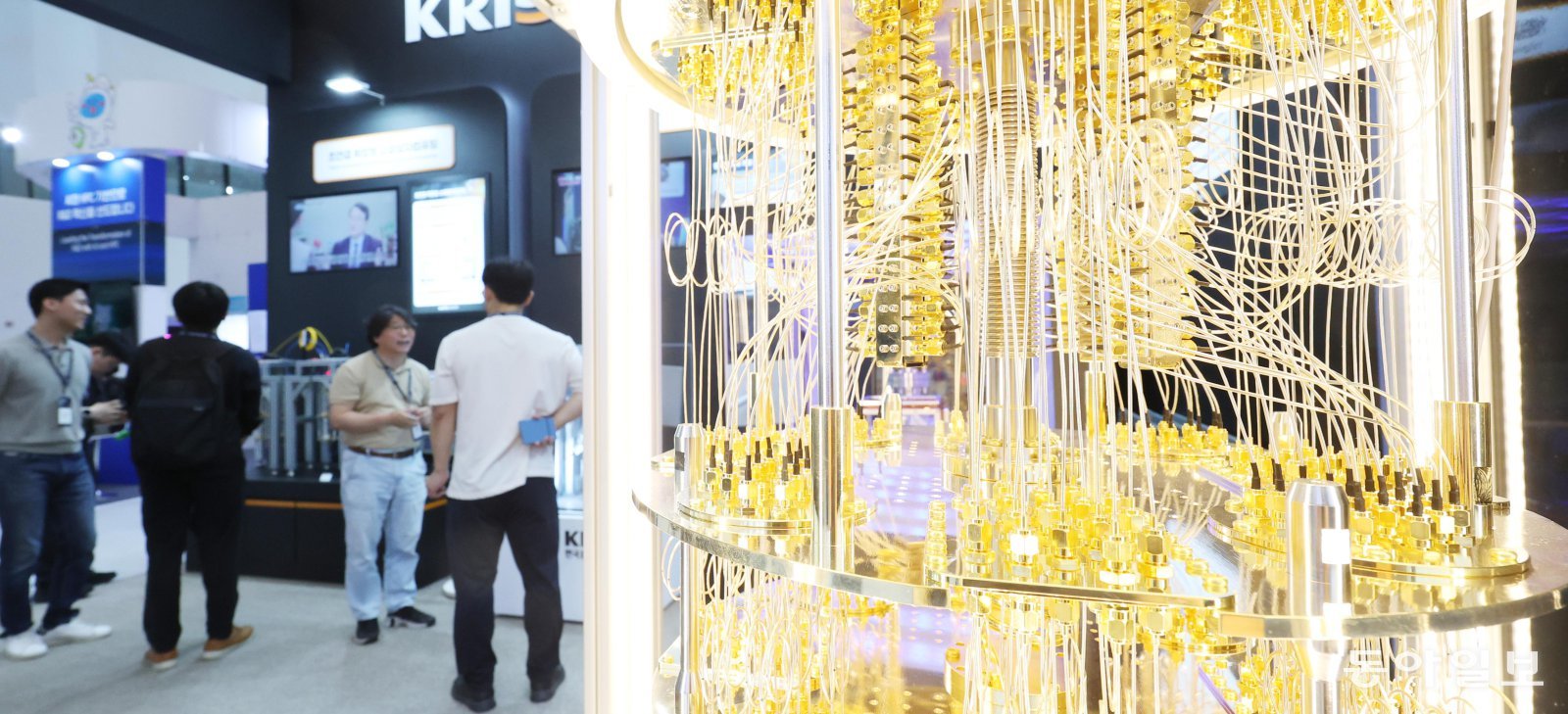
On the 3rd, visitors to the “Quantum Korea” exhibition held at Dongdaemun Design Plaza (DDP) in Jung-gu, Seoul, look at a model of the “50-qubit superconducting-based quantum computer” displayed by the Korea Research Institute of Standards and Science (KRISS). Photo by reporter Shin Won-geon laputa@donga.com
“What you see in front of you is ‘System Two,’ the latest quantum computer platform.”
This was how Lee Kwon-hak, a quantum algorithm engineer at IBM, addressed visitors gathered in front of a 60 cm-tall quantum computer model at the “Quantum Korea 2026” event held at the DDP Art Hall in Jung-gu, Seoul, on the 3rd. He said, “The goal is to raise the current technology level of about 120 qubits to 2,000 qubits by 2033,” adding, “Using quantum computers, it can be employed to solve problems that are difficult to handle with conventional computers, such as complex chemical research.” A qubit is the unit of computation in quantum computers.
This year’s “Quantum Korea 2026,” held at DDP for three days from the 2nd, brought together 56 companies and institutions from 12 countries. Now in its fourth year, the event was hosted by the Ministry of Science and ICT under the slogan “Quantum Becomes Reality.”
● Quantum technology moves onto the factory floor The event showcased a series of quantum technologies that can be applied in industrial settings. Quandela, a French quantum computing company that uses photons—the particles of light—unveiled its quantum computer “MosaiQ.”
Quantum computers use “superposition,” in which particles can exist in multiple states simultaneously, and “entanglement,” in which particles remain correlated even when far apart, for computation. Unlike classical computers, which process information as either 0 or 1, quantum computers can explore multiple computational paths at once, raising expectations for far faster processing in areas such as optimization, new drug development, and code-breaking than is possible with existing systems.
The challenge is that quantum states are easily disturbed by heat and vibration. This is why technologies that store information in electrical states, such as superconducting circuits, require cooling systems close to minus 273 degrees Celsius. Photon-based systems encode information in light, making them relatively less susceptible to environmental disturbances. They are viewed as having strong potential for room-temperature operation and favorable conditions for deployment in industrial sites.
Quantum security technologies also drew attention. SK Telecom presented a technology that integrates a 10 Gbps (10 gigabits per second) quantum random number generator into a 1 cm-by-1 cm chip, along with a quantum key distribution (QKD) chip based on a photonic integrated circuit (PIC). This technology aims to enhance mass-production potential by miniaturizing equipment and reducing costs. KT showcased a proof-of-concept case in which post-quantum cryptography (PQC), designed to withstand attacks from quantum computers, was applied to defense systems.
Choi Ga-hyun, senior researcher at the Superconducting Quantum Computing Systems Research Group of the Korea Research Institute of Standards and Science (KRISS), said, “If (quantum technology) is used for artificial intelligence (AI) training, it will be possible to solve complex problems more efficiently in various fields such as transportation and defense.”
● Private capital focuses on the quantum market According to McKinsey’s “Quantum Technology Monitor 2026” report released in April, global investment in quantum technology startups last year reached USD 12.6 billion (approximately KRW 19.223 trillion), 6.3 times the 2024 figure. The share of private investors rose to 44%.
The government expanded its investment in the quantum sector from KRW 10.6 billion in 2019 to KRW 198 billion last year. Its first comprehensive quantum plan, announced in January, included goals such as becoming the world’s No. 1 quantum chip manufacturing country by 2035, nurturing 2,000 quantum companies, and training 10,000 specialists. The event was held to assess the current status of Korea’s quantum technology and to create momentum for industrialization and international cooperation.
The venue also featured hands-on programs that attracted family visitors. Lectures by leading scholars, including Professor Isaac Chuang of the Massachusetts Institute of Technology (MIT) in the United States, were held, and at the international academic conference, 28 domestic and overseas researchers presented their latest research results. Koo Hyuk-chae, First Vice Minister of Science and ICT, said, “Quantum technological capability now represents a critical battleground that will determine a nation’s future competitiveness and the structure of industries,” adding, “Amid increasingly fierce competition for technological supremacy, it is essential to build close links in research, talent, and industrial ecosystems with trustworthy countries.”
ⓒ dongA.com. All rights reserved. Reproduction, redistribution, or use for AI training prohibited.
Popular News