On the 24th (local time), OpenAI and Broadcom unveiled “Jalapeño,” OpenAI’s first in-house artificial intelligence (AI) chip specialized for AI inference. Sam Altman, OpenAI Chief Executive Officer (CEO, left), and Hock Tan, Broadcom CEO (right), pose for a commemorative photo holding the new AI chip Jalapeño. Provided by OpenAI
OpenAI has unveiled its first in-house developed artificial intelligence (AI) chip. The company is emphasizing that this AI chip, which is specialized for inference, is more economical compared with existing AI chips. As building and operating AI infrastructure has recently required massive expenditure, big tech firms including OpenAI, Google, Amazon, and Meta are pushing to develop their own AI chips optimized for their internal AI workloads to cut costs. Within the industry, the entry of big tech companies into the AI semiconductor sector is seen as a factor that will sustain the growth momentum of memory semiconductor companies such as Samsung Electronics and SK hynix for some time.
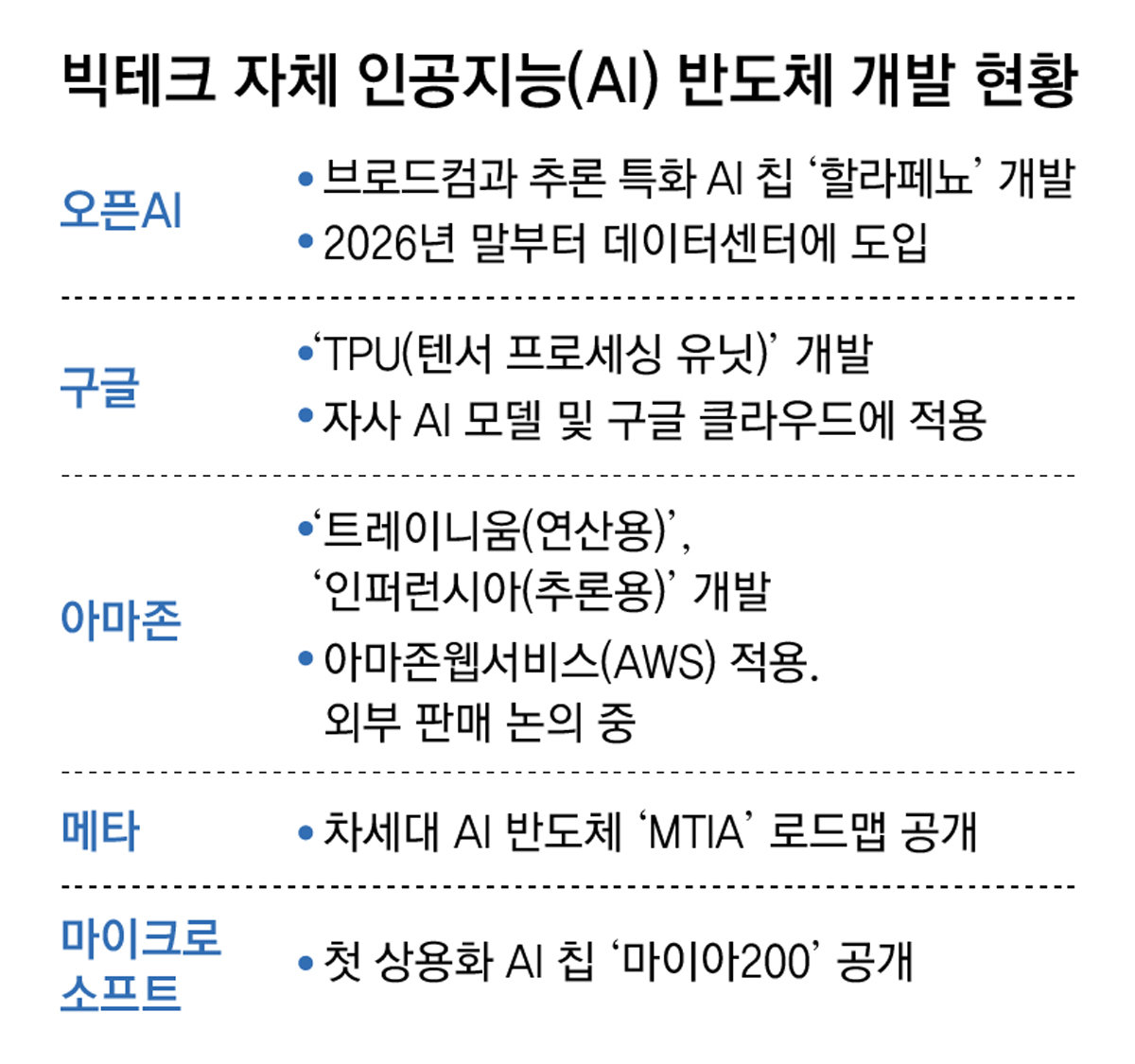
● OpenAI highlights ‘economic efficiency’ of AI chip On the 24th (local time), OpenAI and U.S. fabless semiconductor design company Broadcom unveiled “Jalapeño,” an AI semiconductor specialized for AI inference. It is the first AI semiconductor developed in-house by OpenAI. The company stated that it plans to deploy Jalapeño in its own data centers starting at the end of this year. Although the two companies did not disclose detailed performance specifications, they said that initial tests showed better performance per unit of power (W) compared with the current state-of-the-art technology. In other words, it requires less power to deliver the same performance. The two companies plan to publish a technical report containing precise performance figures within the next few months.
OpenAI’s move to develop its own chip is aimed at enhancing the economic efficiency of AI. Even if NVIDIA’s graphics processing units (GPUs) continue to be used for tasks such as pre-training that require large-scale, repetitive computation, simply optimizing inference costs by using Jalapeño could significantly improve the company’s profitability. For OpenAI, which is planning an initial public offering (IPO) within the year, building a revenue model that can recoup the massive costs poured into AI infrastructure and reducing those costs are the most critical challenges.
● AI semiconductor development rush brightens outlook for memory
Like OpenAI, other big tech firms that are rapidly expanding their AI infrastructure have also embarked on in-house chip development to reduce costs. They are seeking a “two birds with one stone” effect by cutting their own expenses while expanding their business by selling AI chips to other companies.
Google’s TPU (Tensor Processing Unit), considered an early dedicated AI inference chip, drew significant attention as it was used to train Google’s AI model “Gemini 3” series. In April this year, Google announced that it had further maximized AI operational efficiency by separately launching training-only TPUs and inference-only TPUs. In addition, Google stated that it would change its sales strategy so that other companies can use TPUs even without going through Google Cloud.
Amazon has likewise announced that it will sell its large-scale computation AI chip “Trainium” and inference chip “Inferentia” to third parties. Peter DeSantis, Amazon’s Senior Vice President in charge of AI, said in an interview with Bloomberg on the 19th (local time) that “the third generation of Trainium, which began shipping early this year, is already mostly sold out.”
With big tech firms entering the AI semiconductor market, the boom for memory semiconductor companies such as Samsung Electronics, SK hynix, and Micron is expected to continue for some time. Yoo Hoi-joon, Professor at the School of Electrical Engineering at KAIST, said, “The in-house AI chip development by big techs is creating a new market that is different from the existing mass-produced AI chips, which will expand the overall pie of the memory semiconductor market,” adding, “This is a positive signal for memory semiconductor companies.”
ⓒ dongA.com. All rights reserved. Reproduction, redistribution, or use for AI training prohibited.
Popular News