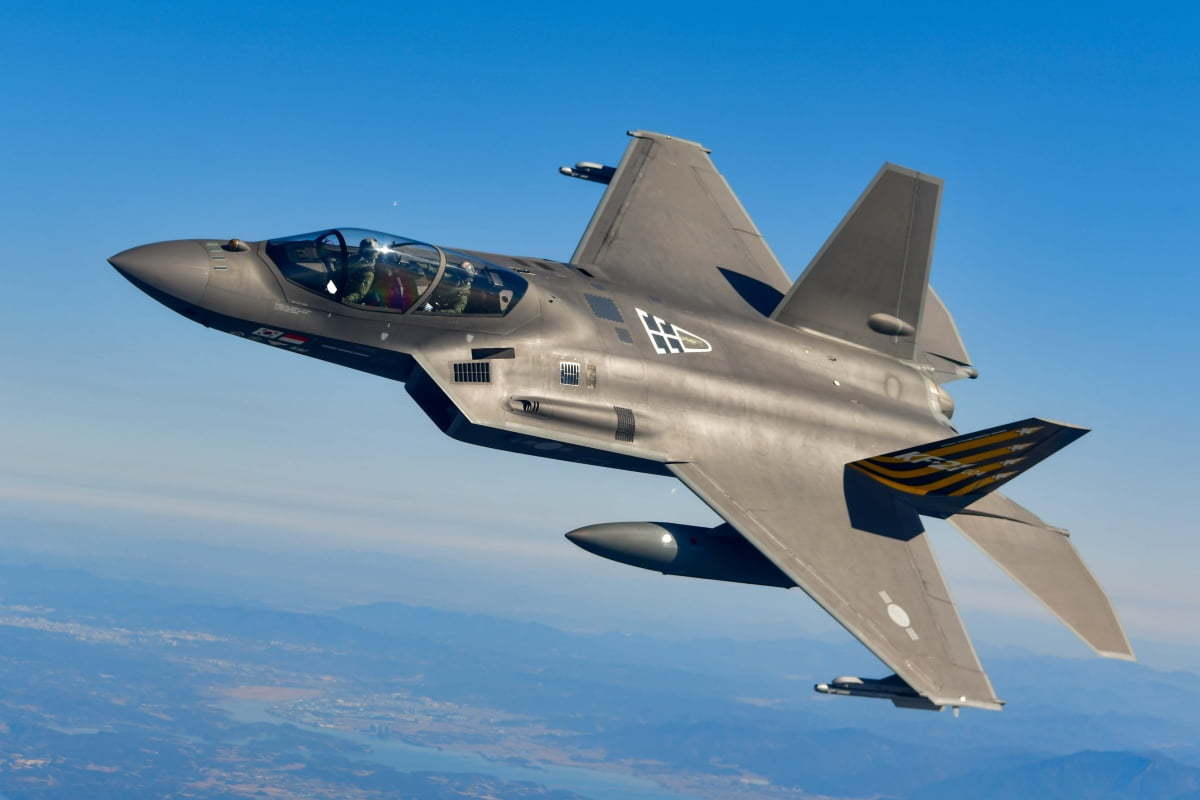
In April, at Korea Aerospace Industries in Sacheon, South Gyeongsang Province, the first mass-production unit of the KF-21 fighter, unveiled in March, successfully completed its maiden flight. Courtesy of Korea Aerospace Industries
On 15 April, an important event took place at Korea Aerospace Industries (KAI) in Sacheon, South Gyeongsang Province. The first mass-production KF-21 fighter, which had been unveiled for the first time on 25 March, achieved a successful maiden flight that day. Led by a domestically developed fighter, this milestone signaled that the Republic of Korea’s aerospace industry has attained advanced, world-class technological capabilities.
When the country first began developing a defense industry, the most urgent task was localizing basic weapons such as rifles, grenades, and mortars. Subsequently, beyond the domestication of small arms, the country advanced to the point of independently developing medium and heavy weapons such as autocannons, towed artillery, and self-propelled howitzers, as well as mobility equipment including military vehicles, armored vehicles, and tanks. As a result of these sustained efforts, signature products representing the so‑called “K-defense industry,” such as the K2 tank and K9 self-propelled howitzer, were able to emerge.
However, in the case of aircraft, which represent cutting-edge industries, the technological barriers are high and even advanced countries are reluctant to transfer technology. In response, KAI and other specialized companies embarked on the journey of developing indigenous aircraft with a distinct determination to succeed.
The domestic aircraft development project can be broadly divided into three stages. First, through the development of the KT-1 basic trainer, domestic technological capabilities were secured. Second, by developing the T-50 advanced trainer, a foundation was laid for independently developing a supersonic aircraft. In the final stage, the successful indigenous development of the KF-21 fighter realized independence in aerospace technology and self-reliant national defense.
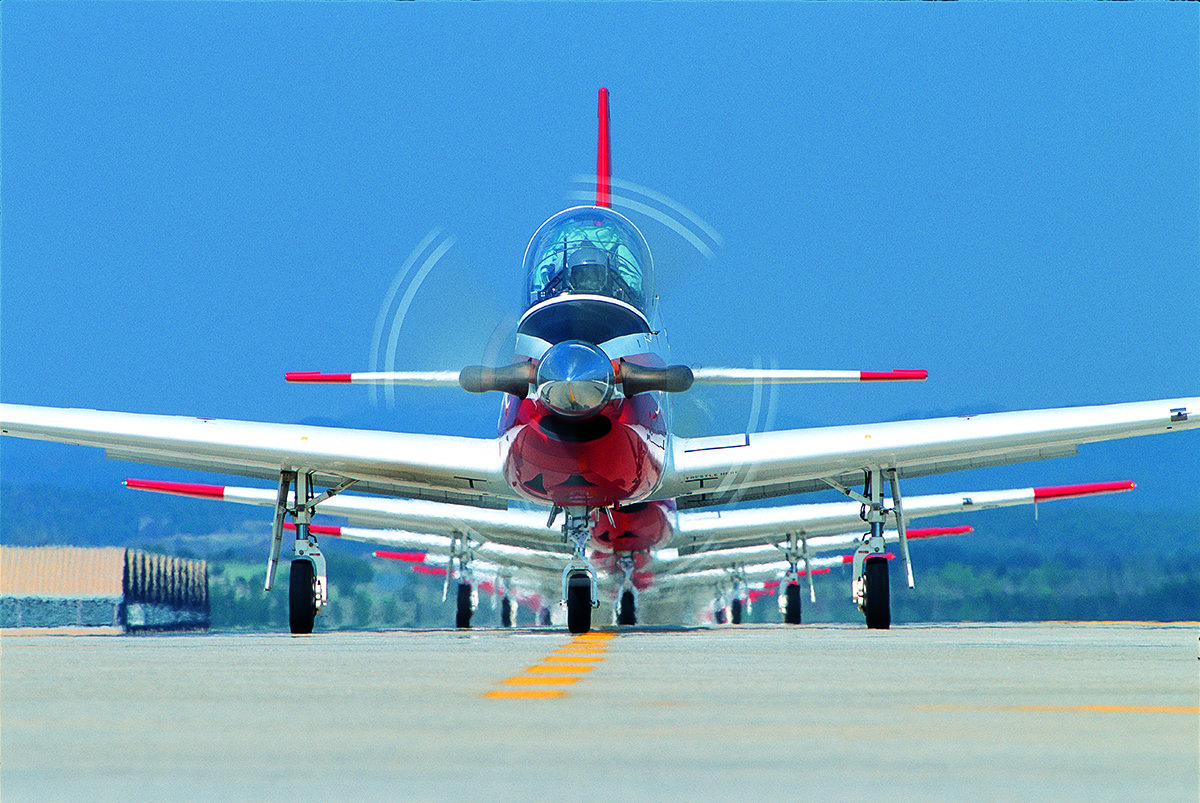
KT-1 basic trainer
When development began on the KT-1 basic trainer, which can be regarded as the starting point of this process, all aircraft had to be procured from overseas, and the domestic technological base was extremely limited. Although the project started from a barren landscape, persistent efforts driven by a determination to succeed led to the aircraft’s first successful flight in December 1991. Today, the KT-1 basic trainer serves as the main platform for training pilots of the Republic of Korea Air Force, and in addition to its domestic role, it has been exported to Indonesia, Turkey, Peru, and Senegal, pioneering a new era of exports for indigenous Korean aircraft.
The next task after the KT-1 was a supersonic fighter. Because it was not feasible to develop a cutting-edge fighter, integrating advanced technologies, entirely domestically in a single step, the program was divided into stages. First, the F-16 was produced under license domestically, which both strengthened the Air Force’s capabilities and enabled South Korea to secure fighter production technology. Afterwards, development of the T-50 advanced trainer began, culminating in a successful first flight in August 2002. Notably, despite it being the country’s first attempt at developing a supersonic aircraft, intense round-the-clock efforts allowed the project to be completed five months ahead of schedule. The successfully developed T-50 advanced trainer later evolved into the FA-50 light combat aircraft, which now contributes to the Air Force’s combat power and has been exported to six countries: Indonesia, Iraq, the Philippines, Thailand, Poland, and Malaysia.
After fully accumulating experience through the development of the T-50 and FA-50, the next step was the KF-21 Boramae fighter program. While some technologies were still dependent on the United States at the time of the T-50 advanced trainer’s development, by the time of the KF-21 project, technological capacity had advanced to the point that development could be carried out entirely by domestic engineers. Development of the KF-21 fighter began in December 2015, and the aircraft’s first successful flight in July 2022 fully demonstrated the technological capabilities of indigenous Korean aircraft. A key advantage of the domestically developed KF-21 fighter is that, unlike in the past, there are no technological restrictions when integrating radar, avionics, and armaments, allowing the aircraft to be freely modified to meet the operational requirements of the Korean military.
Above all, the KF-21 Boramae is being developed, fielded, and brought into operational service more swiftly and decisively than competing foreign models. For comparison, the French Rafale fighter, widely regarded as a highly successful program, began development in 1978, but only succeeded in conducting a prototype flight test 14 years later, in 1991. In this context, completing all stages of development of the KF-21 in such a short period represents a significant triumph for South Korea’s aerospace industry.
ⓒ dongA.com. All rights reserved. Reproduction, redistribution, or use for AI training prohibited.
Popular News