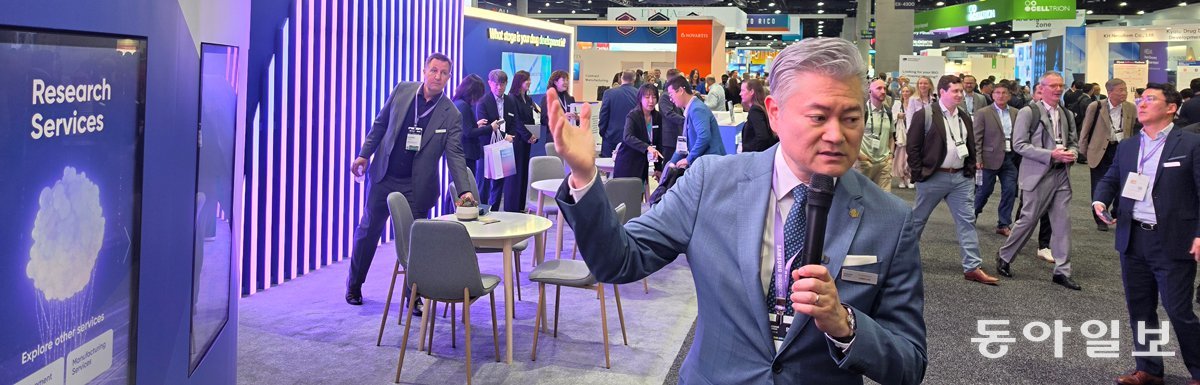
On the 22nd (local time), at the opening of “BIO USA 2026” in San Diego, California, U.S., numerous Korean buyer companies also took part. James Choi, Executive Vice President of Samsung Biologics, introduces the company’s booth. San Diego = Reporter Jeon Hye-jin sunrise@donga.com
The “BIO International Convention 2026 (BIO USA),” the world’s largest pharmaceutical and biotech exhibition organized by the Biotechnology Innovation Organization (BIO), kicked off on the 22nd (local time) in San Diego, California. Over the four days through the 25th, thousands of representatives from global biotech companies and investors visited from the opening day.
In particular, as “global supply chain restructuring” and “artificial intelligence (AI) commercialization” emerged as the core keywords of this year’s BIO USA, 152 companies and institutions from Korea, including Samsung Biologics, SK Biopharmaceuticals, Lotte Biologics, and Celltrion, officially participated and moved swiftly to secure business opportunities.
● China’s WuXi Biologics absent for third consecutive yearThe San Diego Convention Center, where the event was held, was already packed with participants wearing badges around their necks even before the official opening time of 12:00 noon. More than 1,600 booths were set up by companies from over 70 countries around the world, ranging from global big pharma to startups.
However, WuXi Biologics, a leading Chinese contract development and manufacturing organization (CDMO) that had been a major participant in the past, was nowhere to be seen. Under mounting pressure from U.S. national security regulations, it has been absent for three consecutive years since 2024. Earlier, on the 8th, the U.S. Department of Defense placed Chinese biotech firm WuXi AppTec on its list of “military companies.”
This U.S.-led “de-risking from China” and restructuring of the biotech supply chain is seen by some as an opportunity for Korean biotech companies to absorb additional orders. In fact, the Samsung Biologics booth drew a steady stream of industry visitors. Samsung Biologics, which set up a large booth of about 140㎡ in the center of the exhibition hall, installed a large, curved light-emitting diode (LED) screen at the top of the booth for the first time this year, drawing attention. The screen played a promotional video for “Organoid,” a drug screening service launched in June last year. James Choi, Executive Vice President of Samsung Biologics, who was at the booth, said, “Even on the first day, around 100 corporate meetings have already been scheduled,” adding, “We will stress that we can manufacture medicines with equivalent quality at both our Songdo plant in Korea and our Rockville plant in the U.S.”
The booth of Lotte Biologics, which is targeting the global CDMO market, was also crowded. A participatory event related to antibody-drug conjugates (ADCs – therapies that combine antibodies with anticancer agents to selectively attack cancer cells), a key battleground in the oncology market, drew attention. A line formed as visitors waited to play a game in which they popped floating red cancer cells on a screen titled “Target the Cancer.”
● AI becomes a decisive factor in the biotech industry
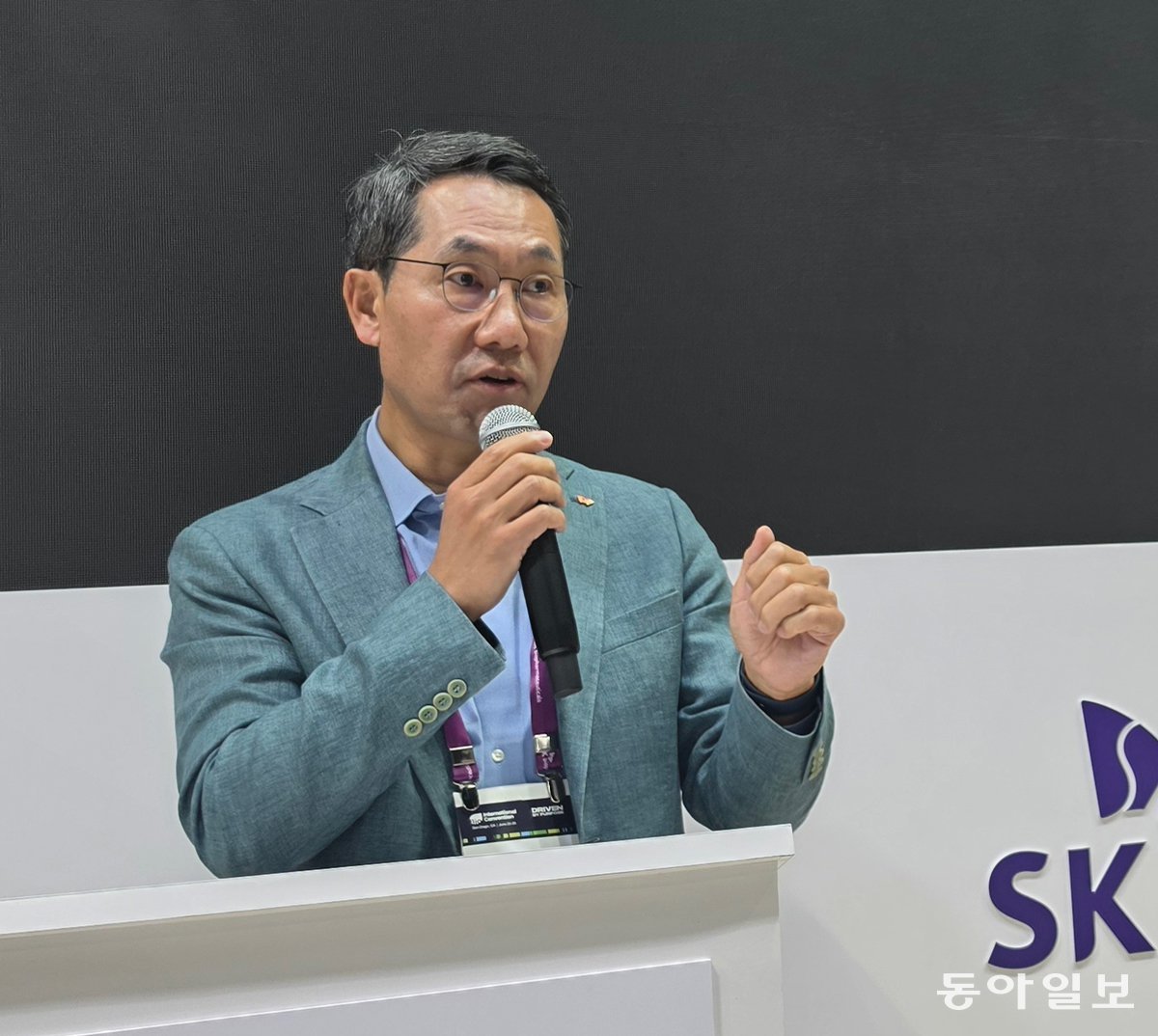
On the 22nd (local time), at the opening of “BIO USA 2026” in San Diego, California, U.S., numerous Korean buyer companies also took part. SK Biopharmaceuticals CEO Lee Dong-hoon visits the company’s booth and explains its AI-based new drug development strategy. San Diego = Reporter Jeon Hye-jin sunrise@donga.com
This year’s event featured an “AI zone” for the first time. SK Biopharmaceuticals, which set up a booth there, presented details of a contract signed the previous day with global AI drug discovery company Insilico Medicine. The agreement focuses on using Insilico’s AI platform to develop treatments for central nervous system disorders, including epilepsy. SK Biopharmaceuticals CEO Lee Dong-hoon, who visited the booth, said, “Insilico has experience verifying the potential of AI-discovered drug candidates in human clinical trials,” and emphasized, “By combining this with the capabilities of a group that is leading AI innovation, we can enhance our competitiveness in new drug development.”
Celltrion also set up a booth to showcase AI-based next-generation multispecific antibody design technology. Its aim is to screen candidates with high clinical development potential at an early stage to shorten development timelines and reduce costs.
Lee Seung-kyou, Vice President of the Korea Biotechnology Industry Organization, said, “From this year, AI has started to enter the realm of a practical ‘industry,’” and added, “To enable domestic companies to leap forward amid technological advances and global supply chain restructuring, government support such as expanding funds is necessary.”
ⓒ dongA.com. All rights reserved. Reproduction, redistribution, or use for AI training prohibited.
Popular News