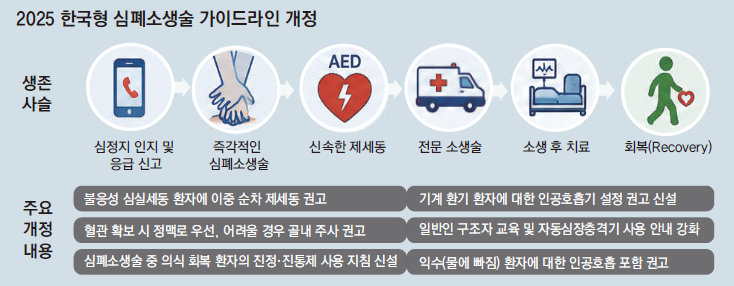
The “2025 Korean Cardiopulmonary Resuscitation (CPR) Guidelines,” which set the national standard for the treatment of cardiac arrest patients, were recently released. Revised for the first time in five years, the new guidelines go beyond the previous CPR- and defibrillation-centered approach and expand to include patient recovery and rehabilitation. They also introduce a new defibrillation strategy for patients with refractory ventricular fibrillation and strengthen the training system for rescuers.
Jointly developed by the Korea Disease Control and Prevention Agency (KDCA) and the Korean Association of Cardiopulmonary Resuscitation, the Korean CPR Guidelines are the national standard clinical practice guidelines, revised every five years on the basis of the latest recommendations of the International Liaison Committee on Resuscitation (ILCOR). They serve as the reference for emergency medicine and critical care physicians nationwide as well as paramedics and related training institutions when treating cardiac arrest patients. Experts recommended by 16 professional medical societies participated in this revision, and the recommendations were prepared using the GRADE methodology, an international evidence evaluation framework.
The most notable change is the expansion of the “chain of survival” concept. Previously, the focus was on recognition of cardiac arrest, emergency call, CPR, defibrillation, advanced life support, and post-resuscitation care. In this revision, a recovery phase, including rehabilitation and return to society, has been newly added. The concept has thus been broadened to consider not only saving the patient’s life but also the quality of life.
Recommendations for lay rescuers have also been strengthened. Dispatchers at the 119 emergency call center are now encouraged to proactively instruct callers on how to use an automated external defibrillator (AED), and in cases of cardiac arrest due to drowning, trained rescuers are recommended to perform rescue breaths in addition to chest compressions.
In the field of advanced life support, dual sequential defibrillation or vector-change defibrillation for patients with refractory ventricular fibrillation has been newly recommended. Refractory ventricular fibrillation refers to a state in which normal cardiac rhythm is not restored despite multiple defibrillation attempts. The latest evidence aimed at improving the survival chances of patients who do not respond to conventional treatment has been reflected.
Vascular access methods have also been specified. Medical staff are recommended to secure intravenous access first, and if rapid intravenous access is difficult, intraosseous access may be used. In addition, principles for the use of sedatives and analgesics when a patient regains consciousness during CPR, as well as recommendations for ventilator settings in mechanically ventilated patients, have been newly included.
This revision is also significant in that it reflects the current realities of treating cardiac arrest patients in Korea. According to the KDCA, more than 30,000 people experience out-of-hospital cardiac arrest each year in Korea. The probability of survival for cardiac arrest patients increases substantially if appropriate treatment is administered within the first few minutes after onset, and whether bystanders perform CPR greatly affects survival rates.
Experts involved in developing the guidelines emphasize that the role of ordinary citizens, as well as medical staff, is crucial for improving the survival rate of cardiac arrest patients. In practice, the survival of a cardiac arrest patient varies greatly depending on whether the event is witnessed, how quickly emergency services are called, whether CPR is initiated promptly, and whether an automated external defibrillator is used.
Kim Tae-yoon, a professor of emergency medicine at Inha University Hospital who participated in the Guideline Development Executive Committee, the Advanced Life Support Committee, and the Writing Committee, stated, “The core of this revision is to establish standards that enable medical staff at the scene of cardiac arrest to make the best decisions without hesitation,” adding, “It is hoped that the revised guidelines will provide practical help in improving the survival and recovery of cardiac arrest patients.”
ⓒ dongA.com. All rights reserved. Reproduction, redistribution, or use for AI training prohibited.
Popular News