Led by Jihoon Park, Principal Researcher at KRICT SRV2-based CAR-T therapy administered No further tumor growth in leukemic mice
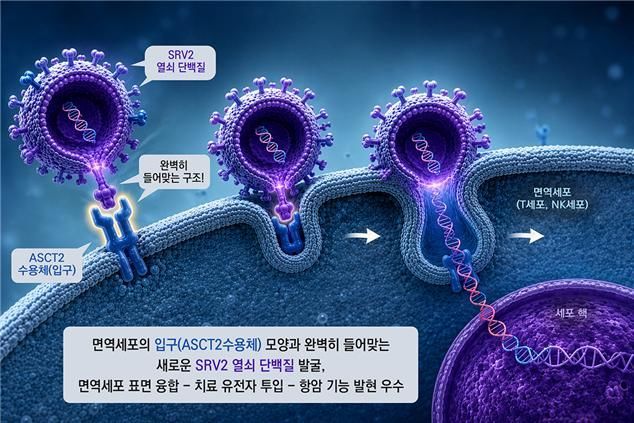
Photo provided by Korea Research Institute of Chemical Technology
The performance of a next-generation gene cell therapy, the chimeric antigen receptor (CAR) therapy—designed to directly locate and attack cancer cells—has been enhanced by a newly developed technology. CAR therapy is a treatment that involves extracting a patient’s immune cells (T cells, NK cells), inserting genes that instruct them to attack specific cells, and then reinfusing them into the body.
The Korea Research Institute of Chemical Technology (KRICT) announced on the 21st that a research team led by Principal Researcher Park Ji-hoon has identified a new viral vector envelope protein, “SRV2,” that increases the expression rate of anticancer genes in CAR therapies. The research findings were published in the April issue of the international journal Nature Communications.
Viral vectors are mainly used to deliver genes that direct immune cells to attack specific cells such as cancer cells into immune cells. Envelope proteins on the surface of viral vectors bind to immune cells and help introduce the genes into the interior of the immune cells.
The research team focused on a new envelope protein, SRV2, derived from a simian virus. Experimental results showed that SRV2-based vectors had higher gene delivery efficiency than vectors made with RD114, the envelope protein most commonly used to date. CAR-T cells and CAR-NK cells produced using SRV2 contained a relatively higher amount of successfully delivered genes inside the immune cells, improving anticancer gene expression rates by 20–25% and 5–12%, respectively, compared with existing methods. This signifies improved efficiency of CAR therapies in attacking specific cells.
The effect was also confirmed in animal experiments. When four mice transplanted with leukemic cancer cells were administered SRV2-based CAR-T therapy, tumors did not grow in three of them until the end of the experiment. All untreated mice died within 46 days.
The research team plans to conduct follow-up studies for large-scale production and commercialization of the vectors. Shin Seok-min, President of KRICT, said, “It is hoped that this new vector will contribute to improved production yield of therapeutics and enhanced anticancer efficacy.”
Moon Hye-won
AI-translated with ChatGPT. Provided as is; original Korean text prevails.
ⓒ dongA.com. All rights reserved. Reproduction, redistribution, or use for AI training prohibited.