[G7 Summit] “Up to two fuel and transport ships may be procured overseas” Defense Authorization Act passed… House drafts its own bill Korean shipbuilders gain pathway into U.S. naval vessel market
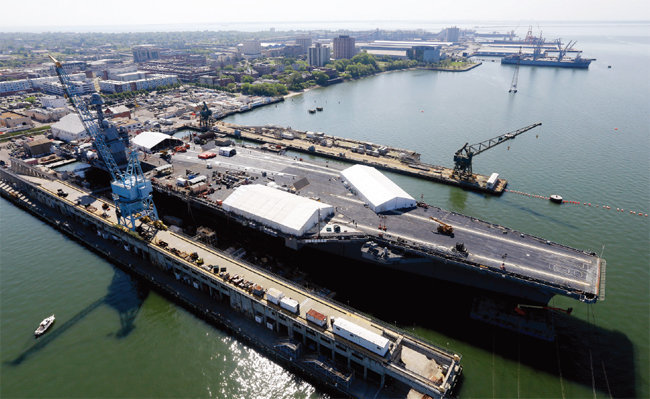
Newport News Shipbuilding in Virginia, United States. Newsis
The U.S. Congress has begun the legal process to allow the U.S. Navy’s strategic sealift ships and bulk fuel carriers to be built at overseas shipyards, and the relevant standing committee has passed the measure. This opens the way for the United States, which until now has stipulated that Navy vessels must be built only domestically, to utilize shipyards in allied countries such as South Korea. South Korea’s “MASGA (Make America’s Shipbuilding Great Again)” project is also expected to gain momentum.
According to the shipbuilding industry on the 17th, the U.S. Senate Armed Services Committee, when approving the Fiscal Year 2027 National Defense Authorization Act (NDAA) on the 11th (local time), included a provision that “permits the procurement of up to two bulk fuel carriers and strategic sealift ships from overseas shipyards.” This effectively allows the overseas construction of non‑combatant vessels. In addition, it attached a condition that “foreign companies participating in the project must invest in the U.S. shipbuilding and maritime industrial base.” The NDAA is the annual bill that sets the direction of U.S. defense policy, including weapons development and ship construction. This move is interpreted as an attempt to circumvent, via the NDAA, the prohibition in the “Burns–Tollefson Act” on building Navy vessels overseas.
Previously, the House Appropriations Committee’s Defense Subcommittee also drafted a 2027 defense appropriations bill in a similar direction. Until last year, the law stipulated that “no funds may be used to construct any naval vessel at a foreign shipyard,” but this year it changed the scope of the funding restriction to “covered ships,” which under U.S. federal law refers to combatant vessels such as nuclear submarines and aircraft carriers. Once the Senate and the House each finally pass the NDAA and the defense appropriations bill, and the two chambers reconcile the legislation, the bills will be finalized upon the President’s signature.
Within the shipbuilding sector, there is an assessment that the direction for South Korea’s shipbuilders to participate in the U.S. “MASGA” project has become clear. Yoon Sang-yong, a professor in the Department of Military Studies at Seokyeong University, said, “The fact that a pathway has opened to enter the U.S. naval vessel market, which had been tightly closed, is a meaningful change,” adding, “It will be necessary to demonstrate construction and delivery capabilities that can contribute to strengthening the U.S. Navy’s power, as well as plans to invest in the U.S. shipbuilding industry.”
HD Hyundai is regarded as possessing extensive construction experience and world‑class technological capabilities in the strategic sealift sector required by the U.S. Navy. It is pursuing design and construction technology cooperation with Huntington Ingalls, the largest military shipbuilder in the United States. Hanwha Ocean has secured the local production base PhilI Shipyard, establishing a foundation to win orders not only for non‑combat support vessels but also for future U.S. Navy combat ship programs. Samsung Heavy Industries is conducting concept design work for the Next‑Generation Logistics Ship (NGLS) together with U.S. company NASSCO. It is expected to seek orders through cooperation with American firms.
Byun Jong-guk
AI-translated with ChatGPT. Provided as is; original Korean text prevails.
ⓒ dongA.com. All rights reserved. Reproduction, redistribution, or use for AI training prohibited.