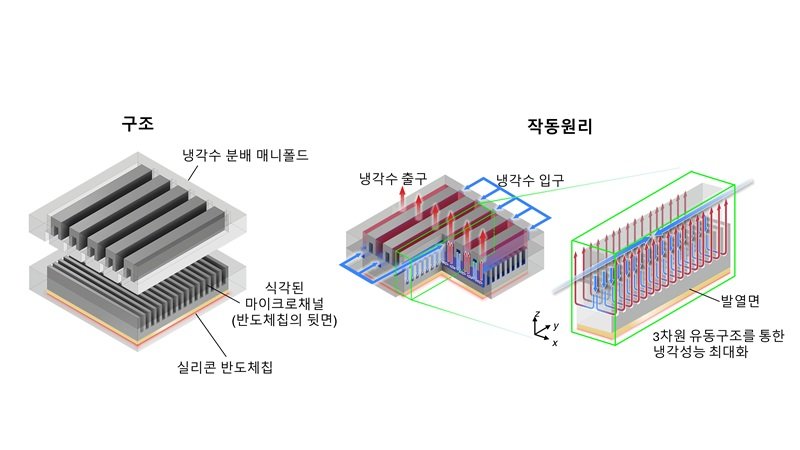
Provided by KAIST
An energy-efficient cooling technology has been developed that can reduce the cooling power consumption of artificial intelligence (AI) data centers—often referred to as “power guzzlers”—to one-tenth of current levels.
KAIST announced on the 16th that a joint research team led by Professor Kim Sung-Jin of the Department of Mechanical Engineering and Professor Lee Ik-Jin of the Department of AX had developed an “ultra-high-efficiency liquid cooling technology” that delivers coolant to various parts of semiconductor chips by using microfluidic channels thinner than a human hair.
Previously, the primary methods involved circulating cold air in server rooms to dissipate heat or using immersion cooling, in which servers are submerged in dielectric coolant (non-conductive oil). However, as the performance of AI semiconductors has recently increased, their heat generation has also risen significantly, drawing attention to direct cooling approaches in which coolant flows through the inside of semiconductor chips.
The research team combined thin microchannels and a “manifold” structure that distributes coolant through multiple paths. This allowed coolant to be evenly distributed through the microchannels.
In terms of a parcel delivery analogy, this is similar to distributing parcels from multiple regional logistics centers instead of shipping all parcels nationwide from a single hub in Seoul. In particular, by optimizing the structure so that coolant flows evenly through all channels, the team was able to improve cooling performance while reducing energy loss.
The team fabricated the optimized structure on an actual silicon wafer and verified its performance. As a result, they confirmed a coefficient of performance (COP) of 106,000, representing cooling efficiency. COP is an indicator that shows the amount of heat removed relative to the energy input; in this case, using 1 unit of energy for cooling removed 106,000 units of heat.
This is more than 10 times higher than the previous world-leading level reported in the international journal Nature in 2020. The researchers explained, “In other words, the energy required to remove the same amount of heat has been reduced to one-tenth that of existing technologies.”
The research team has so far validated the technology using experimental chips measuring 5 mm by 5 mm, but stated that it can also be applied to large AI semiconductors used in AI data centers, such as graphics processing units (GPUs) and tensor processing units (TPUs), which can be up to 7.5 cm in width and length. The team added that, when applied to cold plates (metal cooling plates that remove heat by circulating coolant) used in data centers, they confirmed more than a 40% improvement in cooling performance compared with existing solutions.
Professor Kim Sung-Jin said, “In the AI era, competitiveness depends more on how effectively heat can be controlled than on semiconductor performance itself,” adding, “We expect this technology to serve as a core solution for reducing power consumption in AI data centers.” The research findings were published on June 15 in the international journal Energy Conversion and Management.
ⓒ dongA.com. All rights reserved. Reproduction, redistribution, or use for AI training prohibited.
Popular News